In nature, microbes never live as isolated monocultures; they thrive in dense, cooperative multicellular consortia—from human gut microbiomes to deep-sea biofilms. Early synthetic biology focused on engineering solitary cell lines, but single strains rapidly suffer from metabolic burden and pathway bottlenecks when forced to synthesize long, complex molecules. Today, Synthetic Microbial Consortia distribute biochemical tasks across specialized partner strains communicating via chemical Quorum Sensing. In this article, we analyze intercellular signaling kinetics, Turing morphogen patterns, and the ecology of synthetic mutualism.
1. Quorum Sensing Kinetics and the LuxI/LuxR Circuit
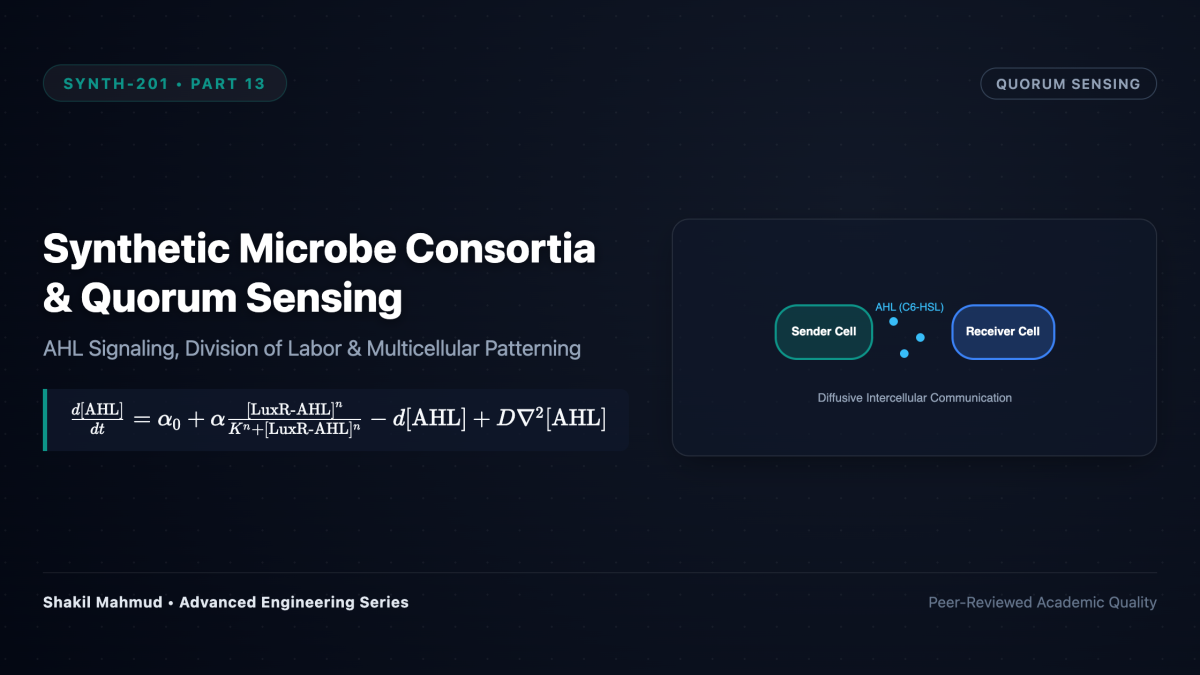
In Gram-negative bacteria, cell-cell communication is mediated by small, membrane-permeable acyl-homoserine lactones (AHL). The classic circuit derived from Vibrio fischeri comprises two key genes:
- LuxI (Synthase): Synthesizes an AHL autoinducer (e.g., 3-oxohexanoyl-homoserine lactone, (3 ext{OC}_6 ext{-HSL})) from S-adenosylmethionine (SAM) and cellular fatty acid precursors.
- LuxR (Receptor): A cytoplasmic transcription factor that binds AHL with high affinity. Upon binding, the ( ext{LuxR} cdot ext{AHL}) complex dimerizes and binds the lux box promoter, activating downstream gene expression.
The spatiotemporal dynamics of the extracellular signaling molecule (S(mathbf{r}, t) quiv [ ext{AHL}]) obey a Reaction-Diffusion Equation:
[
rac{partial S}{partial t} = D
abla^2 S – d_S S + sum_{k=1}^N alpha_k delta(mathbf{r} – mathbf{r}_k)
]
where (D) is the molecular diffusion coefficient through the extracellular matrix, (d_S) is the enzymatic or chemical degradation rate, and (alpha_k) is the AHL production rate of the (k)-th bacterium located at (mathbf{r}_k). In an isolated cell, AHL diffuses freely into the bulk medium, maintaining (S approx 0). As population density increases, extracellular AHL accumulates until it crosses a critical threshold concentration (S_{ ext{crit}}), triggering synchronized, population-wide genetic activation.
2. Synthetic Multicellular Pattern Formation (Turing Mechanisms)
In 1952, Alan Turing mathematically proved that a system of two reacting chemicals—an activator and an inhibitor—with different diffusion coefficients can spontaneously break spatial symmetry, generating stable spots, stripes, and labyrinths. In synthetic biology, Basu, Weiss et al. constructed synthetic Turing patterns by combining sender cells and receiver cells:
- Sender Cells: Form a central point source synthesizing AHL (( ext{LuxI})).
- Receiver Cells: Engineered with a band-detect gene circuit containing feed-forward transcriptional loops. At low AHL concentrations, the promoter is inactive. At high AHL concentrations, a high-affinity repressor shuts off expression. Only at an intermediate band of AHL does expression of fluorescent reporter protein ignite.
The resulting colonies develop macroscopic concentric rings and bullseye targets with millimeter precision, establishing the mathematical foundation for synthetic developmental tissue engineering.
3. Metabolic Division of Labor and Consortium Stability
Synthesizing intricate complex molecules (e.g., the anti-cancer drug Taxol / paclitaxel, which requires over twenty enzymatic steps) causes lethal metabolic burden if crammed into a single E. coli cell. In engineered consortia, the pathway is split:
[
ext{Feedstock} xrightarrow[ ext{Upstream Module}]{ ext{Strain A } ( ext{E. coli})} ext{Intermediate Oxygenated Taxadiene} xrightarrow[ ext{Downstream Module}]{ ext{Strain B } ( ext{Yeast})} ext{Taxol Precursor}
]
However, co-cultures are vulnerable to Evolutionary Cheaters: non-productive mutant cells that shed the metabolic burden of synthesis and outgrow productive cells. To stabilize consortia, synthetic biologists engineer Synthetic Mutualistic Auxotrophies (e.g., Strain A requires tryptophan produced by Strain B, while Strain B requires uracil produced by Strain A). The co-dependent Lotka-Volterra dynamics lock the population ratio into an asymptotically stable fixed point, maintaining optimal biomanufacturing stoichiometry indefinitely.