In the sixth century BCE, in the Greek colony of Croton in Magna Graecia, a secretive philosophical brotherhood gathered under an uncompromising metaphysical creed: All is Number. To Pythagoras and his disciples, whole numbers and their clean ratios were not mere human inventions or accounting conveniences; they were the divine harmonic blueprint of the cosmos, echoing from the vibrating strings of a lyre to the celestial orbits of the wandering stars. Yet from this very brotherhood emerged a geometric theorem so fundamental that it simultaneously established the metric foundation of spatial reality and shattered the brotherhood’s foundational theological assumption: the Pythagorean Theorem.
1. The Geometry of the Triad and the Invariance of Distance
While Babylonian surveyors and Vedic altar-builders in the Indus and Ganges basins had long cataloged empirical triples of right triangles (such as the standard $3-4-5$ and $5-12-13$ ropes), the Greek breakthrough was to divorce the relationship from empirical measurement and ground it in deductive necessity.
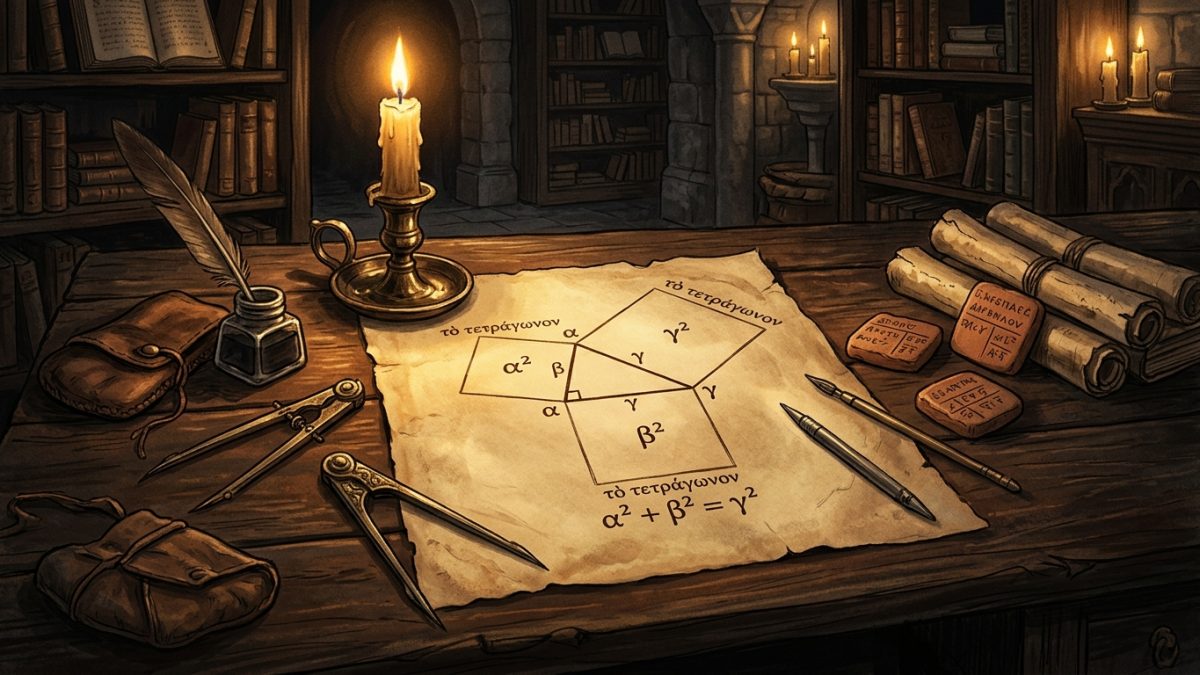
Consider any Euclidean right triangle with legs of length $a$ and $b$, and hypotenuse of length $c$. If one constructs geometric squares upon each side, the physical area of the square spanning the hypotenuse is identically equal to the combined area of the squares constructed upon the perpendicular legs:
$$a^2 + b^2 = c^2$$
This is far more than an algebraic formula; it is the universal definition of flat metric space. In Cartesian coordinates $(x_1, y_1)$ and $(x_2, y_2)$, the spatial separation distance $d$ between two points is an immediate consequence of Pythagoras:
$$d = sqrt{(x_2 – x_1)^2 + (y_2 – y_1)^2}$$
In differential geometry, as formalized by Carl Friedrich Gauss and Bernhard Riemann, the infinitesimal line element $ds$ in flat Euclidean space takes the canonical quadratic form:
$$ds^2 = dx^2 + dy^2 + dz^2$$
When Albert Einstein and Hermann Minkowski unified space and time into four-dimensional spacetime in 1908, the Pythagorean relation did not vanish—it merely adopted a hyperbolic signature where time enters with an opposing sign, establishing the invariant spacetime interval of Special Relativity:
$$ds^2 = -c^2 dt^2 + dx^2 + dy^2 + dz^2$$
2. The Scandal of Hippasus: The Rupture of Rational Numbers
The triumph of the theorem contained a fatal poison pill for the Pythagorean religion. If one constructs an isosceles right triangle whose legs are each exactly $1$ unit of length, the hypotenuse $c$ satisfies:
$$c^2 = 1^2 + 1^2 = 2 implies c = sqrt{2}$$
The young mathematician Hippasus of Metapontum sought to find the two integers $p$ and $q$ whose ratio exactly represented this diagonal: $c = frac{p}{q}$, where $p$ and $q$ share no common factors (are coprime). Through a devastating reductio ad absurdum proof, Hippasus demonstrated that such integers cannot exist:
“Assume $sqrt{2} = frac{p}{q}$. Squaring both sides yields $2 = frac{p^2}{q^2}$, so $p^2 = 2q^2$. This implies that $p^2$ must be an even integer, which means $p$ itself must be even. Let $p = 2k$. Substituting gives $(2k)^2 = 4k^2 = 2q^2$, or $q^2 = 2k^2$. But this requires $q^2$, and therefore $q$, to also be even. If both $p$ and $q$ are even, they share a common factor of $2$, directly contradicting our premise that the fraction was reduced to lowest terms. Hence, $sqrt{2}$ cannot be expressed as a ratio of whole numbers.”
Legend holds that the Pythagorean brotherhood was so terrified by this discovery—which proved that the continuum of space contains quantities that cannot be measured by integers—that Hippasus was drowned at sea for heresy. The crisis was only mathematically resolved two millennia later by Richard Dedekind’s rigorous theory of real number cuts and Georg Cantor’s transfinite set theory.
3. Modern Legacy: From Hilbert Spaces to Machine Learning Vector Embeddings
In contemporary computer science and theoretical physics, the Pythagorean relation has ascended into infinite-dimensional abstraction. In a Hilbert space $mathcal{H}$ with inner product $langle u, v rangle$, two vectors are defined as orthogonal if $langle u, v rangle = 0$. The generalized Pythagorean theorem states that:
$$|u + v|^2 = |u|^2 + |v|^2$$
Every time a modern Large Language Model (such as Gemini, GPT-4, or Claude) calculates the semantic similarity between two concept vectors $mathbf{u}$ and $mathbf{v}$ across thousands of embedding dimensions, it relies directly on the Euclidean inner product and distance metrics born from Pythagoras:
$$text{Cosine Similarity}(mathbf{u}, mathbf{v}) = frac{mathbf{u} cdot mathbf{v}}{|mathbf{u}| |mathbf{v}|} = frac{sum_{i=1}^N u_i v_i}{sqrt{sum_{i=1}^N u_i^2} sqrt{sum_{i=1}^N v_i^2}}$$
From an ancient diagram drawn in Greek sand to the multi-dimensional manifold geometries of artificial intelligence, the Pythagorean Theorem remains the foundational equation of human spatial reason.