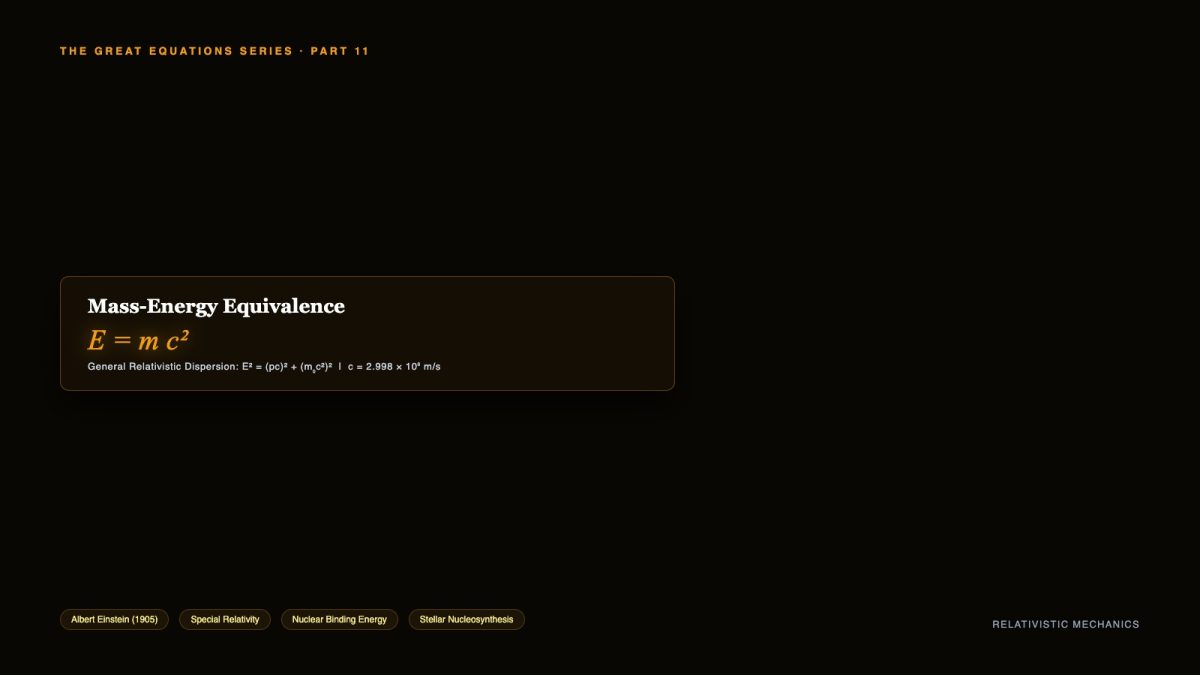
In late September 1905, twenty-six-year-old patent examiner Albert Einstein submitted a three-page manuscript to the Annalen der Physik with an unassuming title posed as a question: “Does the inertia of a body depend upon its energy-content?” It was the fourth of his historic papers written during his Annus Mirabilis. In those three pages, Einstein demonstrated that mass is not an immutable, permanent quantity of matter, and energy is not an ephemeral, weightless property of motion. They are two manifestations of the exact same physical reality. Encapsulated in the five symbols of $E = mc^2$ is the secret mechanism powering the nuclear furnace of the Sun, the terrifying explosive power of atomic weapons, and the cosmic engine of particle creation in the early universe.
1. The Formula: The Cosmic Currency Exchange
For a body at rest with invariant rest mass $m_0$, energy and mass are strictly proportional:
When the object moves with momentum $mathbf{p}$, the full relativistic dispersion relation governs total energy:
The components of this relation reveal the immense leverage of nature:
- $E$ (Total Energy): Measured in Joules ($text{J} = text{kg}cdottext{m}^2/text{s}^2$).
- $m$ (Mass): The inertial resistance to acceleration and source of gravitational attraction ($text{kg}$).
- $c^2$ (The Conversion Multiplier): The speed of light squared: $$c^2 = (299,792,458 text{ m/s})^2 approx 8.98755 times 10^{16} text{ m}^2/text{s}^2$$ Because $c^2$ is an astronomical number ($~9 times 10^{16}$), a microscopic amount of mass converts into a staggering torrent of energy. One single gram of matter contains roughly $9 times 10^{13}$ Joules of energy—equivalent to the explosion of 21.5 kilotons of TNT.
2. First-Principles Derivation via Relativistic Work
In special relativity, the relativistic momentum of a particle of rest mass $m_0$ moving at velocity $mathbf{v}$ is given by $mathbf{p} = gamma m_0 mathbf{v}$, where the Lorentz factor is $gamma = 1 / sqrt{1 – v^2/c^2}$.
The work done $W$ by an applied force $F$ accelerating a body from rest ($v = 0$) to velocity $v$ equals the gain in kinetic energy $E_k$:
Integrating by parts ($int v , dp = pv – int p , dv$):
The remaining integral evaluates via $u = 1 – v^2/c^2$, yielding $m_0 c^2 sqrt{1 – v^2/c^2} = m_0 c^2 / gamma$. Combining the terms algebraically:
Since $frac{v^2}{c^2} + frac{1}{gamma^2} = frac{v^2}{c^2} + left(1 – frac{v^2}{c^2}right) = 1$, the expression simplifies with astonishing finality:
Rearranging this equation reveals that total energy $E = gamma m_0 c^2$ is the sum of kinetic energy $E_k$ and an intrinsic rest energy that persists even when the particle is completely stationary ($v = 0, gamma = 1$):
When expanded in a Taylor series for everyday non-relativistic speeds ($v ll c$):
Classical Newtonian kinetic energy $frac{1}{2}m v^2$ is revealed to be nothing more than the first-order low-velocity approximation of Einstein’s cosmic energy continuum.
3. The Nuclear Defect and Stellar Fire
Where does this energy manifest in nature? In the atomic nucleus. When four individual hydrogen protons fuse together in the core of the Sun to form a single helium-4 nucleus ($^4text{He}$), the final helium nucleus has a mass of $4.0015 text{ u}$, while the four free protons had a combined mass of $4 times 1.0073 text{ u} = 4.0292 text{ u}$.
A mass defect of $Delta m = 0.0277 text{ u}$ (about $0.7%$ of the mass) has vanished. That vanished mass is converted directly via $E = Delta m cdot c^2$ into radiant gamma rays and kinetic energy. Every second, the Sun converts 4.3 million metric tons of mass into pure energy, sustaining all life on Earth.




