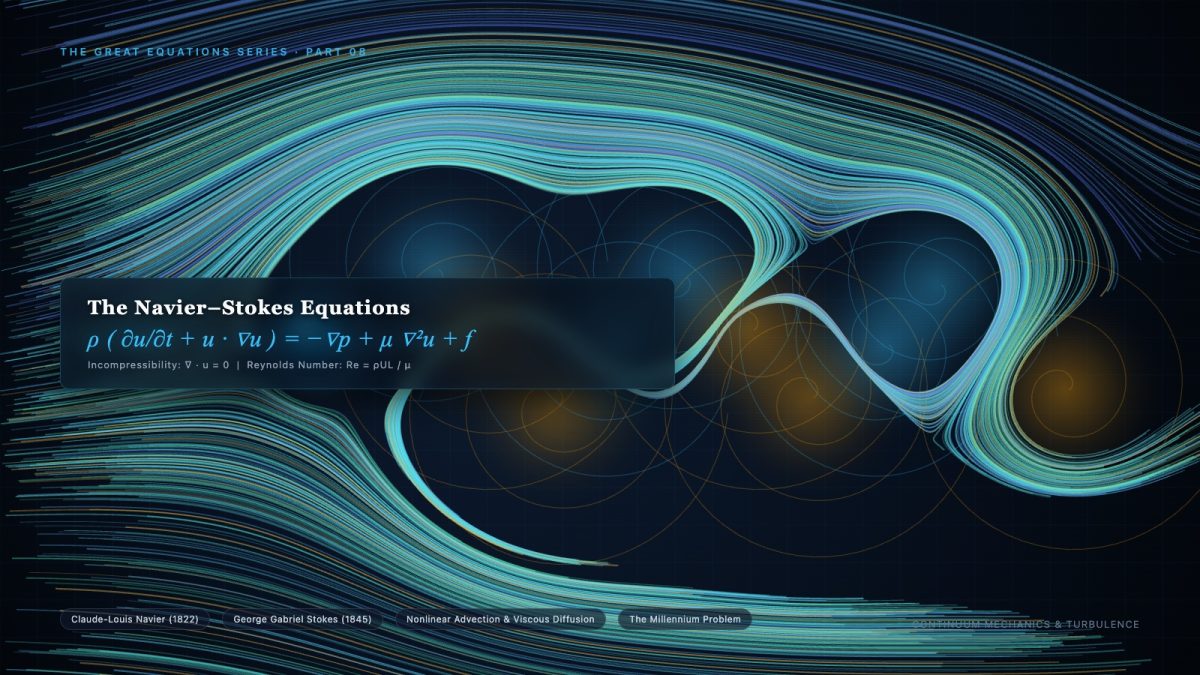
Watch cream swirling into a dark cup of coffee, or the plume of smoke rising from an extinguished candle. At first, the flow rises in a pristine, smooth, glass-like column—laminar and predictable. Then, suddenly, it buckles, twisting into spiraling vortices, turbulent eddies, and chaotic fractal plumes. In 1822, French engineer Claude-Louis Navier merged Isaac Newton’s laws with internal molecular friction, and in 1845, British mathematician Sir George Gabriel Stokes completed the theoretical edifice: The Navier-Stokes Equations. These equations govern the flight of supersonic passenger jets, the oceanic currents circulating global heat, the flow of blood through human heart valves, and the weather forecasts predicting hurricanes. Yet two centuries later, Navier-Stokes remains one of the seven Clay Millennium Prize problems: humanity still cannot prove mathematically whether smooth solutions always exist, or whether the equations can tear themselves apart in finite time.
1. The Formula: Newton’s Law for Continuous Fluids
For an incompressible Newtonian fluid (such as water or low-speed air) with constant density $rho$ and dynamic viscosity $mu$, the Navier-Stokes momentum equation is expressed in vector calculus notation as:
Coupled with the incompressibility condition expressing local conservation of mass:
This single vector equation is nothing less than Newton’s second law $mathbf{F} = mmathbf{a}$ translated into the language of continuous fluid fields:
- $rho$ (Fluid Density): Mass per unit volume ($text{kg/m}^3$), playing the role of inertia ($m$).
- $frac{partial mathbf{u}}{partial t}$ (Local Acceleration): The rate of change of fluid velocity $mathbf{u}(x,y,z,t)$ at a fixed spatial coordinate.
- $(mathbf{u} cdot nabla)mathbf{u}$ (Convective / Advective Acceleration): The nonlinear engine of chaos. It accounts for fluid accelerating because it is carried into a region where surrounding velocities are different. This term creates vortices, whirlpools, and turbulence.
- $-nabla p$ (Pressure Gradient Force): Fluids naturally accelerate from regions of high pressure toward regions of low pressure.
- $mu nabla^2 mathbf{u}$ (Viscous Diffusion): The internal molecular friction resisting fluid deformation ($mu$ is dynamic viscosity). It smooths out velocity spikes and dissipates kinetic energy into heat.
- $mathbf{f}$ (External Body Forces): External field forces such as Earth’s gravity ($mathbf{f} = rho mathbf{g}$) or Coriolis forces in atmospheric circulation.
2. The Substantial Derivative: Lagrangian vs. Eulerian Perspective
To understand why the left side contains two separate velocity derivatives, consider the difference between standing on a bridge watching a river flow beneath you (the Eulerian perspective) versus riding in a canoe drifting downstream (the Lagrangian perspective).
By applying the multi-variable chain rule to a moving fluid parcel whose position changes with velocity $frac{dmathbf{x}}{dt} = mathbf{u}$, the total time derivative—known as the material or substantial derivative $frac{Dmathbf{u}}{Dt}$—naturally splits into two components:
Because the velocity field $mathbf{u}$ acts upon itself in $(mathbf{u} cdot nabla)mathbf{u}$, the equation is strictly nonlinear. Unlike linear wave or diffusion equations where solutions can be superimposed, nonlinear fluid interactions cause energy to cascade from large macroscopic vortices down to microscopic dissipation scales.
3. The Reynolds Number: The Battle Between Inertia and Viscosity
In 1883, Osborne Reynolds conducted legendary experiments injecting colored dye filaments into water flowing through glass tubes. By nondimensionalizing the Navier-Stokes equations, Reynolds discovered that fluid behavior is dictated by a single dimensionless ratio:
Where $U$ is characteristic flow velocity, $L$ is characteristic length, and $nu = mu/rho$ is kinematic viscosity.
- Low Reynolds Number ($Re ll 1$, Stokes Flow): Viscous friction completely dominates inertia. Microscopic bacteria swimming in water live in a high-viscosity world where stopping your flagella stops forward motion instantaneously. Reversing time retraces identical fluid trajectories (kinematic reversibility).
- High Reynolds Number ($Re > 4000$, Turbulent Flow): Inertial advection overwhelms viscous damping. The smooth laminar streamlines fracture into chaotic eddies, forming boundary-layer separation, wake vortices, and the famous Kármán vortex streets behind aircraft wings and submarine hulls.
4. The Million-Dollar Millennium Problem
In the year 2000, the Clay Mathematics Institute declared the Navier-Stokes existence and smoothness problem one of the seven greatest unsolved mathematical challenges in the world, placing a $1,000,000 bounty on its solution. The challenge asks:
Given physically reasonable, smooth, finite-energy initial fluid velocities in three-dimensional space, do smooth, infinitely differentiable solutions to the Navier-Stokes equations exist for all future time $t > 0$, or can the nonlinear term $(mathbf{u} cdot nabla)mathbf{u}$ cause vorticity to concentrate infinitely fast, producing a mathematical singularity (a blow-up) where fluid velocity or energy density becomes infinite in finite time?
Despite centuries of engineering success and supercomputer simulations, mathematicians still do not know if our governing equations of water and air remain mathematically consistent under extreme conditions. The Navier-Stokes equation remains a magnificent monument to nature’s untamed complexity.




