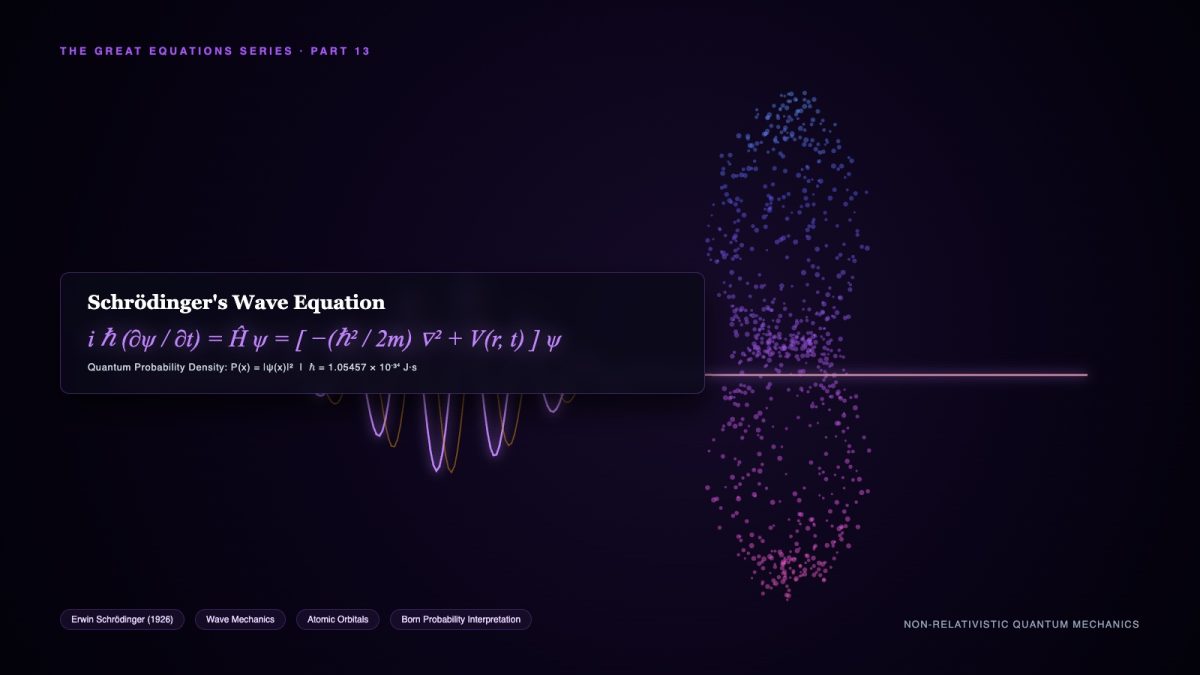
During the Christmas holidays of 1925, thirty-eight-year-old Austrian physicist Erwin Schrödinger retreated to a secluded sanatorium villa in Arosa, Switzerland, accompanied by an old lover. In that serene alpine retreat, Schrödinger embarked on one of the most intense creative bursts in scientific history. Inspired by Louis de Broglie’s radical hypothesis that material particles such as electrons possess wave-like nature, Schrödinger set out to construct a proper wave equation for matter. Within weeks, he emerged from the Alps holding the master key to the microscopic universe: Schrödinger’s Wave Equation. It banished Niels Bohr’s ad-hoc planetary orbits and replaced them with shimmering, three-dimensional probability harmonic clouds, laying the mathematical foundation for modern chemistry, solid-state physics, lasers, and quantum computing.
1. The Formula: The Quantum Law of Motion
The time-dependent Schrödinger equation governs the continuous deterministic evolution of a quantum state $psi(mathbf{r}, t)$ across space and time:
And for stationary states where energy is constant, the time-independent Schrödinger equation takes the form of an eigenvalue problem:
The mathematical elements of this equation redefine physical reality:
- $i = sqrt{-1}$ (The Imaginary Unit): The explicit appearance of $i$ in a fundamental law of physics is profound. Because of $i$, quantum wavefunctions are necessarily complex-valued, causing amplitudes to oscillate with phase and produce interference patterns rather than merely diffusing like classical heat.
- $hbar = h / 2pi$ (Reduced Planck’s Constant): The fundamental quantum of action ($1.05457 times 10^{-34} text{ J}cdottext{s}$).
- $psi(mathbf{r}, t)$ (The Wavefunction): The state vector containing all knowable information about the quantum particle. In Max Born’s statistical interpretation (1926), the modulus squared $|psi(mathbf{r}, t)|^2 = psi^* psi$ represents the exact probability density of finding the particle at coordinate $mathbf{r}$ at time $t$.
- $-frac{hbar^2}{2m}nabla^2$ (The Kinetic Energy Operator): Derived from the quantum momentum operator $hat{mathbf{p}} = -ihbar nabla$, representing kinetic energy $hat{T} = frac{hat{p}^2}{2m}$.
- $V(mathbf{r}, t)$ (The Potential Energy Function): The landscape of external forces (e.g., the attractive Coulomb potential $V(r) = -frac{e^2}{4pivarepsilon_0 r}$ binding an electron to a proton in a hydrogen atom).
- $hat{H}$ (The Hamiltonian Operator): The total energy observable of the quantum system.
2. The Origin of Energy Quantization
Why is energy quantized in the subatomic realm? In classical physics, an electron in orbit could take any arbitrary continuous energy. Schrödinger revealed that quantization is not an arbitrary rule inserted by hand; it is the natural boundary condition of standing waves.
Just as a violin string pinned at both ends can only vibrate at discrete harmonic frequencies ($f_n = n frac{v}{2L}$), an electron wave trapped in an attractive potential well must satisfy the boundary condition that its probability amplitude vanishes at infinity ($lim_{r to infty} psi(r) = 0$). Only specific discrete eigenvalues $E_n$ permit smooth, non-diverging wave solutions.
For the hydrogen atom, solving the radial and spherical harmonic parts of Schrödinger’s equation naturally yields the discrete energy levels first conjectured empirically by Bohr:
The shapes of chemical bonds, the periodic table of elements, and molecular hybridization all emerge directly from the spatial node surfaces of Schrödinger’s spherical harmonic wavefunctions $Y_ell^m(theta, phi)$.
3. The Philosophical Enigma: The Measurement Problem
Schrödinger’s equation is strictly linear, unitary, and deterministic: given an initial wavefunction $psi(mathbf{r}, 0)$, the equation determines $psi(mathbf{r}, t)$ forever with mathematical certainty. Yet when a macroscopic measurement is made, the continuous wave of possibilities instantly ‘collapses’ into a single definite eigenvalue.
Schrödinger himself was deeply uneasy with this Copenhagen interpretation, famously devising his thought experiment in 1935 involving a cat in a sealed box entangled with a decaying radioactive atom: according to the linear equation alone, the cat is in a simultaneous superposition of $| text{alive} rangle$ and $| text{dead} rangle$ until observed. This tension between linear wave evolution and nonlinear collapse remains the central foundational mystery of quantum mechanics today.




