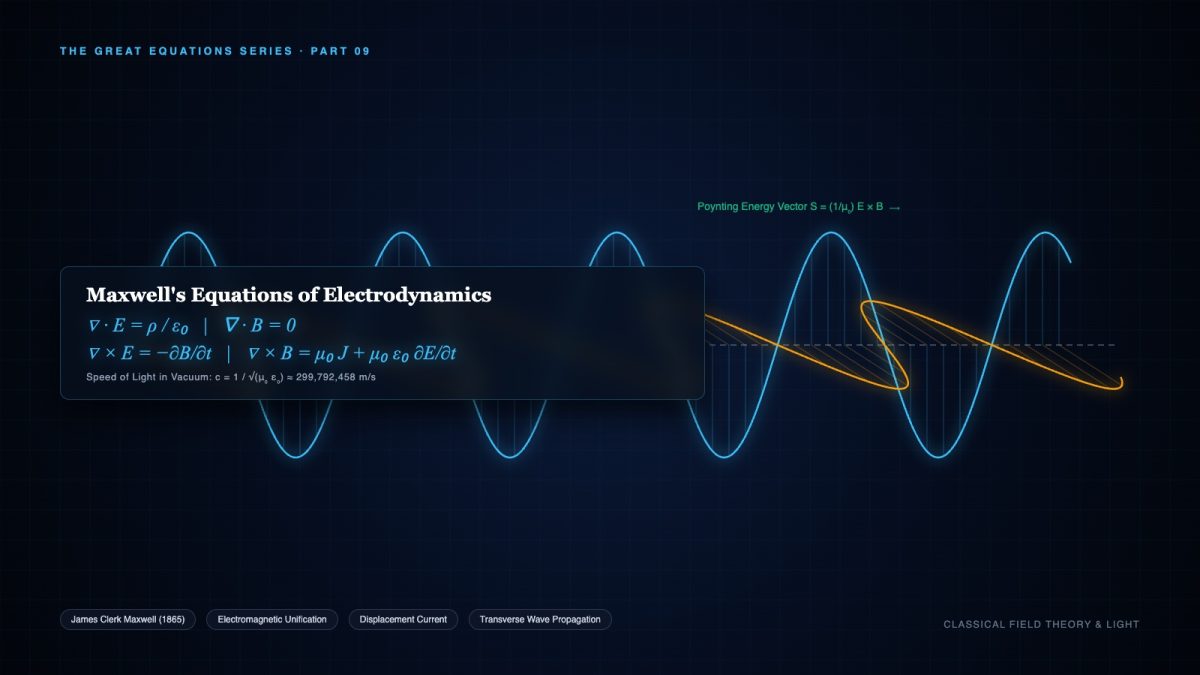
In the early 1860s, Scottish physicist James Clerk Maxwell sat at his family estate in Glenlair, staring at a set of disparate laws describing electricity and magnetism: Coulomb’s attraction of static charges, Ampère’s magnetic fields around wires, and Faraday’s electric induction from moving magnets. Something bothered Maxwell deeply: mathematically, Ampère’s law violated the conservation of electric charge during the charging of a capacitor. To fix this conceptual crack, Maxwell postulated an invisible, non-material current: the displacement current. When he slotted this single term into the equations, a mathematical miracle unfolded. Electric and magnetic fields leaped off their wires and began chasing each other through empty space in a self-sustaining perpendicular dance. When Maxwell calculated their speed using purely laboratory electrical measurements, the number stunned him: 310,740,000 meters per second. In that solitary instant, Maxwell realized what light truly was: “We can scarcely avoid the inference that light consists in the transverse undulations of the same medium which is the cause of electric and magnetic phenomena.”
1. The Four Pillars of Electrodynamics
In modern vector calculus notation (streamlined by Oliver Heaviside from Maxwell’s original twenty equations), the four Maxwell equations are:
Each equation represents an absolute symmetry of the physical universe:
- Gauss’s Law for Electricity ($nabla cdot mathbf{E} = rho / varepsilon_0$): Electric charges are the fundamental sources (divergence) of electric fields. Positive charges act as outward fountains of flux, while negative charges act as sinks. $varepsilon_0$ is the permittivity of free space.
- Gauss’s Law for Magnetism ($nabla cdot mathbf{B} = 0$): Magnetic field lines possess zero divergence; they never begin or terminate at a point charge. Magnetic monopoles do not exist in classical physics; every magnet is an inseparable dipole with continuous closed loops.
- Faraday’s Law of Induction ($nabla times mathbf{E} = -partial mathbf{B} / partial t$): A dynamically changing magnetic field curls space to induce an electric vortex. This is the operating principle behind every hydroelectric turbine, electric generator, and induction motor.
- The Ampère-Maxwell Law ($nabla times mathbf{B} = mu_0 mathbf{J} + mu_0 varepsilon_0 partial mathbf{E} / partial t$): Magnetic fields are curled not only by physical electric currents ($mathbf{J}$), but also by changing electric fields ($partial mathbf{E} / partial t$). This second term—Maxwell’s displacement current—is the catalyst that allows electromagnetic fields to detach from charges and fly across empty vacuum.
2. The Mathematical Derivation of Light from Pure Vacuum
Consider empty space devoid of all matter and electric charges: charge density $rho = 0$ and current density $mathbf{J} = mathbf{0}$. The equations simplify to:
Now, take the curl of Faraday’s Law on both sides:
Using the fundamental vector calculus identity $nabla times (nabla times mathbf{A}) = nabla(nabla cdot mathbf{A}) – nabla^2 mathbf{A}$, and substituting Gauss’s vacuum law $nabla cdot mathbf{E} = 0$, the left-hand side reduces directly to $-nabla^2 mathbf{E}$.
For the right-hand side, substitute Maxwell’s vacuum relation for $nabla times mathbf{B}$:
Equating both sides and canceling the negative signs yields d’Alembert’s three-dimensional wave equation for the electric field:
By identical manipulation, the magnetic field satisfies the exact same relation: $nabla^2 mathbf{B} = mu_0 varepsilon_0 frac{partial^2 mathbf{B}}{partial t^2}$. Comparing this to the general wave equation $nabla^2 u = frac{1}{v^2} frac{partial^2 u}{partial t^2}$, the wave velocity $v$ is revealed:
Light was no longer a mysterious mechanical substance vibrating through an imaginary mechanical ether; it was pure, unadulterated electromagnetism traveling through spacetime.
3. The Catalyst for Einstein’s Special Relativity
Notice something startling about the speed of light $c = 1/sqrt{mu_0 varepsilon_0}$: it depends solely on universal fundamental electromagnetic constants ($mu_0$ and $varepsilon_0$), with no reference to any observer’s reference frame. Under Newtonian Galilean relativity, if you chase a beam of light at velocity $v$, you should measure its speed as $c – v$. But if you change Maxwell’s equations under Galilean velocity transformations, they break down completely.
In 1905, Albert Einstein took Maxwell’s equations seriously: he realized that Maxwell was right and Newton was wrong. The speed of light is absolute and invariant for all inertial observers; instead of light slowing down, time dilates and space contracts. Modern special relativity was born directly out of Maxwell’s electrodynamics.