On November 25, 1915, exhausted and near nervous collapse after an eight-year intellectual odyssey, Albert Einstein presented his crowning masterpiece to the Prussian Academy of Sciences: The Einstein Field Equations of General Relativity. For more than two centuries, humanity had lived under Isaac Newton’s conception of gravity as an invisible, instantaneous tether pulling masses across an absolute, rigid Euclidean stage. Einstein overturned this foundation completely. Gravity is not a force; it is the geometric curvature of four-dimensional spacetime itself. As the legendary physicist John Archibald Wheeler famously crystallized: “Spacetime tells matter how to move; matter tells spacetime how to curve.”
1. The Formula: Geometry Equals Matter
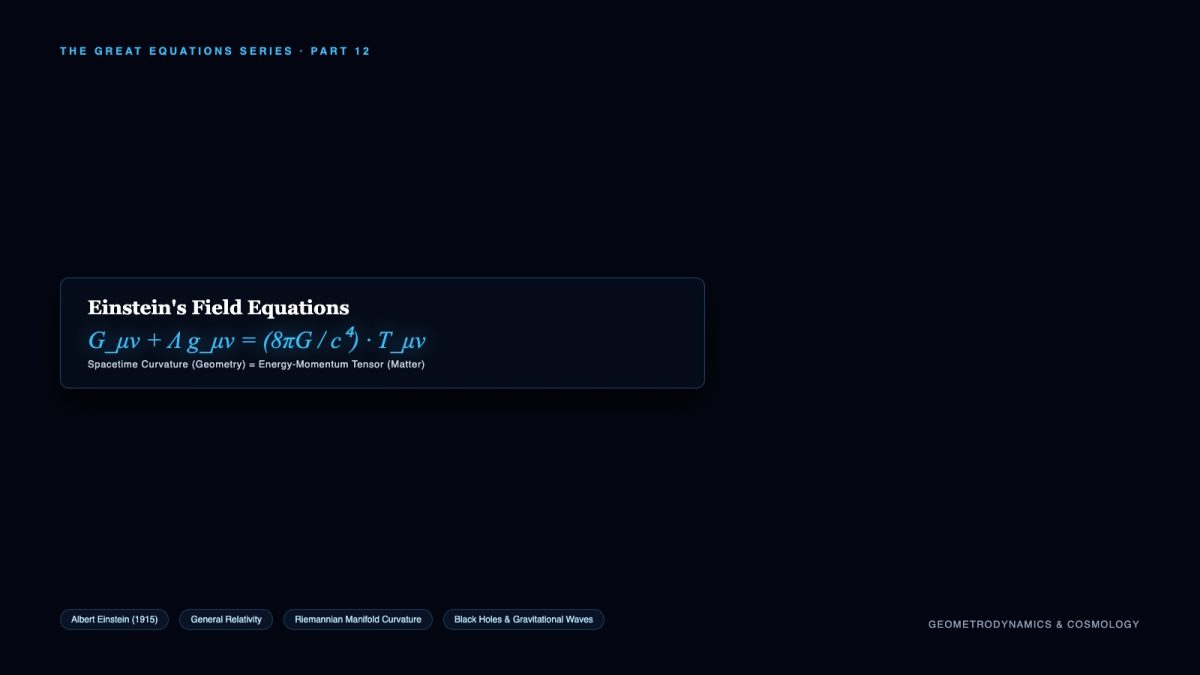
Written in the elegant, compact language of differential geometry and tensor calculus, the field equations are:
Where the Einstein tensor $G_{munu}$ is explicitly expanded in terms of the Ricci curvature tensor $R_{munu}$, the Ricci scalar $R$, and the spacetime metric tensor $g_{munu}$:
Though written as a single line, this tensor relation represents a system of ten coupled, highly nonlinear partial differential equations in four spacetime dimensions ($mu, nu in {0, 1, 2, 3}$):
- The Left Side (Pure Geometry):
- $g_{munu}$ (The Metric Tensor): The fundamental ruler of spacetime, defining the infinitesimal invariant interval between events: $ds^2 = g_{munu} dx^mu dx^nu$.
- $R_{munu}$ and $R$ (Ricci Curvature): Contracted from the four-index Riemann curvature tensor $R^rho_{ sigmamunu}$, measuring how geodesic paths of freely falling test masses diverge or converge due to spacetime curvature.
- $Lambda$ (The Cosmological Constant): Introduced by Einstein in 1917, now understood as dark energy driving the accelerating expansion of the universe.
- The Right Side (Matter and Energy):
- $T_{munu}$ (The Stress-Energy-Momentum Tensor): Contains all mass density, energy flux, shear stress, and isotropic pressure within the universe.
- The Coupling Constant $frac{8pi G}{c^4}$: The cosmic stiffness of spacetime: $$frac{8pi G}{c^4} approx frac{8pi (6.674 times 10^{-11})}{(2.998 times 10^8)^4} approx 2.076 times 10^{-43} text{ s}^2 / (text{kg}cdottext{m})$$ Because $c^4$ in the denominator is gigantic, spacetime is extraordinarily rigid. It requires colossal concentrations of matter—such as colliding neutron stars or supermassive black holes—to bend spacetime noticeably.
2. The Newtonian Weak-Field Limit
How do we know the coupling constant must be exactly $frac{8pi G}{c^4}$? General Relativity must reproduce Newton’s law of universal gravitation in the limit of weak gravitational fields and slow velocities ($v ll c$).
In this weak-field approximation, the metric tensor is a slight perturbation away from flat Minkowski spacetime: $g_{munu} = eta_{munu} + h_{munu}$, where $|h_{munu}| ll 1$. The temporal component of the metric is directly tied to the Newtonian gravitational potential $Phi$:
For static non-relativistic matter, the only significant component of the stress-energy tensor is the rest mass density: $T_{00} approx rho c^2$. Computing the 00-component of the Ricci tensor yields:
Matching this with the trace-reversed Einstein field equations $R_{00} = frac{8pi G}{c^4}(T_{00} – frac{1}{2}T g_{00}) = frac{4pi G}{c^2}rho$, we immediately recover Newton’s Poisson equation:
Newton’s law is not overthrown; it is embraced as the quiet, slow-motion shadow of curved Riemannian geometrodynamics.
3. Triumphs: Black Holes, Gravitational Lensing, and LIGO
- The Schwarzschild Black Hole (1916): Just months after Einstein published his equations, Karl Schwarzschild, serving on the Russian front in World War I, calculated the exact spherically symmetric vacuum solution ($T_{munu} = 0$). It predicted that if mass $M$ is compressed within the radius $r_s = 2GM/c^2$, spacetime curves infinitely, sealing an event horizon from which even light cannot escape.
- Gravitational Lensing: In 1919, Sir Arthur Eddington measured the deflection of starlight grazing the Sun during a total solar eclipse ($1.75$ arcseconds, exactly matching Einstein’s factor of 2 over Newton’s scalar prediction), making Einstein a global icon overnight.
- Gravitational Waves (LIGO 2015): A century after Einstein predicted that accelerating masses generate ripples in the fabric of spacetime traveling at speed $c$, the LIGO interferometers detected the collision of two black holes 1.3 billion light-years away, flexing laser arms by less than one-ten-thousandth the diameter of a proton.




