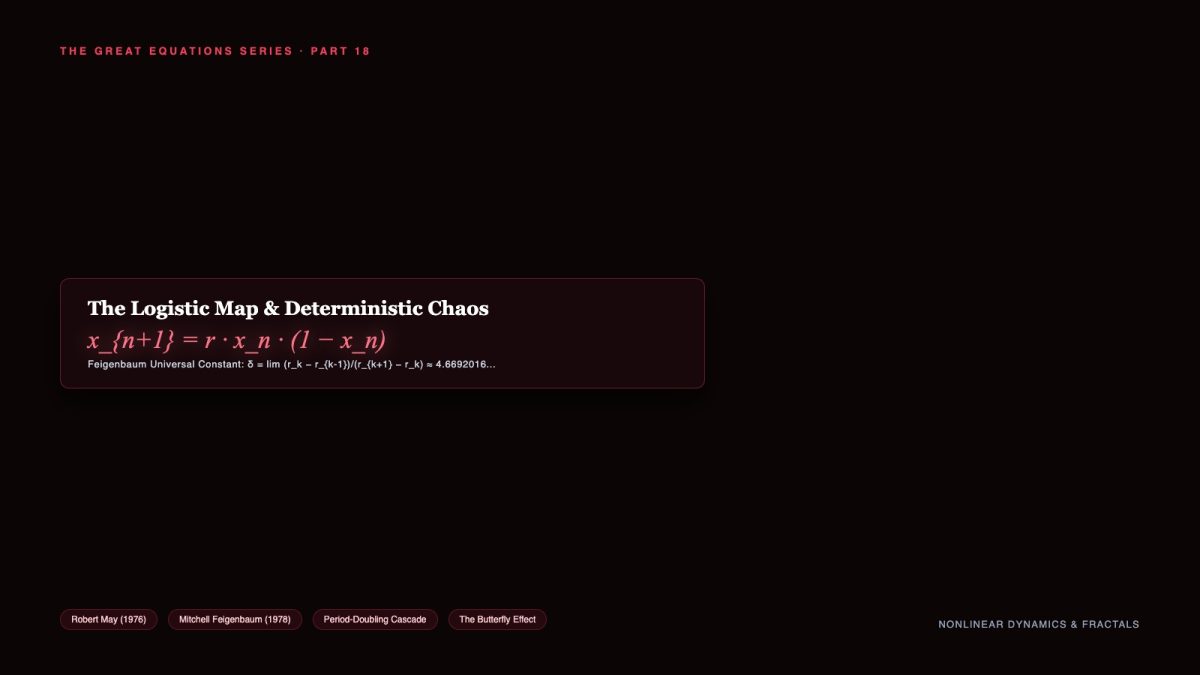
In 1976, Australian theoretical ecologist Robert May published a landmark paper in Nature with a title that was an understatement of cosmic proportions: “Simple mathematical models with very complicated dynamics.” For three centuries following Isaac Newton, scientific orthodoxy held that simple, deterministic mathematical equations produced simple, predictable behavior. If you knew the initial conditions with sufficient precision, the future could be forecast indefinitely into the future. May shattered this Newtonian worldview using an elementary quadratic recurrence relation taught in high school algebra: The Logistic Map. It revealed that perfect mathematical determinism does not imply predictability, birthing the modern science of Chaos Theory and uncovering a universal constant of nature as fundamental as $pi$ or $e$: Mitchell Feigenbaum’s $delta approx 4.6692016$.
1. The Formula: The Non-Linear Engine
The logistic map models the year-to-year population fraction $x_n in [0, 1]$ of a biological species constrained by finite environmental carrying capacity:
The components of this simple iterative map contain two competing forces:
- $x_n in [0, 1]$: The current population as a fraction of the maximum theoretical carrying capacity ($x = 1$).
- The Growth Term ($r x_n$): Represents natural reproduction proportional to current population size ($r$ is the fecundity or biotic growth parameter, typically $0 < r le 4$).
- The Starvation Term $(1 – x_n)$: The negative quadratic feedback. As population increases toward $1$, resource depletion, disease, and starvation reduce the surviving fraction in the next generation.
2. The Route to Chaos: Period-Doubling Bifurcations
What happens when you iterate this formula repeatedly ($x_0 to x_1 to x_2 to dots$)? The behavior changes radically as the growth parameter $r$ increases:
- $0 < r < 1$: The population invariably dies out to extinction: $lim_{n to infty} x_n = 0$.
- $1 le r le 3$: The population settles into a stable, non-zero fixed point: $x^* = 1 – frac{1}{r}$. For instance, at $r = 2.5$, $x^* = 0.60$. Perturb the population, and it reliably returns to this single equilibrium.
- $3 < r < 1 + sqrt{6} approx 3.449$: Period-2 Cycle. The fixed point destabilizes. The population oscillates endlessly between two alternating values (e.g., boom year followed by bust year).
- $r approx 3.449$: Period-4 Cycle. The two cycle points split into four alternating stable values.
- $r approx 3.544$: Period-8 Cycle. The four points split into eight, then sixteen, thirty-two, sixty-four…
- $r_infty approx 3.569946dots$: The Onset of Chaos. The period doubles infinitely fast. Beyond this critical threshold, the population never settles, never repeats, and wanders pseudo-randomly throughout continuous chaotic bands.
3. Feigenbaum Universality: The Constant of Chaos
In 1978, mathematical physicist Mitchell Feigenbaum analyzed the spacing between consecutive bifurcation points $r_k$ where period-$2^k$ transitions occur:
Feigenbaum discovered something miraculous: this number $delta$ is completely universal. If you replace the quadratic peak $x(1-x)$ with a sine wave $r sin(pi x)$, an exponential map, or any smooth function with a single quadratic maximum, the period-doubling cascade converges at the exact same geometric rate $delta approx 4.6692016$.
This universality was soon confirmed experimentally in the laboratory: in the onset of turbulence in liquid helium convection cells, the oscillations of nonlinear electronic circuits, and the onset of fibrillating cardiac arrhythmias in living hearts. Chaos has its own universal arithmetic.
4. The Butterfly Effect: Determinism Without Predictability
Within the chaotic regime ($r = 4$), the logistic map exhibits sensitive dependence on initial conditions. If you take two initial populations that differ by just one-trillionth: $x_0 = 0.500000000000$ and $x_0′ = 0.500000000001$, their trajectories track each other for the first thirty generations. Then, the difference expands exponentially governed by a positive Lyapunov exponent $lambda = ln 2 > 0$:
By generation 50, the two trajectories are completely uncorrelated, occupying opposite ends of the interval. As meteorologist Edward Lorenz summarized: the flap of a butterfly’s wings in Brazil can set off a tornado in Texas. Even with perfect, known equations, long-term forecasting of weather, financial markets, and turbulent fluid flows is fundamentally impossible.