In the early 1970s, legendary Princeton physicist John Archibald Wheeler posed a devious puzzle to his graduate student Jacob Bekenstein: “If I pour a hot cup of tea into a black hole, its entropy disappears from the universe. Have I successfully violated the Second Law of Thermodynamics?” Bekenstein boldly proposed that the black hole must possess entropy of its own, proportional to the surface area of its event horizon. When Stephen Hawking heard this, he was outraged: black holes could not have entropy, because an object with entropy must have a temperature, and an object with a temperature must radiate—which contradicted the very definition of a black hole. Determined to prove Bekenstein wrong, Hawking sat down in 1974 to perform a rigorous quantum field calculation around a curved event horizon. To his absolute astonishment, Hawking found that the black hole does radiate particles. In that climactic epiphany, the greatest synthesis in the history of theoretical physics was born: The Bekenstein-Hawking Entropy Formula.
1. The Formula: The Grand Quadruple Synthesis
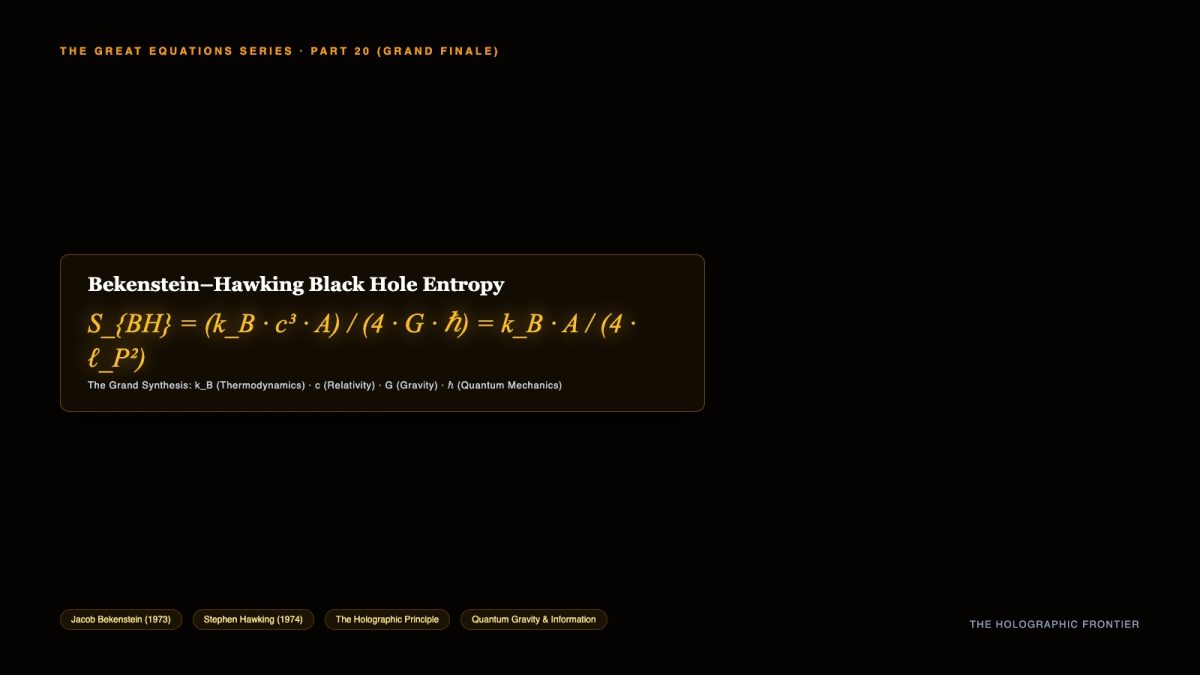
The Bekenstein-Hawking entropy of a black hole with event horizon area $A$ is given by the magnificent relation:
Take a breath and gaze upon the constants assembled in this single equation. It is the only formula in all of human knowledge that unites all four fundamental pillars of modern physics:
- $k_B$ (Boltzmann’s Constant): Represents Thermodynamics and statistical mechanics ($1.381 times 10^{-23} text{ J/K}$).
- $c$ (The Speed of Light): Represents Albert Einstein’s Special Relativity ($2.998 times 10^8 text{ m/s}$).
- $G$ (Newton’s Gravitational Constant): Represents General Relativity and cosmic spacetime curvature ($6.674 times 10^{-11} text{ N}cdottext{m}^2/text{kg}^2$).
- $hbar$ (Reduced Planck’s Constant): Represents Quantum Mechanics ($1.055 times 10^{-34} text{ J}cdottext{s}$).
- $ell_P = sqrt{frac{Ghbar}{c^3}} approx 1.616 times 10^{-35} text{ m}$ (The Planck Length): The fundamental pixel of spacetime. One bit of quantum information ($S = k_B ln 2$) occupies exactly four Planck areas ($Delta A = 4 ell_P^2$) on the event horizon.
2. Hawking Radiation and the Resolution of the Factor of 4
Bekenstein’s initial heuristic argument could only establish that entropy was proportional to area ($S propto A$), but could not fix the dimensionless coefficient. Hawking resolved the missing factor through quantum field theory in curved spacetime.
Near the event horizon, vacuum quantum fluctuations continually produce virtual particle-antiparticle pairs. Normally, these pairs annihilate in $10^{-21}$ seconds. But at the razor-edge of the event horizon, tidal gravitational forces can pull the pair apart before they recombine:
- One particle falls across the horizon into negative-energy orbits ($E < 0$), decreasing the black hole’s mass ($dM < 0$).
- The partner particle escapes into outer space with positive real energy ($E > 0$), appearing to a distant observer as thermal Hawking Radiation.
Hawking proved that the emitted spectrum is a perfect blackbody with temperature:
Now, applying the first law of black hole mechanics $dE = T_H , dS$, where $E = M c^2$ and the Schwarzschild area is $A = 16pi left(frac{GM}{c^2}right)^2$ (so $dA = 32pi frac{G^2 M}{c^4} dM$):
Integrating with respect to mass $M$ from $0$ to $M$:
The factor of $1/4$ was fixed forever. Black holes are not dead, eternal sinks of matter; they are living thermodynamic furnaces that slowly evaporate into pure radiation over googols of years.
3. The Holographic Principle and the Future of Physics
Why is black hole entropy proportional to surface area ($A$) rather than volume ($V$)? In every other system in the universe—a glass of water, a star, a computer memory bank—entropy scales with three-dimensional volume ($S propto V$). If you pack too much information into a region of space, it collapses into a black hole, and the maximum information capacity suddenly becomes bounded strictly by the two-dimensional boundary surface ($A / 4ell_P^2$).
In 1993, Nobel laureate Gerard ’t Hooft and Stanford theorist Leonard Susskind proposed the revolutionary Holographic Principle: our three-dimensional reality—complete with gravity, galaxies, and conscious minds—may be an exact holographic projection encoded on a two-dimensional boundary at the edge of the universe, just as a 3D hologram is encoded on a 2D flat film.
In 1997, Juan Maldacena formalized this with the AdS/CFT correspondence, showing that a gravitational theory in five dimensions is mathematically identical to a quantum gauge theory on its four-dimensional boundary. Bekenstein and Hawking’s equation is our first shimmering window into the ultimate theory of Quantum Gravity.
4. Epilogue: The Arc of The Great Equations
We have journeyed across 2,500 years of human thought:
- From Pythagoras discovering Euclidean space in ancient Samos ($a^2 + b^2 = c^2$),
- To Newton and Leibniz unlocking continuous fluxions ($frac{d}{dx}int f = f$),
- Newton binding the Moon to the falling apple ($F = G m_1 m_2 / r^2$),
- Euler uniting the five cosmic constants ($e^{ipi} + 1 = 0$),
- Gauss taming randomness into the bell curve ($f(x) propto e^{-(x-mu)^2/2sigma^2}$),
- D’Alembert setting space and time into harmonic vibration ($partial_t^2 u = v^2 nabla^2 u$),
- Fourier deconstructing reality into pure frequencies ($hat{f}(xi) = int f e^{-2pi i xi t} dt$),
- Navier and Stokes grappling with fluid turbulence ($rho Du/Dt = -nabla p + munabla^2 u$),
- Maxwell discovering that light is electromagnetic ($nabla times mathbf{E} = -partial_t mathbf{B}$),
- Boltzmann discovering the arrow of time in atomic permutations ($S = k_B ln Omega$),
- Einstein unlocking the cosmic energy forge ($E = mc^2$),
- Einstein curving the fabric of Riemannian spacetime ($G_{munu} = frac{8pi G}{c^4} T_{munu}$),
- Schrödinger orchestrating the quantum probability wave ($ihbar partial_t psi = hat{H}psi$),
- Heisenberg drawing the eternal boundary of measurement ($Delta x Delta p ge hbar/2$),
- Dirac summoning antimatter out of relativistic symmetry ($(igamma^mu partial_mu – m)psi = 0$),
- Shannon quantifying the bit and digital communication ($H = -sum p log_2 p$),
- Turing establishing the limits of algorithmic computability ($text{HALT}(M, w) implies text{Undecidable}$),
- May and Feigenbaum revealing universality in chaos ($x_{n+1} = rx(1-x), delta approx 4.6692$),
- Bell proving that nature is fundamentally non-local ($|S| le 2 implies 2sqrt{2}$),
- And finally Bekenstein and Hawking uniting thermodynamics, relativity, gravity, and quanta on the event horizon ($S_{text{BH}} = frac{k_B c^3 A}{4Ghbar}$).
Equations are not arbitrary inventions of human minds; they are the eternal poetry of the cosmos. Through them, the universe awakens, looks back upon itself, and understands its own design.




