In 1935, Albert Einstein, Boris Podolsky, and Nathan Rosen published their famous EPR paper, arguing that quantum mechanics was incomplete. Einstein could not stomach the idea that measuring one particle could instantaneously dictate the state of an entangled twin across the galaxy, famously dismissing it as “spukhafte Fernwirkung” (spooky action at a distance). Einstein insisted that nature must possess local realism: objects have definite physical properties prior to measurement, and no influence can travel faster than the speed of light. For thirty years, this debate remained an untestable philosophical squabble. Then, in 1964, a quiet Northern Irish theorist at CERN named John Stewart Bell transformed philosophy into experimental physics with a simple mathematical inequality: Bell’s Inequality. Bell proved that if Einstein’s local realism were true, nature could never exceed a strict numerical threshold. Today, laboratory experiments have conclusively shattered that threshold, proving that the universe is fundamentally, incontrovertibly non-local.
1. The Formula: The Boundary of Classical Reality
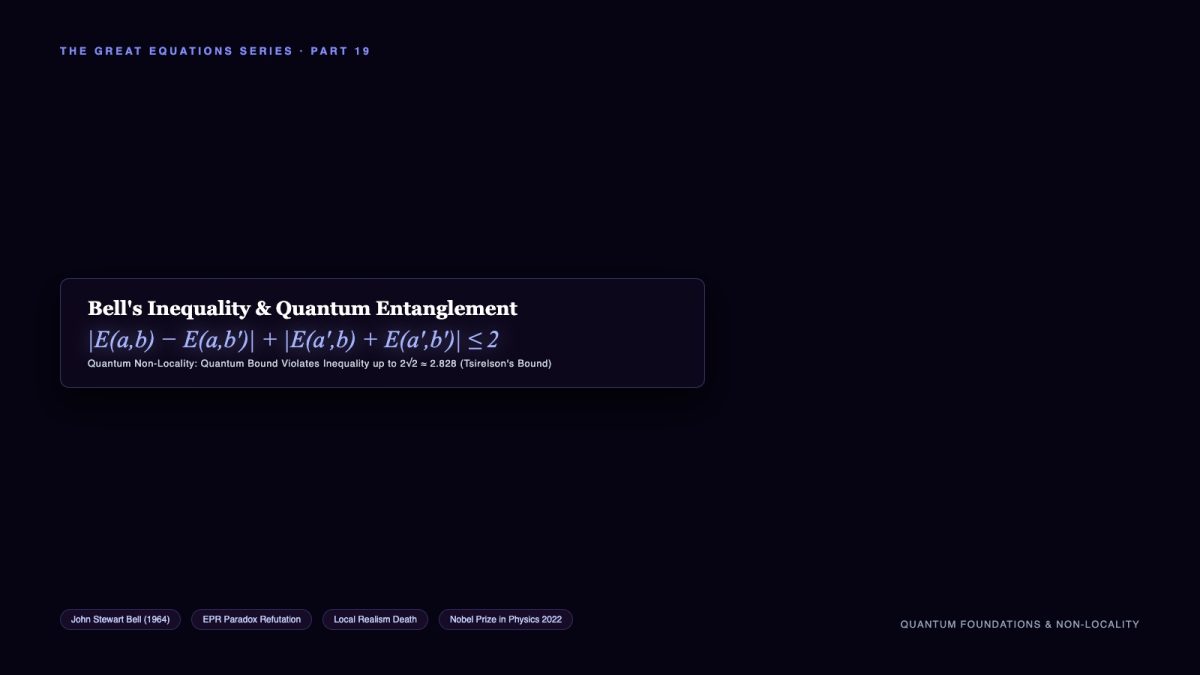
In the Clauser-Horne-Shimony-Holt (CHSH) formulation, two experimenters—Alice and Bob—measure the spins or polarizations of an entangled pair of particles. Alice chooses between two detector settings $a$ and $a’$, while Bob chooses between $b$ and $b’$. The measurement correlation expectation value is denoted $E(a, b) in [-1, +1]$.
Bell proved that under any theory based on Local Realism (where outcomes are determined by hidden variables $lambda$ localized at the source and unaffected by distant detector choices), the correlation parameter $S$ must strictly obey:
However, under standard Quantum Mechanics, the correlation for an entangled singlet state $|psi^-rangle = frac{1}{sqrt{2}}(|01rangle – |10rangle)$ is dictated by the inner product of the detector orientation angles:
By carefully selecting the detector angles at increments of $45^circ$ ($theta_{ab} = 45^circ, theta_{ab’} = 135^circ, theta_{a’b} = 45^circ, theta_{a’b’} = 45^circ$):
Because $2sqrt{2} approx 2.828 > 2$, quantum mechanics predicts an undeniable mathematical violation of local realism up to Tsirelson’s bound.
2. First-Principles Derivation of the CHSH Inequality
To see why classical reality can never exceed 2, consider the local realistic premise. Let the measurement outcomes for Alice be $A(a, lambda) in {-1, +1}$ and $A(a’, lambda) in {-1, +1}$, and for Bob be $B(b, lambda) in {-1, +1}$ and $B(b’, lambda) in {-1, +1}$, governed by a probability distribution $rho(lambda) ge 0$ with $int rho(lambda) dlambda = 1$.
Consider the algebraic quantity for a single trial:
Since $B(b)$ and $B(b’)$ can each only take values $+1$ or $-1$:
- If $B(b) = B(b’)$, then $B(b) – B(b’) = 0$ and $B(b) + B(b’) = pm 2$.
- If $B(b) neq B(b’)$, then $B(b) – B(b’) = pm 2$ and $B(b) + B(b’) = 0$.
In either case, one bracket is zero and the other is $pm 2$. Since $A(a) = pm 1$ and $A(a’) = pm 1$:
Integrating this expression against the probability density $rho(lambda) dlambda$ and applying the triangle inequality immediately forces:
This proof is airtight. If measurements correspond to pre-existing local elements of physical reality, the value cannot exceed 2. Period.
3. The Death of Local Realism and the 2022 Nobel Prize
In 1982, French physicist Alain Aspect conducted the definitive experimental test at the Institut d’Optique in Orsay. Using rapidly switching optical mirrors that changed detector angles while the entangled photons were already in mid-flight (preventing any sub-luminal communication between detectors), Aspect measured $S = 2.697 pm 0.015$, violating Bell’s inequality by dozens of standard deviations.
Subsequent loophole-free experiments in 2015 closed every conceivable detection and locality loophole. In 2022, the Nobel Prize in Physics was awarded to Alain Aspect, John Clauser, and Anton Zeilinger for these historic breakthroughs. Einstein’s dream of local realism was dead: the universe does not consist of isolated local pieces; reality is fundamentally entangled, non-separable, and interconnected across space and time.