In 1928, the preeminent German mathematician David Hilbert issued a grand challenge to the world: the Entscheidungsproblem (the Decision Problem). Could there exist an automatic, mechanical procedure—an algorithm—that could determine the truth or falsity of any well-formed mathematical assertion? For eight years, mathematicians dreamed of an omniscient proof machine. Then, in the summer of 1936, a twenty-four-year-old Cambridge fellow named Alan Mathison Turing delivered a stunning negative verdict. By inventing an abstract imaginary machine consisting of a paper tape and a scanning head—the blueprint of every modern computer—Turing demonstrated that mathematics contains questions that no computer can ever answer: The Halting Problem. It established the absolute, eternal boundary of what is computable in our universe.
1. The Formula: The Formalism of Undecidability
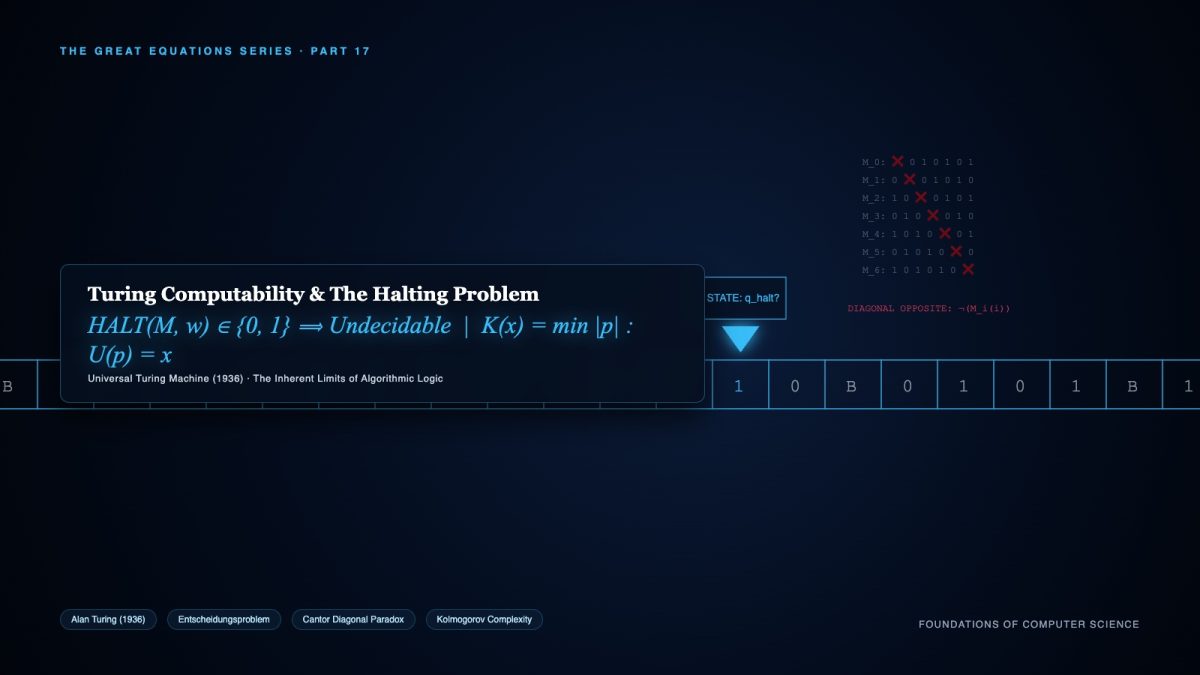
The Halting Problem asks whether there exists a general algorithm $text{HALT}(M, w)$ that takes the description of an arbitrary Turing machine $M$ and an input string $w$, and halts with a binary verdict:
Turing’s theorem states unequivocally:
Related to this uncomputability is Kolmogorov Complexity $K(x)$, the length of the shortest computer program that outputs string $x$ on a universal Turing machine $U$:
Kolmogorov complexity is similarly uncomputable: you can never prove algorithmically whether a given program is the absolute most compressed representation of a mathematical object.
2. Turing’s Diagonalization Proof by Contradiction
Turing’s proof is one of the most elegant intellectual constructions in history, adapting Georg Cantor’s diagonal argument into algorithmic logic.
Suppose, for the sake of contradiction, that a hypothetical algorithm $text{Halt}(M, w)$ exists. Since every computer program can be encoded as a finite string of binary text $langle M rangle$, a program can take its own code as input: $text{Halt}(M, langle M rangle)$.
Now, construct a new pathological program $D$ (the Diagnoser / Adversary) that takes the description of any machine $M$ and does the exact opposite of what $text{Halt}$ predicts:
Now comes the lethal self-referential trap: what happens when we feed program $D$ its own source code as input: $D(langle D rangle)$?
- If $text{Halt}(D, langle D rangle) == 1$ (predicting that $D$ halts), the code forces $D$ to enter an infinite loop and never halt. Contradiction!
- If $text{Halt}(D, langle D rangle) == 0$ (predicting that $D$ loops forever), the code forces $D$ to exit immediately and halt. Contradiction!
In both cases, we arrive at an inescapable logical contradiction: $D(langle D rangle)$ halts if and only if $D(langle D rangle)$ does not halt. Therefore, the original premise was false: no general halting algorithm can ever exist. Not now, not on supercomputers, and not on future quantum computers.
3. The Philosophical and Practical Consequences
- The Universal Turing Machine: To prove this result, Turing had to first define the mathematical blueprint of computation: an infinite tape, a state register, and a transition table. In doing so, he invented the stored-program computer—where code and data reside in the same memory—the architecture powering every smartphone and cloud server today.
- Rice’s Theorem: In 1953, Henry Gordon Rice extended Turing’s result to prove that any non-trivial semantic property of a computer program is undecidable. You can never write an automated tool that perfectly verifies whether arbitrary software is bug-free, halts, or leaks memory without making approximations.
- The Limits of Mathematical Knowledge: Combined with Kurt Gödel’s Incompleteness Theorems (1931), Turing proved that truth outstrips proof. Mathematics is not an enclosed, fully predictable clockwork mechanism; it is an open-ended ocean containing inherently unprovable truths.