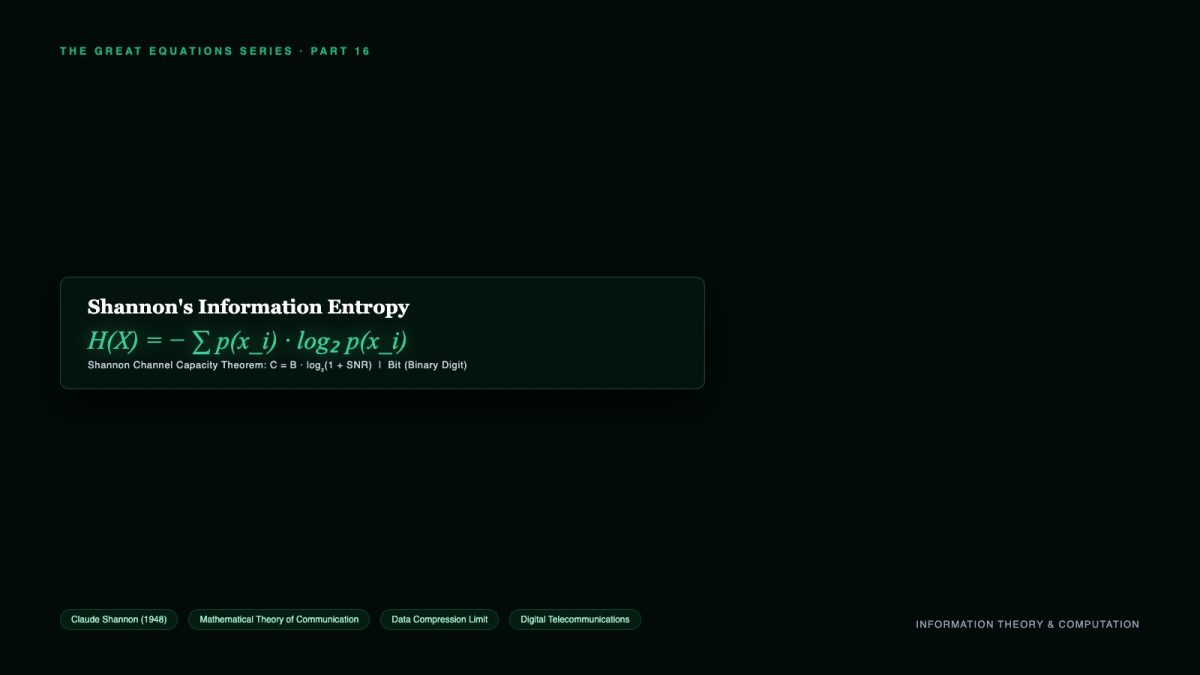
In 1948, an unassuming thirty-two-year-old mathematician and cryptographer at Bell Telephone Laboratories named Claude Elwood Shannon published a seventy-nine-page paper in the Bell System Technical Journal titled simply: “A Mathematical Theory of Communication.” Before Shannon, communication was understood as an analog engineering problem of electrical voltages, vacuum tube amplification, and copper wire fidelity. Shannon swept all of that away with a concept of breathtaking abstraction. He proved that all communication—whether human speech, Beethoven symphonies, telegraph Morse code, or printed literature—could be stripped of physical media and quantified into pure, discrete mathematical units called bits. At the core of Shannon’s triumph was an immortal formula for the fundamental uncertainty of knowledge: Shannon’s Information Entropy.
1. The Formula: Quantifying Uncertainty
For a discrete random variable $X$ taking possible outcomes ${x_1, x_2, dots, x_n}$ with probability distribution $P(X = x_i) = p_i$, the information entropy $H(X)$ is defined as the expected information content of an observation:
Where information content is measured in bits (binary digits, using base-2 logarithm):
- $I(x_i) = log_2(1 / p_i) = -log_2 p_i$ (Surprise / Self-Information): If an event is certain ($p = 1$), observing it gives zero information ($I = log_2 1 = 0$ bits). If an event is extremely rare ($p = 1/1024$), learning that it occurred yields high information ($I = 10$ bits of surprise). Information is mathematically defined as the resolution of uncertainty.
- $H(X)$ (Average Uncertainty / Entropy): The statistical expectation $mathbb{E}[I(X)]$. It measures the minimum number of binary yes/no questions needed on average to completely determine an unknown outcome.
- Maximum Entropy Principle: For $n$ possible states, entropy reaches its absolute maximum when all outcomes are equally likely (uniform distribution, $p_i = 1/n$): $$H_{text{max}} = log_2 n$$ For a fair coin ($n = 2$), $H = -left(frac{1}{2}log_2frac{1}{2} + frac{1}{2}log_2frac{1}{2}right) = 1.0 text{ bit}$. For a biased coin that always lands on heads ($p = 1, 1-p = 0$), $H = 0$ bits.
2. The Two Golden Theorems of Information
Shannon’s 1948 paper did not stop at defining entropy; it established the two ultimate physical speed limits governing the modern digital universe:
- Theorem 1: The Source Coding Theorem (Lossless Compression Limit): Shannon proved that a data stream emitted by source $X$ cannot be compressed into fewer than $H(X)$ bits per symbol without losing information. All modern lossless compression algorithms—from Huffman coding and Lempel-Ziv (ZIP, GZIP, PNG) to arithmetic coding—are asymptotic approximations reaching toward Shannon’s entropy limit.
- Theorem 2: The Noisy Channel Coding Theorem (Channel Capacity): Can you transmit data with arbitrarily low error over a communication channel corrupted by background physical noise? Classical engineers believed that to reduce errors to zero, transmission speed must drop to zero. Shannon proved them wrong: as long as the information transmission rate $R$ is below the Channel Capacity $C$, there exists an error-correcting code that allows transmission with near-zero error: $$C = B log_2 left( 1 + frac{S}{N} right)$$ where $B$ is channel bandwidth in Hertz, and $S/N$ is the signal-to-noise ratio. This formula dictates the maximum data throughput of every 5G cell tower, Wi-Fi router, fiber-optic cable, and deep-space NASA satellite transponder.
3. The Information Age and Artificial Intelligence
Today, Shannon’s information entropy extends far beyond telecommunications. In machine learning and deep neural networks, the objective function optimized during training is almost universally Cross-Entropy Loss:
Training a large language model or vision classifier is mathematically equivalent to minimizing the Kullback-Leibler divergence between the ground-truth probability distribution and the model’s predictions. Claude Shannon transformed information from a subjective human concept into an exact physical currency.




