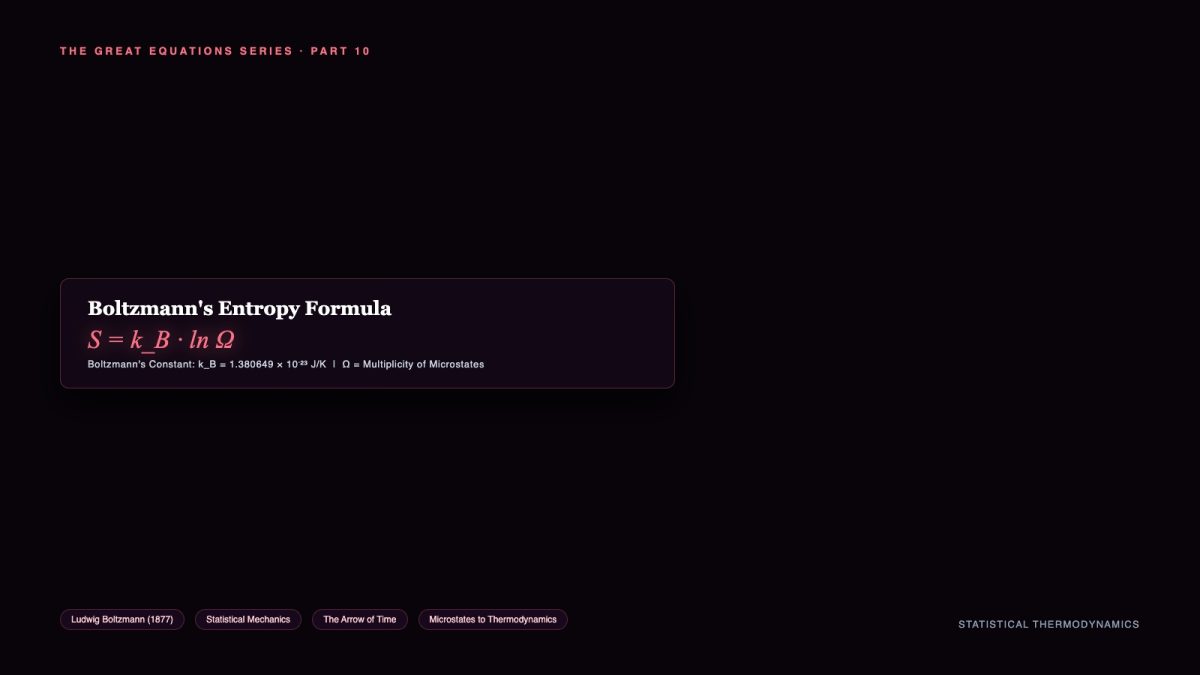
Drop a porcelain teacup onto a stone floor: it shatters into dozens of sharp fragments. But film that event and play it in reverse, and you will instantly recognize an impossibility: scattered shards will never spontaneously leap off the floor, assemble themselves into an intact vessel, and catch warm tea pouring from the ceiling. Yet none of Isaac Newton’s laws of motion, nor Maxwell’s electrodynamics, prohibit that reversed trajectory. At the microscopic level of colliding atoms, every fundamental law of physics is completely time-symmetric. Why, then, does our macroscopic universe possess an inexorable, irreversible Arrow of Time? In 1877, Austrian physicist Ludwig Boltzmann carved the bridge between the unseen atomic world and macroscopic reality with an equation so monumental that it is engraved upon his tombstone in Vienna: $S = k_B ln Omega$.
1. The Formula: The Bridge from Atoms to Thermodynamics
The statistical definition of entropy relates the macroscopic thermodynamic entropy $S$ of an isolated system to the total number of its accessible microscopic configurations $Omega$:
In this deceptively brief equation resides the resolution to the greatest mystery of thermodynamics:
- $S$ (Thermodynamic Entropy): The macroscopic measure of degraded energy, disorder, or lost work capacity, measured in Joules per Kelvin ($text{J/K}$). In classical thermodynamics (Rudolf Clausius, 1865), it was defined macroscopically as $dS = delta Q_{text{rev}} / T$.
- $k_B$ (Boltzmann’s Constant): The fundamental scaling factor connecting microscopic thermal kinetic energy to macroscopic temperature: $$k_B approx 1.380649 times 10^{-23} text{ J/K}$$
- $Omega$ (Multiplicity of Microstates): The exact count of distinct quantum or phase-space microstates (the specific positions and momenta of all $10^{23}$ individual molecules) that correspond to the exact same macroscopic state (the observed temperature, pressure, and volume).
- The Natural Logarithm ($ln$): The mathematical bridge that transforms multiplicative microstate combinations into additive thermodynamic entropy.
2. Why the Logarithm? The Additivity of Physical Systems
Why must entropy depend strictly on the logarithm of microstates rather than a linear or power law? Boltzmann reasoned from first principles of physical composition.
Consider two independent, non-interacting physical systems, $A$ and $B$. If system $A$ has $Omega_A$ possible microstates and system $B$ has $Omega_B$ possible microstates, the total number of joint microstates for the combined system $A + B$ is multiplicative by elementary combinatorics:
However, macroscopic thermodynamics requires that extensive properties—such as mass, volume, and total entropy—must be additive:
Therefore, any statistical function connecting entropy $S = f(Omega)$ to multiplicity must satisfy the Cauchy functional equation for all positive values:
The only continuous mathematical function in existence that turns multiplication into addition is the logarithm: $f(Omega) = k ln Omega$. Multiplicativity of atomic microstates directly necessitates the logarithmic nature of entropy.
3. The Statistical Law: Why Entropy Always Increases
Before Boltzmann, the Second Law of Thermodynamics ($Delta S ge 0$) was treated as an absolute, dogmatic dictate of nature. Boltzmann revealed that it is not an absolute mechanical prohibition, but a statistical overwhelming certainty.
Imagine a container divided in half. Initially, all $N = 10^{23}$ gas molecules are compressed into the left half. There is only $Omega_{text{left}} = 1^{10^{23}}$ way for all molecules to be on the left. Once the barrier is removed, each molecule is equally likely to be on the left or the right. The number of configurations where the gas is uniformly spread throughout the entire container is:
The ratio of uniform microstates to the initial state is $2^{10^{23}} / 1$, a number so unimaginably colossal that the probability of all gas molecules spontaneously gathering back into the left half is effectively zero. A teacup breaks and never reassembles simply because there are billions of trillions of broken arrangements, but only one unbroken arrangement. Time marches forward because nature blindly explores phase space, and states of higher $Omega$ outnumber states of lower $Omega$ by astronomical orders of magnitude.
4. Legacy: From Maxwell’s Demon to Claude Shannon
In 1948, Claude Shannon founded digital information theory. When seeking a mathematical metric for the uncertainty of an information source emitting symbols with probabilities $p_i$, he derived the formula:
Legend tells that mathematician John von Neumann advised him: “You should call it entropy, for two reasons. In the first place your uncertainty function has been used in statistical mechanics under that name, so it already has a name. In the second place, and more importantly, no one really knows what entropy is, so in a debate you will always have the advantage.” Boltzmann’s formula proved that thermodynamic entropy is ultimately missing microscopic information.