In 1928, a painfully shy, twenty-five-year-old English mathematical physicist named Paul Adrien Maurice Dirac sat in his rooms at St John’s College, Cambridge, staring into an open fireplace. Physics was in a severe crisis: Erwin Schrödinger’s wave equation could describe slow-moving electrons in atoms, but it broke down completely when electrons approached relativistic speeds near the speed of light. Meanwhile, the relativistic Klein-Gordon equation contained second time derivatives that yielded absurd negative probabilities ($P < 0$). Dirac sought an equation that was strictly linear in time, linear in space, and fully invariant under Albert Einstein’s Lorentz transformations. By inventing an entirely new algebra of four-by-four matrices, Dirac unlocked a magnificent masterpiece: The Dirac Equation. It not only explained why elementary particles possess intrinsic quantum spin ($S = 1/2$), but it forced physics to accept an unimaginable revelation: for every particle of matter in our universe, there must exist an identical twin of mirror-opposite electric charge—Antimatter.
1. The Formula: The Relativistic Symphony
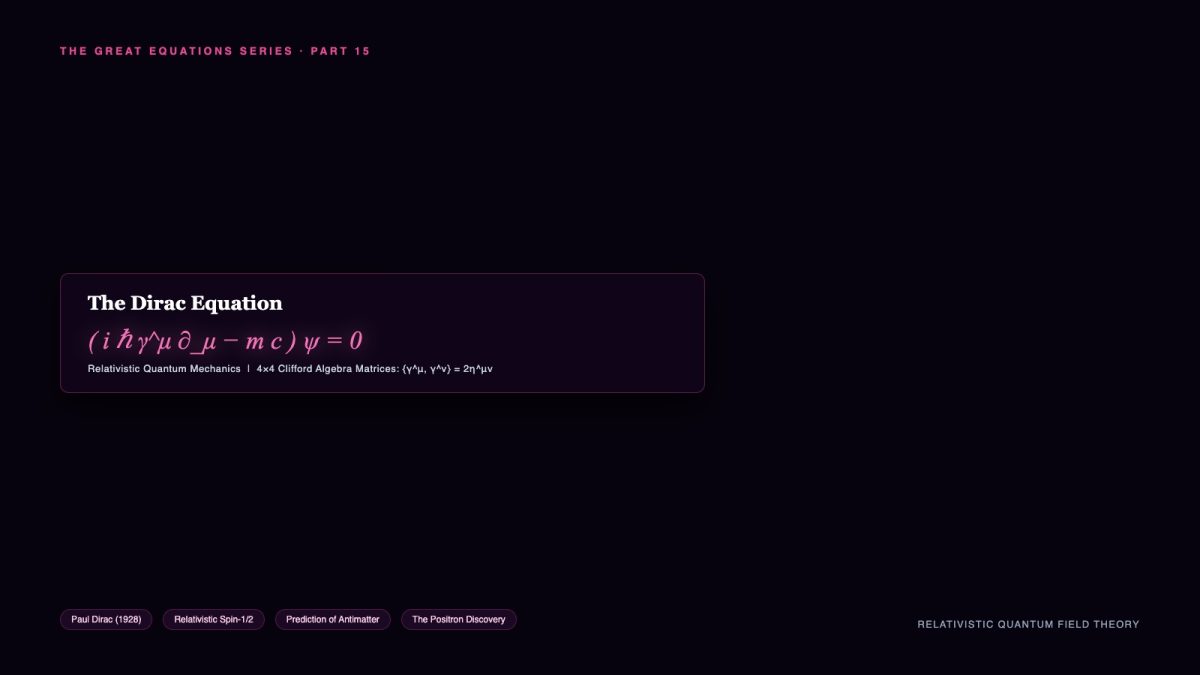
In natural units ($hbar = c = 1$), the Dirac equation for a relativistic fermion of mass $m$ is written with breathtaking brevity:
And with explicit physical units reinstated:
The components of this equation are unlike anything that existed before in classical physics:
- $partial_mu = left(frac{1}{c}frac{partial}{partial t}, nablaright)$ (The Spacetime Four-Gradient): Treats time and the three spatial dimensions on an entirely equal, linear footing, ensuring relativistic covariance.
- $gamma^mu$ ($mu in {0, 1, 2, 3}$) (The Dirac Gamma Matrices): Four $4 times 4$ complex matrices satisfying the anticommutation relation of Clifford algebra: $${ gamma^mu, gamma^nu } = gamma^mu gamma^nu + gamma^nu gamma^mu = 2 eta^{munu} I_4$$ where $eta^{munu} = text{diag}(1, -1, -1, -1)$ is the Minkowski metric tensor of flat spacetime.
- $psi$ (The Dirac Bispinor): Not a scalar wavefunction, but a four-component column vector $psi = (psi_1, psi_2, psi_3, psi_4)^T$. Two components describe an electron with spin-up and spin-down; the other two components describe its antimatter counterpart with positive energy.
2. Factoring the Relativistic Energy-Momentum Relation
Einstein’s relativistic energy relation states that $E^2 = p^2 c^2 + m^2 c^4$, which translates into quantum operator form as the second-order Klein-Gordon equation:
Dirac wondered: Can we take the square root of the wave operator? Can we find coefficients $alpha_i$ and $beta$ such that:
Squaring both sides:
To match $p^2 + m^2$, the coefficients must satisfy:
Ordinary numbers cannot anticommute ($alpha_1 alpha_2 = -alpha_2 alpha_1$). Dirac realized that these objects must be matrices. Furthermore, to satisfy the tracelessness and determinant conditions, the minimum dimension of these matrices must be $4 times 4$. Spin was not an add-on; spin-1/2 is an inescapable consequence of combining quantum mechanics with special relativity.
3. The Negative Energy Sea and the Prediction of Antimatter
When solving the Dirac equation for a free particle, solutions naturally split into positive energy states $E = +sqrt{p^2 + m^2}$ and negative energy states $E = -sqrt{p^2 + m^2}$. In classical physics, negative energy is simply discarded as unphysical. But in quantum mechanics, an electron would continuously radiate photons and cascade infinitely downward into negative energy oblivion.
Dirac made a staggering proposal: what if all negative energy states in the vacuum of the universe are already completely filled by an infinite sea of electrons (the Dirac Sea)? Because electrons obey the Pauli exclusion principle, a normal electron cannot fall into an occupied negative state. But if a high-energy gamma-ray photon strikes this sea with energy $hnu ge 2mc^2$, it can knock a negative-energy electron out into the positive realm, leaving behind an empty ‘hole’.
That hole would behave in all respects like a positively charged electron. In 1931, Dirac declared that this hole was a new particle unknown to science: the antielectron or positron. Just one year later, in August 1932, American experimentalist Carl Anderson observed cosmic ray tracks in a cloud chamber curling in a magnetic field in the direction opposite to electrons: the positron had been found. Dirac had conjured half of the matter in the universe out of pure mathematical aesthetic symmetry.




