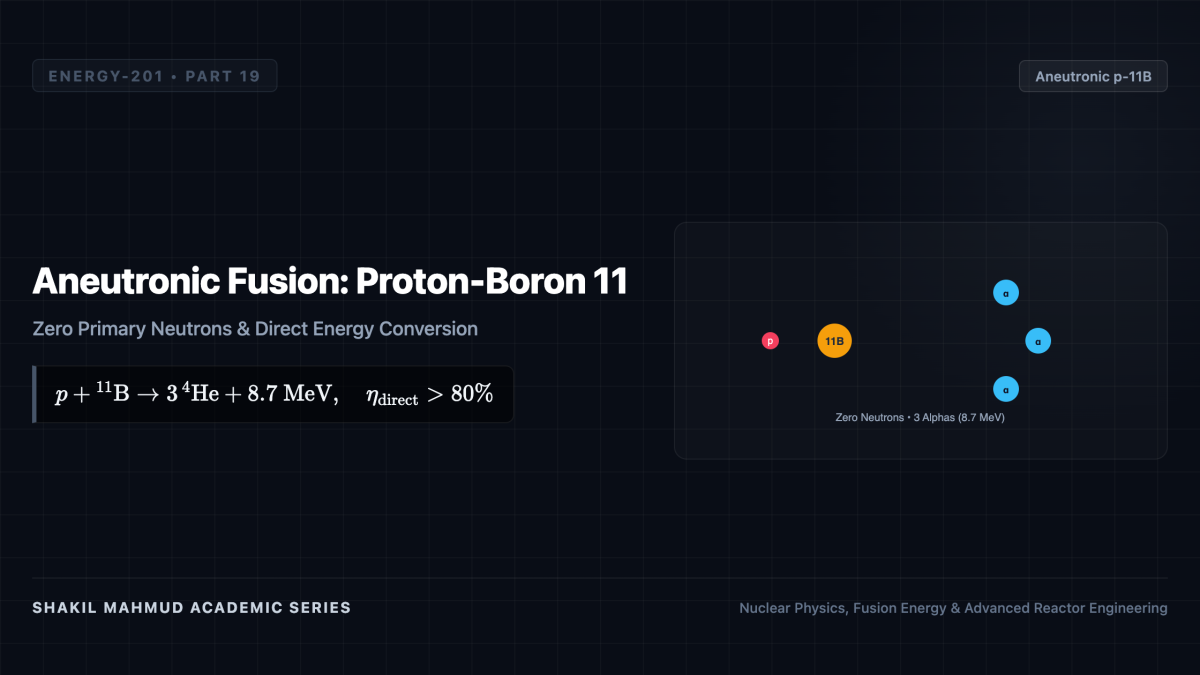
The fundamental Achilles’ heel of deuterium-tritium fusion is its reliance on uncharged (14.1 ext{ MeV}) neutrons and radioactive tritium. Aneutronic fusion eliminates these vulnerabilities by selecting fuel cycles whose primary reaction branches produce exclusively charged particles (alpha particles and protons) with virtually zero secondary neutrons. Among all aneutronic candidates, the proton-boron 11 ((p ext{-}^{11} ext{B})) reaction stands as the ultimate holy grail of nuclear power: abundant fuel, no radioactive waste, and the potential for direct electrostatic conversion of kinetic energy into electricity without boiling water.
1. The Proton-Boron 11 Nuclear Reaction
When an energetic proton collides with a boron-11 nucleus, it forms an unstable intermediate compound carbon-12 nucleus in an excited state, which rapidly fissions into three energetic alpha particles (helium-4 nuclei):
[
p + {}^{11} ext{B} o {}^{12} ext{C}^* o 3 , {}^4 ext{He} , (alpha) + 8.68 ext{ MeV}
]
Key physics features of this reaction include:
- Zero Primary Neutrons: All reaction products are positively charged alpha particles carrying (2.9 ext{ MeV}) kinetic energy each.
- Trace Secondary Neutrons ((< 0.1%)): Parasitic side reactions (such as ({}^{11} ext{B}(alpha, n){}^{14} ext{N}) and ({}^{11} ext{B}(p, n){}^{11} ext{C})) produce an exceptionally tiny neutron flux, eliminating massive biological shields, activation hazards, and structural embrittlement.
- Fuel Abundance: Boron is mined worldwide in immense, inexpensive mineral deposits (borax), while protons come from ordinary water.
2. Physics Hurdles: The Bremsstrahlung Barrier
Why has the world pursued DT fusion instead of (p ext{-}^{11} ext{B})? The answer lies in the Coulomb barrier and atomic charge numbers ((Z_1 = 1, Z_2 = 5)):
- Ignition Temperature: The DT fusion cross-section peaks at (T approx 65 ext{ keV}) with practical operation at (15 ext{ keV}). In contrast, the (p ext{-}^{11} ext{B}) cross-section requires ion temperatures exceeding (T_i > 150 ext{–}300 ext{ keV}) ((> 2 ext{ billion Kelvin})).
- Bremsstrahlung Radiation Cooling: In a plasma, electron-ion collisions emit continuous X-ray bremsstrahlung radiation. The power loss scales as:
[
P_{ ext{brem}} = C_B , n_e^2 , Z_{ ext{eff}} , T_e^{1/2}
]
Because boron has (Z = 5), (Z_{ ext{eff}} approx 3 ext{–}4), and electron density (n_e = n_p + 5 n_B). At thermal equilibrium ((T_e = T_i approx 200 ext{ keV})), bremsstrahlung losses strictly exceed thermonuclear fusion power output!
3. Non-Thermal Plasmas and Advanced Confinement
To overcome the bremsstrahlung barrier, modern aneutronic fusion pioneers (such as TAE Technologies and Marvel Fusion) utilize non-equilibrium plasmas where the ion temperature is maintained at hundreds of keV while electrons are actively cooled or kept out of equilibrium ((T_i gg T_e approx 30 ext{–}50 ext{ keV})):
- Field-Reversed Configuration (FRC): A closed, high-beta ((beta sim 0.9)) prolate plasma toroid suspended inside a linear cylindrical vacuum chamber by diamagnetic plasma currents. FRCs naturally repel internal magnetic fields, suppressing synchrotron radiation while accommodating high plasma pressures.
- Neutral Beam Injection (NBI): High-current tangential neutral beams inject energetic protons, stabilizing macroscopic plasma tilt instabilities and heating ions selectively.
- Ultra-Short Petawatt Lasers: Relativistic laser-driven ion acceleration exploits non-thermal ponderomotive forces to accelerate protons directly into boron targets, triggering fusion through non-equilibrium hydrodynamic avalanche channels.
4. Direct Energy Conversion ((ta > 80%))
In conventional fission and DT fusion plants, energy is extracted as heat, boiling water to drive steam turbine generators bounded by the Carnot thermodynamic efficiency limit ((ta_{ ext{Carnot}} approx 35 ext{–}45%)).
Because all (p ext{-}^{11} ext{B}) fusion energy is carried by charged alpha particles (( ext{He}^{2+})), thermal cycles can be bypassed entirely in favor of Direct Electrostatic Energy Conversion:
[
ta_{ ext{direct}} = 1 – rac{Delta V_{ ext{spread}}}{V_0} approx 80 ext{–}90%
]
Charged alphas expanding against an electrostatic decelerator grid or inductive pickup coil generate direct high-voltage direct current (HVDC) electricity with minimal thermal rejection, revolutionizing power plant efficiency and footprint.




