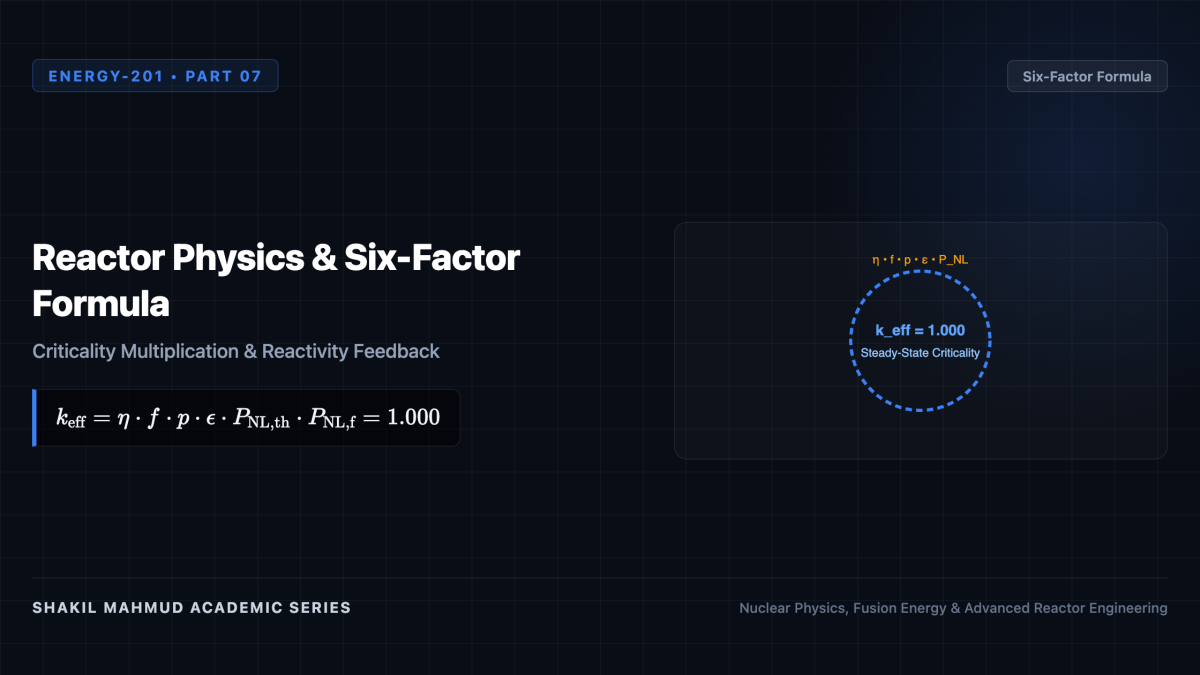
A commercial nuclear power reactor is a delicate thermodynamic balancing act: it must sustain an astronomical rate of (10^{20}) fission reactions per second while maintaining the effective multiplication factor (k_{ ext{eff}}) strictly equal to (1.00000). The mathematical framework that quantifies this neutron lifecycle is the Six-Factor Formula, while intrinsic core safety is safeguarded by negative reactivity feedback coefficients that instantly throttle reactor power during temperature excursions without mechanical intervention.
1. The Four-Factor and Six-Factor Formulas
In an infinite homogeneous or heterogeneous multiplying medium, the infinite multiplication factor (k_infty) is governed by the classic Four-Factor Formula (Fermi):
[
k_infty = ta cdot f cdot p cdot psilon
]
- Thermal Neutron Reproduction Factor ((ta)): The average number of fast fission neutrons produced per thermal neutron absorbed in fuel:
[
ta =
u rac{Sigma_f^F}{Sigma_a^F} =
u rac{sigma_f^{235}}{sigma_a^{235} + rac{N_{238}}{N_{235}}sigma_a^{238}}
]
For natural uranium, (ta approx 1.34); for (3.5%) low-enriched uranium (LEU), (ta approx 1.8 ext{–}2.0). - Thermal Utilization Factor ((f)): The probability that a thermalized neutron is absorbed in fuel rather than in moderator, cladding, or control poisons:
[
f = rac{Sigma_a^F}{Sigma_a^F + Sigma_a^M + Sigma_a^{ ext{clad}} + Sigma_a^{ ext{poison}}}
] - Resonance Escape Probability ((p)): The fraction of fast neutrons that escape radiative capture in the gigantic Breit-Wigner resonant absorption cross-section peaks of ({}^{238} ext{U}) ((E approx 6.6 ext{–}100 ext{ eV})) while slowing down:
[
p approx xpleft( -rac{N_F}{xi Sigma_s} I_{ ext{eff}}
ight)
]
where (I_{ ext{eff}}) is the effective resonance integral. Heterogeneous fuel lumping increases (p) from (0.6) to (0.9) by self-shielding interior ({}^{238} ext{U}) nuclei. - Fast Fission Factor ((psilon)): The ratio of total neutrons produced by all fissions (including fast fission of ({}^{238} ext{U}) above (1 ext{ MeV})) to neutrons produced by thermal fission: (psilon approx 1.03 ext{–}1.08).
In a finite reactor core, neutrons leak through the outer boundary. Multiplying (k_infty) by the fast non-leakage probability (P_{ ext{NL,f}} = e^{-B_g^2 au}) and thermal non-leakage probability (P_{ ext{NL,th}} = rac{1}{1 + L_{ ext{th}}^2 B_g^2}) yields the universal Six-Factor Formula:
[
k_{ ext{eff}} = ta cdot f cdot p cdot psilon cdot left( rac{e^{-B_g^2 au}}{1 + L_{ ext{th}}^2 B_g^2}
ight)
]
2. Reactivity and Inhour Equation
The fractional departure from critical equilibrium is the reactivity (
ho):
[
ho = rac{k_{ ext{eff}} – 1}{k_{ ext{eff}}} = rac{Delta k}{k}
]
Reactivity is measured in units of pcm ((1 ext{ pcm} = 10^{-5})) or in normalized units of Dollars ($), where ($1.00 = beta_{ ext{eff}}) (the effective delayed neutron fraction, (beta approx 0.0065)). If (
ho < $1.00), the reactor is delayed-critical: reactor period (T) is governed by delayed precursor decay ((T sim ext{tens of seconds})), allowing safe mechanical control.
If (
ho ge $1.00) ((
ho ge beta)), the reactor becomes prompt-critical: power increases exponentially with period (T = l / (
ho – beta) sim 10^{-4} ext{ s}), triggering catastrophic thermal disruption within milliseconds.
3. Inherent Passive Safety: Reactivity Feedback Coefficients
In modern commercial reactors, core physics is engineered to provide negative reactivity feedback coefficients across all operating conditions ((alpha = partial
ho / partial X < 0)):
- Fuel Doppler Coefficient ((alpha_T^{ ext{fuel}} = partial
ho / partial T_f < 0)): The fastest and most vital safety barrier. As fuel temperature rises, the thermal agitation of ({}^{238} ext{U}) nuclei broadens the sharp Breit-Wigner capture resonance peaks (Doppler broadening). This increases parasitic neutron capture, instantly dropping (p) and inserting negative reactivity within microseconds. - Moderator Temperature Coefficient ((alpha_T^{ ext{mod}} < 0)): As coolant water heats up, it expands and decreases in density. In an under-moderated core design, fewer water molecules are present to thermalize neutrons, reducing (p) and inserting negative reactivity.
- Void Coefficient of Reactivity ((alpha_V = partial
ho / partial alpha_{ ext{void}} < 0)): If coolant boils to form steam voids, light water reactors lose moderation, immediately shutting down power. (Conversely, the Chernobyl RBMK reactor suffered from a catastrophic positive void coefficient due to its over-moderated graphite lattice, leading to prompt-critical explosion).