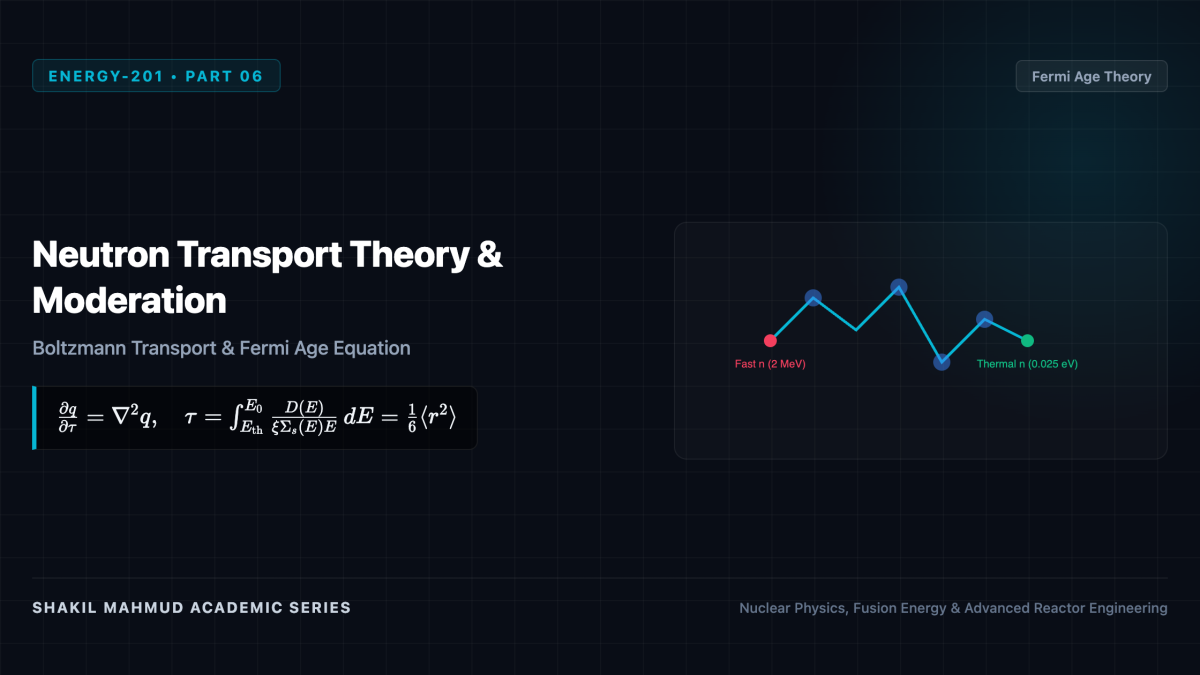
Inside a nuclear reactor core, quadrillions of neutrons propagate through a heterogeneous matrix of fuel pins, cladding, coolant, and structural alloys. Controlling this vast kinetic population requires rigorous mathematical modeling. Governed by the integro-differential Boltzmann Neutron Transport Equation, neutrons born at fast mega-electron-volt energies lose kinetic energy through elastic collisions with moderator nuclei in a process known as moderation, transitioning into thermal equilibrium with the core medium.
1. The Boltzmann Neutron Transport Equation
Let (n(mathbf{r}, E, mathbf{hat{Omega}}, t)) denote the angular neutron density distribution per unit energy (E) moving in direction (mathbf{hat{Omega}}). The angular neutron flux is (psi = v n). Enforcing phase-space conservation yields the exact Boltzmann Transport Equation:
[
rac{1}{v}rac{partial psi}{partial t} + mathbf{hat{Omega}} cdot
abla psi + Sigma_t(mathbf{r}, E) psi = iint Sigma_s(E’ o E, mathbf{hat{Omega}’} o mathbf{hat{Omega}}) psi’ , dE’ dmathbf{hat{Omega}’} + S(mathbf{r}, E, mathbf{hat{Omega}}, t)
]
where (Sigma_t = Sigma_s + Sigma_a) is the macroscopic total cross-section. The four terms describe: temporal accumulation, streaming (spatial leakage), total collision removal, in-scattering from other energies and directions, and external fission source injection.
2. Diffusion Approximation and Fick’s Law
Because the full transport equation is computationally formidable across complex geometries, reactor physicists integrate over all angles (mathbf{hat{Omega}}) to obtain the scalar flux (phi(mathbf{r}, E) = int psi , dmathbf{hat{Omega}}). When scattering dominates over absorption ((Sigma_s gg Sigma_a)) and flux varies slowly over a mean free path, the neutron current vector (mathbf{J}) obeys Fick’s Law of Diffusion:
[
mathbf{J}(mathbf{r}, E) = -D(E)
abla phi(mathbf{r}, E)
]
where (D = rac{1}{3 Sigma_{ ext{tr}}} = rac{1}{3(Sigma_t – bar{mu}_0 Sigma_s)}) is the diffusion coefficient, corrected for anisotropic forward scattering by the average scattering cosine (bar{mu}_0 = rac{2}{3A}). Substituting Fick’s law into the continuity equation yields the steady-state one-group neutron diffusion equation:
[
-D
abla^2 phi(mathbf{r}) + Sigma_a phi(mathbf{r}) = S(mathbf{r})
]
3. Neutron Moderation and The Lethargy Parameter
Fission neutrons are born with an average kinetic energy of (E_0 approx 2 ext{ MeV}). However, the fission cross-section (sigma_f) of ({}^{235} ext{U}) is hundreds of times higher for thermal neutrons ((E_{ ext{th}} approx 0.0253 ext{ eV}), (v approx 2200 ext{ m/s})) than for fast neutrons. Slowing down occurs through elastic collisions with light moderator nuclei (({}^1 ext{H}), ({}^2 ext{H}), ({}^{12} ext{C})).
To linearize the slowing-down logarithmic energy loss, physicists define neutron lethargy (u):
[
u = lnleft(rac{E_0}{E}
ight) implies du = -rac{dE}{E}
]
The average lethargy gain per collision (xi = langle Delta u
angle) is an invariant geometric constant of the moderator nucleus of atomic mass number (A):
[
xi = 1 + rac{(A-1)^2}{2A} lnleft( rac{A-1}{A+1}
ight) approx rac{2}{A + 2/3}
]
For ordinary hydrogen ((A=1), light water), (xi = 1.00); an energetic neutron loses an average of (50%) of its energy per collision, thermalizing in merely (approx 18) collisions. For graphite ((A=12)), (xi approx 0.158), requiring (approx 115) collisions.
4. Fermi Age Theory
In Enrico Fermi’s continuous slowing-down model, the slowing-down density (q(mathbf{r}, au))—representing the rate at which neutrons slow down past energy (E) per unit volume—obeys a parabolic partial differential equation identical to thermal heat conduction:
[
rac{partial q}{partial au} =
abla^2 q
]
where ( au) is the Fermi Age, possessing dimensions of area (( ext{cm}^2)):
[
au(E) = int_E^{E_0} rac{D(E’)}{xi Sigma_s(E’) E’} , dE’
]
The physical meaning of Fermi age is profound: ( au) represents one-sixth of the mean squared Euclidean displacement a fast neutron travels through the moderator from its birth coordinate at (2 ext{ MeV}) to thermalization at (E):
[
au = rac{1}{6} langle r^2
angle
]
In light water, ( au_{ ext{th}} approx 27 ext{ cm}^2) ((r_{ ext{rms}} approx 12.7 ext{ cm})), while in graphite ( au_{ ext{th}} approx 368 ext{ cm}^2) ((r_{ ext{rms}} approx 47 ext{ cm})), dictating the physical spacing of fuel assemblies in commercial reactor core designs.