While the Liquid Drop Model successfully explains collective macroscopic phenomena like binding energies and fission, it fails utterly to account for quantum microscopic anomalies: certain nuclei possessing specific numbers of protons or neutrons exhibit extraordinary stability, anomalously low neutron capture cross-sections, and zero quadrupole moments. In 1949, Maria Goeppert Mayer and J. Hans D. Jensen (1963 Nobel Prize) unlocked this puzzle by establishing the Nuclear Shell Model, demonstrating that nucleons occupy quantized, independent single-particle energy shells governed by strong spin-orbit coupling.
1. The Mean-Field Approximation and Woods-Saxon Potential
In atomic physics, electrons move in a centralized Coulomb potential established by the heavy nucleus at the origin. In nuclear physics, there is no central external body; nucleons interact via pairwise short-range forces. In the Hartree-Fock self-consistent mean-field approach, the sum of pairwise interactions is replaced by an effective single-particle potential well (V(r)).
The realistic nuclear mean field is represented by the Woods-Saxon Potential, reflecting the flat interior density and diffuse surface boundary of the nucleus:
[
V_{ ext{WS}}(r) = -rac{V_0}{1 + xpleft(rac{r – R}{a}
ight)}
]
where (V_0 approx 50 ext{ MeV}) is the well depth, (R approx 1.25 A^{1/3} ext{ fm}) is the half-density nuclear radius, and (a approx 0.5 ext{–}0.65 ext{ fm}) is the surface diffuseness parameter.
Solving the single-particle Schrödinger equation with a Woods-Saxon or 3D isotropic harmonic oscillator potential yields degenerate orbital shells labeled by radial quantum number (n) and orbital angular momentum (l) ((s, p, d, f, g, dots)). However, summing nucleon capacities ((2(2l+1))) across harmonic levels predicts shell closures at:
[
N, Z = 2, 8, 20, 40, 70, 112, 168
]
While the first three match observation, the higher numbers disagree sharply with the experimentally discovered nuclear magic numbers: 2, 8, 20, 28, 50, 82, and 126.
2. Strong Inverted Spin-Orbit Coupling ((V_{so} mathbf{L} cdot mathbf{S}))
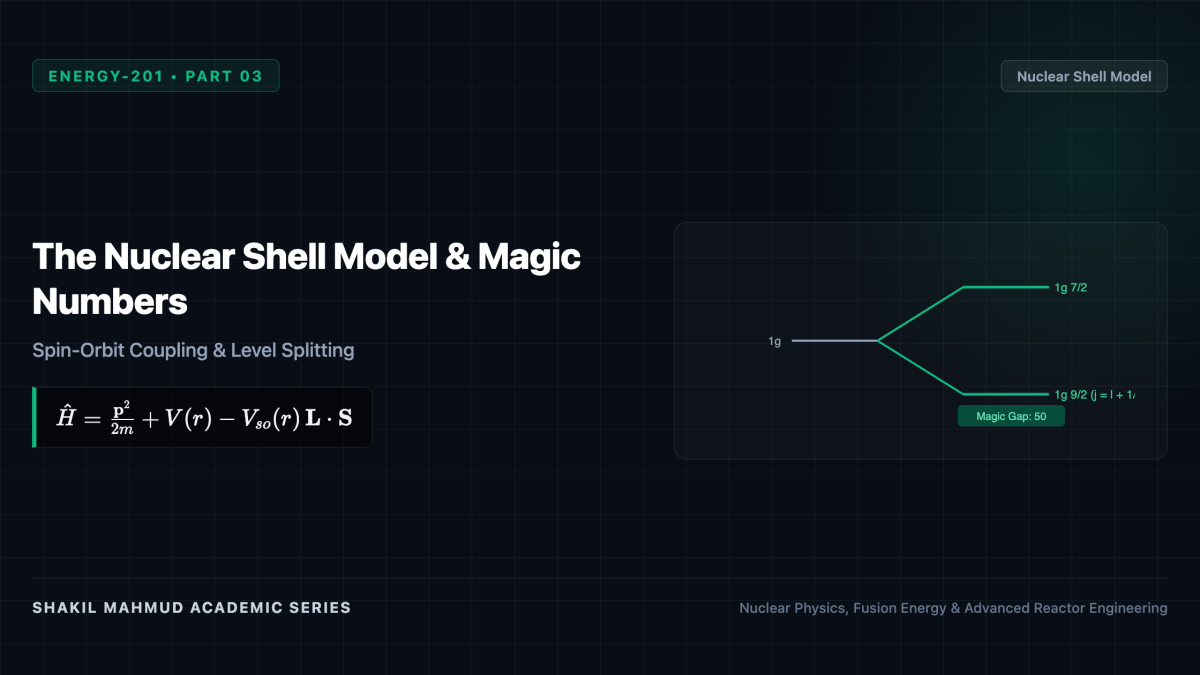
The historic breakthrough came when Mayer and Jensen independently introduced a powerful velocity-dependent spin-orbit interaction into the single-particle Hamiltonian:
[
hat{H} = hat{H}_0 + V_{so}(r) , mathbf{L} cdot mathbf{S}
]
In atomic physics, spin-orbit coupling arises relativistically from the magnetic moment of the moving electron interacting with the nuclear electric field, yielding a tiny energy perturbation. In the nucleus, the spin-orbit force is mediated directly by the strong interaction and is orders of magnitude stronger and inverted in sign ((V_{so} < 0)).
Total nucleon angular momentum is (mathbf{J} = mathbf{L} + mathbf{S}). Squaring yields:
[
mathbf{J}^2 = mathbf{L}^2 + mathbf{S}^2 + 2 mathbf{L} cdot mathbf{S} implies langle mathbf{L} cdot mathbf{S}
angle = rac{hbar^2}{2} left[ j(j+1) – l(l+1) – s(s+1)
ight]
]
Since nucleon spin is (s = 1/2), the total angular momentum quantum number takes two values: (j = l + 1/2) (parallel alignment) and (j = l – 1/2) (anti-parallel alignment). The expectation value evaluates to:
[
langle mathbf{L} cdot mathbf{S}
angle = begin{cases} +rac{l}{2} hbar^2 & ext{for } j = l + 1/2 -rac{l+1}{2} hbar^2 & ext{for } j = l – 1/2 nd{cases}
]
The energy splitting between the sub-levels is directly proportional to orbital angular momentum:
[
Delta E_{ls} = E(j = l – 1/2) – E(j = l + 1/2) = rac{2l + 1}{2} hbar^2 |V_{so}|
]
3. Synthesis of Nuclear Magic Numbers
Because (V_{so}) is negative, the state with parallel alignment ((j = l + 1/2)) is driven significantly downward in energy. For high orbital momentum states ((l ge 3)), this downward energy shift is so massive that the intruder state crosses the major harmonic oscillator shell boundary, plunging into the lower shell:
- The (1f_{7/2}) state ((l=3, j=7/2)) shifts down into the (N=2) shell, opening a large energy gap at 28.
- The (1g_{9/2}) state ((l=4, j=9/2)) shifts down into the (N=3) shell, opening a massive gap at 50.
- The (1h_{11/2}) state shifts down, creating the magic closure at 82.
- The (1i_{13/2}) state plunges, establishing the neutron magic closure at 126.
Doubly magic nuclei—possessing closed shells of both protons and neutrons, such as Helium-4 (({}^4 ext{He}), (Z=2, N=2)), Oxygen-16 (({}^{16} ext{O}), (Z=8, N=8)), Calcium-40 (({}^{40} ext{Ca}), (Z=20, N=20)), Calcium-48 (({}^{48} ext{Ca}), (Z=20, N=28)), and Lead-208 (({}^{208} ext{Pb}), (Z=82, N=126))—represent the most tightly bound, spherical, and stable nuclear architectures in the universe.