More than (80%) of the world’s commercial nuclear electricity is generated by two classic Light Water Reactor (LWR) thermodynamic architectures: the Pressurized Water Reactor (PWR) and the Boiling Water Reactor (BWR). Both exploit enriched uranium dioxide ceramic fuel pellets housed in zirconium-alloy pins cooled by demineralized light water. However, they manage phase change, heat flux, and radioactive isolation through fundamentally divergent thermal-hydraulic paradigms.
1. Thermodynamic Architecture: PWR vs. BWR
The core operating dichotomy between PWR and BWR systems centers on primary loop pressure:
| Parameter | Pressurized Water Reactor (PWR) | Boiling Water Reactor (BWR) |
|---|---|---|
| Operating Pressure | (15.5 ext{ MPa}) ((155 ext{ bar})) | (7.0 ext{–}7.5 ext{ MPa}) ((70 ext{–}75 ext{ bar})) |
| Core Coolant Temperature | Inlet: (290 ^circ ext{C}), Outlet: (325 ^circ ext{C}) | Inlet: (278 ^circ ext{C}), Outlet: (288 ^circ ext{C}) |
| Phase State in Core | Subcooled liquid (zero bulk boiling) | Two-phase saturated boiling ((sim 15%) steam quality) |
| Coolant Circuits | Indirect (Primary loop + Secondary steam loop) | Direct (Single loop from core to turbine) |
| Turbine Radioactivity | Completely non-radioactive (isolated by steam generator) | Mildly radioactive (({}^{16} ext{N}), (gamma)-emitter, (t_{1/2}=7.13 ext{ s})) |
2. Core Heat Transfer and Departure from Nucleate Boiling (DNB)
Nuclear fuel rods operate under colossal volumetric heat generation rates ((q”’ approx 300 ext{–}400 ext{ MW/m}^3)). The heat flux (q”) (( ext{W/m}^2)) passing through the Zircaloy cladding to the fluid follows the Nukiyama boiling curve:
- Single-Phase Convection: At low surface temperatures, heat is transferred via turbulent forced convection described by the Dittus-Boelter correlation:
[
ext{Nu} = 0.023 , ext{Re}^{0.8} , ext{Pr}^{0.4}
] - Subcooled Nucleate Boiling: Microscopic vapor bubbles form at cladding surface nucleation sites, detaching and collapsing in the cooler subcooled liquid bulk. This micro-convection provides exceptional heat transfer coefficients ((h sim 50,000 ext{ W}/( ext{m}^2 cdot ext{K}))).
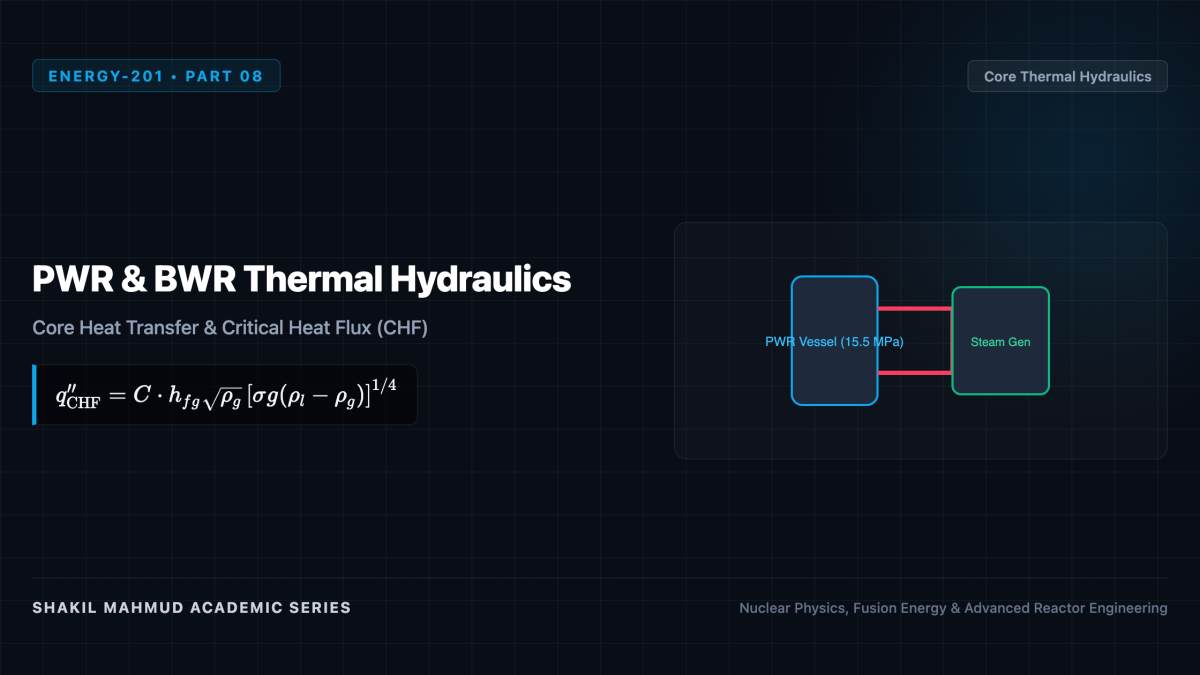
- Critical Heat Flux (CHF) and DNB: If the local heat flux exceeds the Critical Heat Flux ((q”_{ ext{CHF}})), individual vapor bubbles coalesce into an insulating continuous vapor blanket. Because steam thermal conductivity is two orders of magnitude lower than liquid water, cladding surface temperature surges catastrophically by hundreds of degrees within seconds:
[
Delta T = q” / h_{ ext{film}} gg 1000 ^circ ext{C}
]
In a PWR, this phenomenon is called Departure from Nucleate Boiling (DNB); in a BWR, it is called Dryout. The regulatory thermal-hydraulic safety limit is the Departure from Nucleate Boiling Ratio (DNBR):
[
ext{DNBR} = rac{q”_{ ext{CHF}}}{q”_{ ext{actual}}} ge 1.30 ext{–}1.50
]
3. Zircaloy Cladding Kinetics and Loss-of-Coolant Accidents (LOCA)
Fuel pellets are clad in zirconium alloys (Zircaloy-4, ZIRLO, M5) due to zirconium’s minuscule thermal neutron absorption cross-section ((sigma_a approx 0.18 ext{ barns})) and high corrosion resistance. However, if a Loss-of-Coolant Accident (LOCA) occurs and fuel temperature exceeds (1200 ^circ ext{C}) ((1473 ext{ K})), an aggressive autocatalytic, highly exothermic zirconium-water reaction ignites:
[
ext{Zr} + 2 ext{H}_2 ext{O} o ext{ZrO}_2 + 2 ext{H}_2 + 586 ext{ kJ/mol}
]
The reaction releases massive quantities of explosive hydrogen gas and additional chemical heat that accelerates core melting (the primary cause of the Fukushima Daiichi hydrogen explosions). Modern reactors integrate passive autocatalytic hydrogen recombiners (PARs) and are developing Accident-Tolerant Fuels (ATF), utilizing chromium-coated zirconium or silicon carbide (( ext{SiC})) composite cladding to resist oxidation up to (1600 ^circ ext{C}).