In a 500-megawatt fusion reactor like ITER, the core plasma reaches temperatures of (150 ext{ million K}), while the surrounding vacuum vessel walls must survive at room temperature only meters away. Managing this astronomical thermal gradient ((dT/dr sim 10^8 ext{ K/m})) and exhausting helium ash (“alpha waste”) without contaminating the core represents one of fusion engineering’s greatest triumphs: the invention of the Poloidal Divertor and the discovery of the High-Confinement Mode (H-Mode).
1. Magnetic Topology: The Separatrix and The X-Point
Early tokamaks utilized a mechanical “limiter”: a solid refractory tile protruding into the plasma boundary. Sputtering from direct plasma impact contaminated the core with high-(Z) metallic impurities, causing catastrophic radiative cooling. The modern solution is the magnetic divertor:
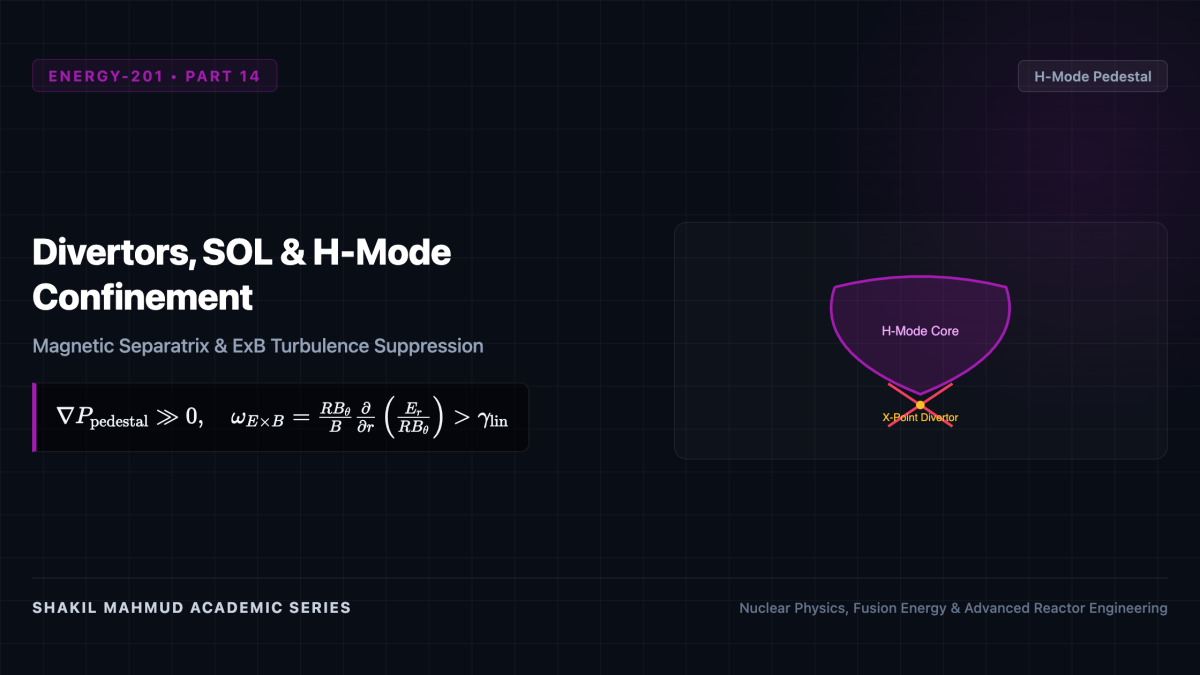
- External divertor magnetic coils run current parallel to the plasma current, creating a null point in the poloidal magnetic field ((B_p = 0)): the X-point.
- The magnetic boundary separating closed, nested core magnetic flux surfaces from open field lines that intersect target plates is the Separatrix (Last Closed Flux Surface, LCFS).
- Outside the separatrix lies the Scrape-Off Layer (SOL): a narrow boundary layer ((approx 1 ext{–}5 ext{ mm}) wide at the midplane) where particles and thermal heat flow rapidly along open field lines into remote, water-cooled tungsten divertor target plates.
2. Scrape-Off Layer (SOL) Heat Exhaust and Detachment
Parallel thermal conduction along open field lines is governed by the classical Spitzer-Härm electron heat conductivity (kappa_parallel propto T_e^{7/2}). The parallel heat flux density flowing into the divertor satisfies the two-point model:
[
q_parallel(s) = -kappa_{0} T_e^{5/2} rac{partial T_e}{partial s} implies T_{ ext{upstream}}^{7/2} – T_{ ext{target}}^{7/2} = rac{7}{2} rac{q_parallel L}{kappa_0}
]
In unmitigated operation, heat flux arriving at divertor target plates exceeds (q_{ ext{peak}} > 20 ext{–}50 ext{ MW/m}^2)—far above the steady-state thermal engineering limit of solid tungsten ((q_{ ext{limit}} approx 10 ext{ MW/m}^2)).
To prevent target vaporization, modern divertors operate in the Detached Regime: nitrogen or neon impurities are injected into the divertor region, accompanied by heavy deuterium gas puffing. Radiative cooling and charge-exchange atomic collisions drop the local plasma temperature below (T_{ ext{target}} < 5 ext{ eV}). At this low temperature, volume electron-ion recombination extinguishes the plasma into a benign, cold neutral gas cushion before it touches the tungsten tiles.
3. The L-H Transition and Edge Transport Barrier (ETB)
In 1982, Fritz Wagner and the ASDEX team discovered a miraculous non-linear bifurcation: when auxiliary heating power exceeds a distinct threshold ((P_{ ext{heat}} > P_{ ext{L-H}})), the plasma abruptly jumps from a low-confinement turbulent state (L-mode) to the High-Confinement Mode (H-Mode), doubling the energy confinement time ( au_E).
The physical mechanism of the L-H transition is shear-flow decorrelation:
- Heating creates a steep radial electric field gradient (
abla E_r) at the separatrix edge via neoclassical ion loss cone kinetics. - The radial electric field drives an inhomogeneous poloidal rotation via the (mathbf{E} imes mathbf{B}) drift velocity:
[
mathbf{v}_{E imes B} = rac{mathbf{E}_r imes mathbf{B}}{B^2}
] - When the sheared rotational flow rate (omega_{E imes B}) exceeds the linear growth rate (gamma_{ ext{lin}}) of turbulent drift-wave micro-instabilities (the Biglari-Diamond-Terry criterion):
[
omega_{E imes B} = left| rac{R B_ heta}{B} rac{partial}{partial r}left( rac{E_r}{R B_ heta}
ight)
ight| > gamma_{ ext{turb}}
]
the turbulent eddies and vortices are violently sheared apart and extinguished.
This suppression establishes an insulating Edge Transport Barrier (ETB): a razor-thin boundary layer across which density and temperature plunge, forming the famous H-mode Pedestal that lifts the entire core plasma to thermonuclear fusion conditions.
4. Edge Localized Modes (ELMs)
The steep pressure gradient ((
abla p)) and high bootstrap current inside the H-mode pedestal drive coupled peeling-ballooning MHD instabilities known as Edge Localized Modes (ELMs). Periodic Type-I ELMs erupt like solar flares every few milliseconds, ejecting energetic plasma bursts that can erode divertor plates. Modern tokamaks suppress ELMs using 3D Resonant Magnetic Perturbation (RMP) coils and pellet pace-making, ensuring steady-state operation.