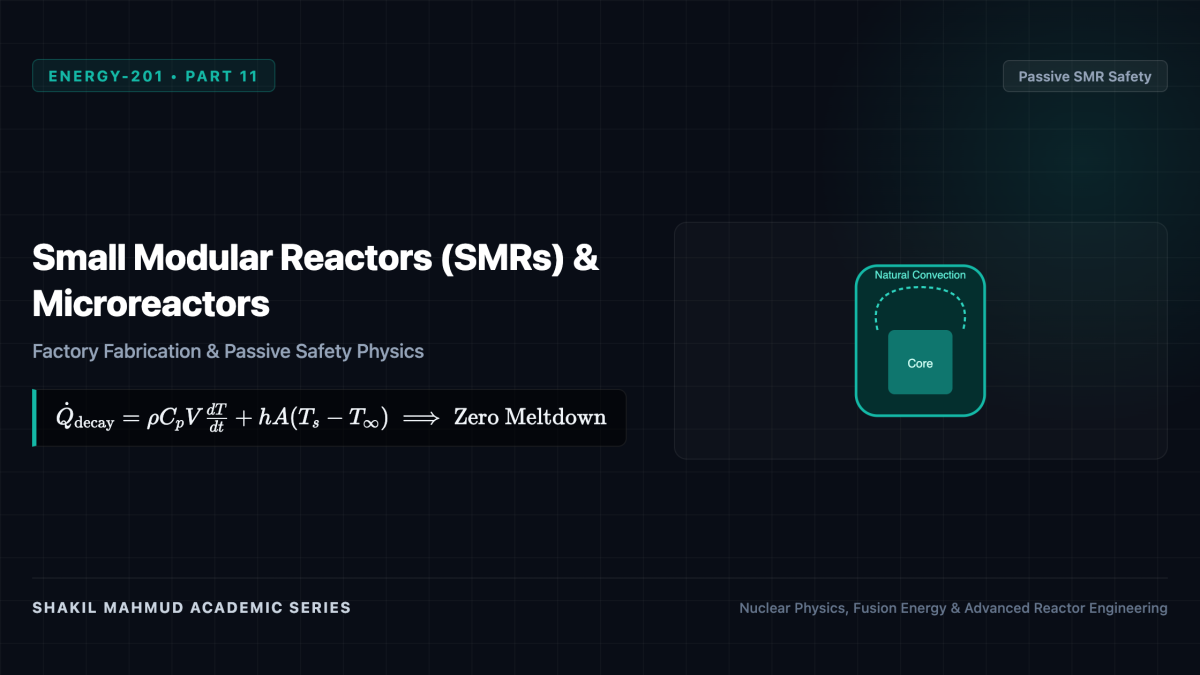
For half a century, the commercial nuclear industry pursued economies of scale, constructing colossal gigawatt-scale power stations ((> 1200 ext{–}1600 ext{ MWe})). However, gigawatt reactors suffer from crippling financial liabilities: multi-billion-dollar upfront capital costs, decade-long on-site construction schedules, and massive balance-of-plant auxiliary safety infrastructures. The 21st-century renaissance is driven by the exact opposite philosophy: Small Modular Reactors (SMRs, (< 300 ext{ MWe})) and Microreactors ((1 ext{–}20 ext{ MWe})), built in factory assembly lines and relying entirely on passive gravitational physics for ultimate safety.
1. The Integral Reactor (iPWR) Architecture
Traditional PWRs connect the reactor pressure vessel (RPV) to separate steam generators, pressurizers, and reactor coolant pumps via massive primary coolant piping loops. If a pipe ruptures, a catastrophic Loss-of-Coolant Accident (LOCA) ensues. Modern SMRs (such as NuScale, Westinghouse SMR, and Rolls-Royce SMR) adopt the integral Pressurized Water Reactor (iPWR) architecture:
- The reactor core, helical-coil steam generators, and pressurizer are housed inside a single compact reactor vessel.
- Primary loop piping is completely eliminated, making large-break LOCAs physically impossible by geometric design.
- The entire vessel is immersed inside a subterranean cooling water pool situated below grade level, shielded against aircraft impact and external natural disasters.
2. Natural Buoyancy Circulation and Walk-Away Passive Safety
In standard gigawatt plants, decay heat removal requires active diesel-powered emergency core cooling pumps. In contrast, SMRs are engineered to operate with zero pumps, utilizing 100% natural buoyancy-driven thermal convection:
[
Delta P_{ ext{buoyancy}} = oint
ho(T) g , dz = g beta Delta T oint
ho_0 , dz
]
Heated water in the core decreases in density and rises buoyant into the upper riser, flows down through the helical steam generators where it transfers heat to secondary steam, becomes dense and cold, and recirculates back down into the lower plenum.
During a total station blackout (Fukushima scenario):
- Control rods drop into the core by gravity within seconds.
- Emergency core cooling valves open passively via fail-safe pneumatic releases.
- Decay heat ((P_{ ext{decay}} approx 0.065 P_0 t^{-0.2})) is conducted through the vessel steel into the subterranean containment pool.
- Natural convection into the pool provides continuous, indefinite cooling. Even with zero operator action, zero AC electrical power, and zero external water addition, the core remains submerged and cannot melt down.</
3. TRISO Fuel and High-Temperature Gas Microreactors
For remote mining outposts, military installations, and localized microgrids, microreactors utilize TRISO (Tristructural-Isotropic) particle fuel:
- A central (approx 500 mu ext{m}) kernel of uranium oxycarbide (UCO).
- Surrounded by a porous carbon buffer layer that absorbs fission gas pressure.
- Encapsulated within an inner dense pyrolytic carbon layer, an impermeable silicon carbide (( ext{SiC})) ceramic barrier layer, and an outer pyrolytic carbon shell.
TRISO particles act as individual microscopic containment vessels, remaining structurally intact and retaining (99.999%) of fission gases up to (1800 ^circ ext{C})—far above any temperature achievable during severe reactor accidents. This enables gas-cooled microreactors (e.g., eVinci, Xe-100) to operate at (750 ^circ ext{C}) with air or helium cooling, transporting fully fueled reactor cores inside standard shipping containers.
4. Economics: Capital Risk vs. Modular Learning Curve
While SMRs sacrifice volumetric economy of scale, they capture massive financial and economic advantages:
- Factory Modular Fabrication: Standardized components are manufactured in controlled factory settings, shipped by rail or barge, and assembled on site in under (24 ext{–}36 ext{ months}) (versus (10 ext{–}15 ext{ years}) for gigawatt plants).
- Learning Rate Scaling: By Wright’s Law, serial mass production of dozens of identical reactor units drives capital expenditure (CAPEX) down along the industrial learning curve:
[
C(N) = C_1 N^{-b} quad ( ext{where } b approx 0.15 ext{–}0.20)
] - Staged Capital Investment: Utilities deploy modules incrementally, financing subsequent reactor additions using operating cash flows from earlier online modules.