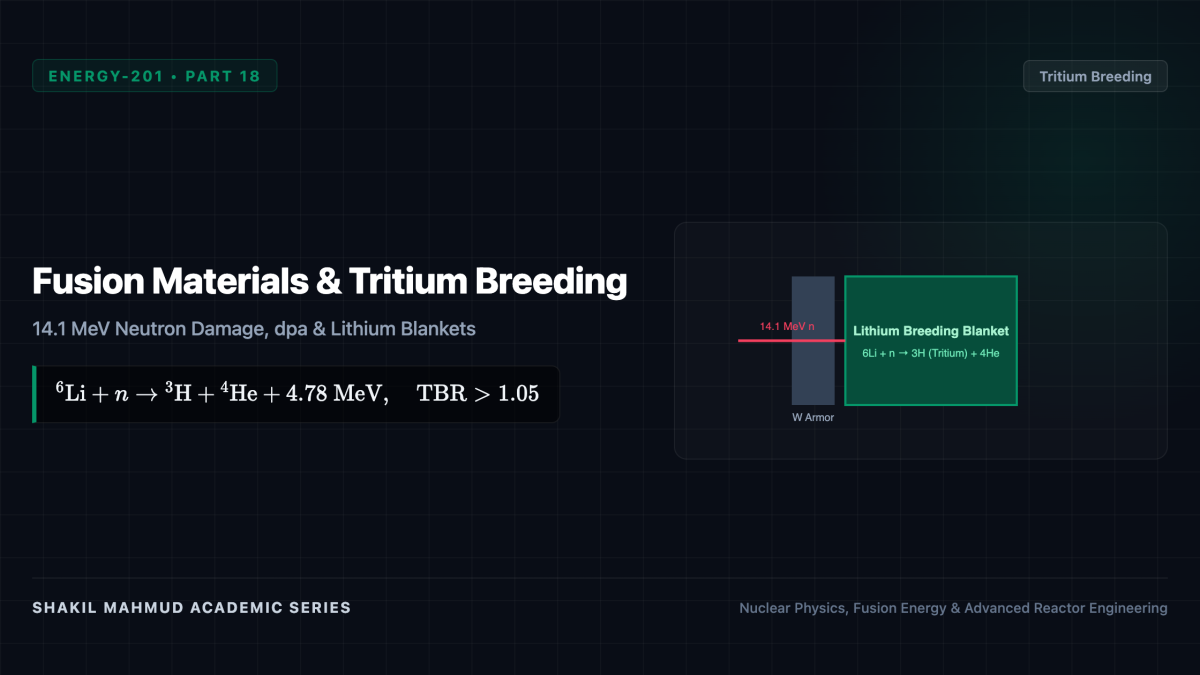
The ultimate bottleneck governing the economic lifespan of commercial fusion power reactors is not plasma stability, but materials science. In a deuterium-tritium reactor, (80%) of the total energy yield is released as uncharged (14.1 ext{ MeV}) fast neutrons. These intense neutral particles penetrate the vacuum vessel walls unimpeded, inducing catastrophic crystal lattice displacement cascades, transmuting structural elements, and generating embrittling helium gas. Overcoming this hostile environment requires engineered low-activation steels, refractory metal armors, and multi-functional tritium breeding blankets.
1. Neutron Irradiation Damage: The dpa Metric
Unlike thermal fission neutrons ((E approx 1 ext{–}2 ext{ MeV})), a (14.1 ext{ MeV}) fusion neutron imparts hundreds of kiloelectron-volts of kinetic energy to primary knock-on atoms (PKA) in the reactor wall. The cumulative damage is quantified in displacements per atom (dpa):
[
ext{dpa} = int Phi(E) , sigma_d(E) , dE cdot t
]
In a commercial fusion reactor operating at a first-wall neutron wall load of (2 ext{ MW/m}^2), structural steels experience (20 ext{–}30 ext{ dpa per year}). Over a multi-year service life ((> 100 ext{ dpa})), every single atom in the crystal lattice is violently knocked out of its lattice site dozens of times.
2. Helium Embrittlement and Void Swelling
High-energy fusion neutrons cross the threshold for ((n, alpha)) nuclear transmutation reactions with nickel, iron, and chromium atoms:
[
{}^{58} ext{Ni} + n o {}^{55} ext{Fe} + alpha , ({}^4 ext{He})
]
- Helium is completely insoluble in metal lattices. Precipitating helium atoms migrate to grain boundaries and dislocation loops, forming nanoscale helium pressurized bubbles.
- Under tensile thermal stress, grain-boundary helium bubbles cause catastrophic intergranular embrittlement, dropping fracture toughness and shifting the ductile-to-brittle transition temperature (DBTT) above operating temperatures.
- Simultaneously, supersaturated vacancies aggregate into voids, causing macroscopic volumetric swelling ((Delta V / V > 5%)), warping precision magnetic components.
3. Advanced Structural Alloys: RAFM and ODS Steels
To ensure reactor structures decay to non-hazardous clearance levels within (100 ext{ years}) (eliminating deep geological repositories), conventional elements with long-lived activation isotopes (Nb, Mo, Ni, Co) are replaced with rapid-decay substitutes (W, V, Ta, Ti):
| Material Class | Key Alloy | Composition | Temperature Window | Displacement Tolerance |
|---|---|---|---|---|
| RAFM Steel | EUROFER97 / F82H | Fe-9Cr-1.1W-0.2V-0.08Ta-0.1C | (350 ext{–}550^circ ext{C}) | (sim 50 ext{–}70 ext{ dpa}) |
| ODS Ferritic | 14Cr-ODS | Fe-14Cr-3W-0.4Ti + (0.3% ext{Y}_2 ext{O}_3) | (350 ext{–}750^circ ext{C}) | (> 100 ext{ dpa}) |
| Tungsten Armor | W-1%La2O3 | Pure / dispersion-strengthened Tungsten | (800 ext{–}1300^circ ext{C}) | High heat flux ((10 ext{–}20 ext{ MW/m}^2)) |
Oxide Dispersion Strengthened (ODS) steels incorporate nanometer-scale yttria (( ext{Y}_2 ext{O}_3)) nanoparticles throughout the ferritic matrix. These high-density interfaces serve as neutral recombination sinks where vacancies and interstitials annihilate, trapping helium in sub-nanometer bubbles and preventing macroscopic swelling.
4. Tritium Self-Sufficiency: Lithium Breeding Blankets
Tritium has a half-life of only (12.3 ext{ years}); natural geological reserves are virtually non-existent, and global commercial CANDU fission reserves total less than (30 ext{ kg}). A (1 ext{ GW}_{ ext{electric}}) fusion plant consumes (approx 56 ext{ kg}) of tritium annually. Therefore, reactors must breed their own tritium via nuclear reactions with lithium blankets surrounding the vacuum vessel:
- Exothermic Thermal Reaction:
[
{}^6 ext{Li} + n_{ ext{thermal}} o {}^3 ext{H} , ( ext{T}) + {}^4 ext{He} + 4.78 ext{ MeV} quad (sigma approx 940 ext{ barns})
] - Endothermic Fast Reaction:
[
{}^7 ext{Li} + n_{ ext{fast}} o {}^3 ext{H} , ( ext{T}) + {}^4 ext{He} + n’ – 2.47 ext{ MeV} quad (E_n > 2.8 ext{ MeV})
]
To compensate for neutron capture in structural walls and ports, neutron multipliers such as beryllium (({}^9 ext{Be}(n, 2n)2alpha)) or lead (( ext{Pb}(n, 2n))) are integrated into the blanket. The fundamental design criterion is the Tritium Breeding Ratio (TBR):
[
ext{TBR} = rac{ ext{Tritium produced in blanket}}{ ext{Tritium consumed in plasma}} ge 1.05 ext{–}1.15
]
A margin of (5 ext{–}15%) above unity is required to cover decay losses during extraction, processing inventories, and initial fuel loading for next-generation reactors.




