Nuclear fusion is the cosmic powerhouse of the universe: the primordial stellar furnace that powers the Sun and synthesizes all heavy elements beyond hydrogen. Bringing this celestial fire to Earth promises boundless, carbon-free energy without meltdown risks or long-lived transuranic nuclear waste. However, terrestrial fusion faces an extreme physical barrier: before two light atomic nuclei can merge, they must conquer the immense electrostatic Coulomb repulsion that keeps positive charges apart.
1. The Coulomb Barrier and Quantum Tunneling
Consider two bare nuclei with atomic numbers (Z_1, Z_2) and masses (m_1, m_2) separated by distance (r). The repulsive electrostatic potential energy is:
[
V_C(r) = rac{Z_1 Z_2 e^2}{4pi psilon_0 r}
]
To fuse, the nuclei must approach within the range of the strong nuclear force, the nuclear contact radius (R approx 1.4 (A_1^{1/3} + A_2^{1/3}) ext{ fm}). For Deuterium (({}^2 ext{H})) and Tritium (({}^3 ext{H})), the height of the Coulomb Barrier is:
[
V_{ ext{max}} = rac{e^2}{4pi psilon_0 R} approx 400 ext{–}500 ext{ keV}
]
Under purely classical physics, nuclei would require thermal temperatures exceeding (T approx 5 imes 10^9 ext{ K}) (5 billion degrees) to surmount this peak. In 1929, Robert Atkinson and Fritz Houtermans realized that quantum tunneling makes fusion possible at far lower temperatures.
In the WKB approximation, the transmission probability (P(E)) for center-of-mass kinetic energy (E) is governed by the Gamow Penetration Factor:
[
P(E) = xpleft( – sqrt{rac{E_G}{E}}
ight) quad ext{where} quad E_G = 2 m_r c^2 (pi alpha Z_1 Z_2)^2
]
where (m_r = rac{m_1 m_2}{m_1 + m_2}) is the reduced mass, (alpha approx 1/137) is the fine-structure constant, and (E_G) is the Gamow energy ((E_G approx 986 ext{ keV}) for D-T).
2. The Gamow Peak: The Thermonuclear Reaction Window
In a thermal plasma at temperature (T), ion kinetic energies follow the classical Maxwell-Boltzmann distribution (f(E) propto E^{1/2} e^{-E/k_B T}). The volumetric reaction rate (langle sigma v
angle) is the convolution of this thermal velocity tail with the quantum tunneling cross-section:
[
langle sigma v
angle = sqrt{rac{8}{pi m_r}} rac{1}{(k_B T)^{3/2}} int_0^infty S(E) xpleft[ -left( rac{E}{k_B T} + sqrt{rac{E_G}{E}}
ight)
ight] , dE
]
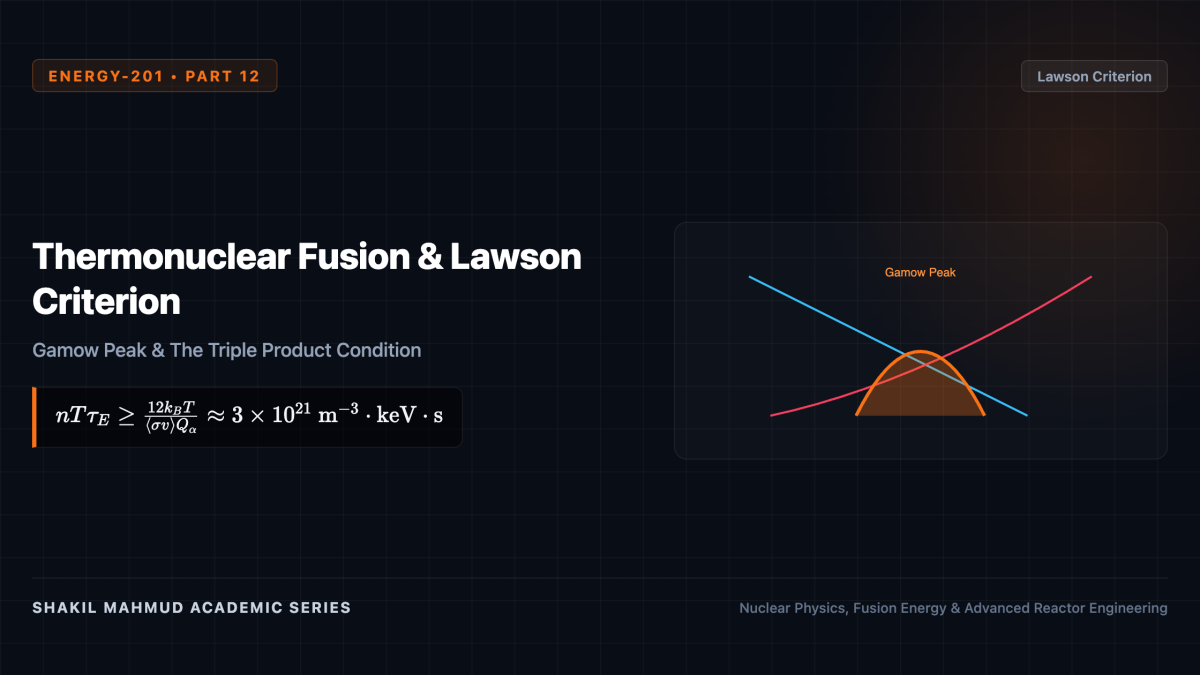
where (S(E)) is the astrophysical S-factor accounting for intrinsic nuclear matrix elements. The integrand represents the product of two violently opposing exponential functions:
- The Maxwell-Boltzmann tail ((e^{-E/k_B T})), which plunges exponentially as (E) rises.
- The Gamow tunneling probability ((e^{-sqrt{E_G/E}})), which surges exponentially as (E) rises.
Differentiating the exponent yields the narrow energy window where fusion actually occurs: the celebrated Gamow Peak ((E_0)):
[
E_0 = left( rac{sqrt{E_G} k_B T}{2}
ight)^{2/3} approx 1.22 left( Z_1^2 Z_2^2 A_r T_{ ext{keV}}^2
ight)^{1/3} ext{ keV}
]
For a D-T plasma at (T = 10 ext{ keV}) ((approx 116 ext{ million K})), the Gamow peak sits at (E_0 approx 66 ext{ keV})—far out in the suprathermal Maxwellian tail. This reduces the required operating temperature from billions down to (sim 100 ext{–}150 ext{ million K}) ((10 ext{–}15 ext{ keV})).
3. Candidate Thermonuclear Reactions
Among light isotopic pairings, four primary fusion reactions dominate research:
- Deuterium-Tritium (D-T):
[
{}^2 ext{H} + {}^3 ext{H} o {}^4 ext{He} (3.5 ext{ MeV}) + n (14.1 ext{ MeV}) quad [Q = 17.6 ext{ MeV}]
]
The lowest Coulomb barrier, highest cross-section ((sigma_{ ext{peak}} approx 5.0 ext{ barns}) at (64 ext{ keV})), and lowest ignition temperature ((T approx 10 ext{–}15 ext{ keV})). - Deuterium-Deuterium (D-D):
[
{}^2 ext{H} + {}^2 ext{H} xrightarrow{50%} {}^3 ext{He} (0.82 ext{ MeV}) + n (2.45 ext{ MeV})
]
[
{}^2 ext{H} + {}^2 ext{H} xrightarrow{50%} {}^3 ext{H} (1.01 ext{ MeV}) + p (3.02 ext{ MeV})
]
Eliminates external tritium reliance, but cross-section is two orders of magnitude lower, requiring (T > 50 ext{ keV}). - Deuterium-Helium-3 (( ext{D-}^3 ext{He})):
[
{}^2 ext{H} + {}^3 ext{He} o {}^4 ext{He} (3.6 ext{ MeV}) + p (14.7 ext{ MeV}) quad [Q = 18.3 ext{ MeV}]
]
Near-aneutronic (charged reaction products), but requires (T > 60 ext{–}100 ext{ keV}) and lunar ({}^3 ext{He}) mining.
4. The Lawson Criterion and Fusion Triple Product
In 1957, British physicist John D. Lawson established the thermodynamic energy balance for self-sustaining fusion. For a plasma to achieve Ignition—where alpha-particle self-heating ((P_alpha)) completely balances all thermal transport losses ((P_{ ext{loss}} = 3 n k_B T / au_E)) and bremsstrahlung radiation ((P_{ ext{brem}})) without external heating—the Lawson Criterion mandates:
[
P_alpha ge P_{ ext{loss}} implies rac{1}{4} n^2 langle sigma v
angle Q_alpha ge rac{3 n k_B T}{ au_E}
]
Rearranging yields the universal Fusion Triple Product:
[
n cdot T cdot au_E ge rac{12 k_B T^2}{langle sigma v
angle Q_alpha}
]
where (n) is plasma density (( ext{m}^{-3})), (T) is ion temperature (( ext{keV})), and ( au_E) is the energy confinement time (( ext{s})). For the D-T reaction, the right-hand side exhibits a minimum near (T approx 15 ext{ keV}), establishing the rigorous threshold for ignition:
[
n T au_E ge 3 imes 10^{21} ext{ m}^{-3} cdot ext{keV} cdot ext{s} quad left( approx 5 imes 10^{21} ext{ m}^{-3} cdot ext{keV} cdot ext{s} ext{ for commercial margin}
ight)
]
This single parameter dictates the two primary pathways to controlled fusion: Magnetic Confinement Fusion (low density (n sim 10^{20} ext{ m}^{-3}), long confinement time ( au_E sim ext{seconds})) and Inertial Confinement Fusion (ultra-high density (n sim 10^{31} ext{ m}^{-3}), nanosecond confinement time ( au_E sim 10^{-10} ext{ s})).