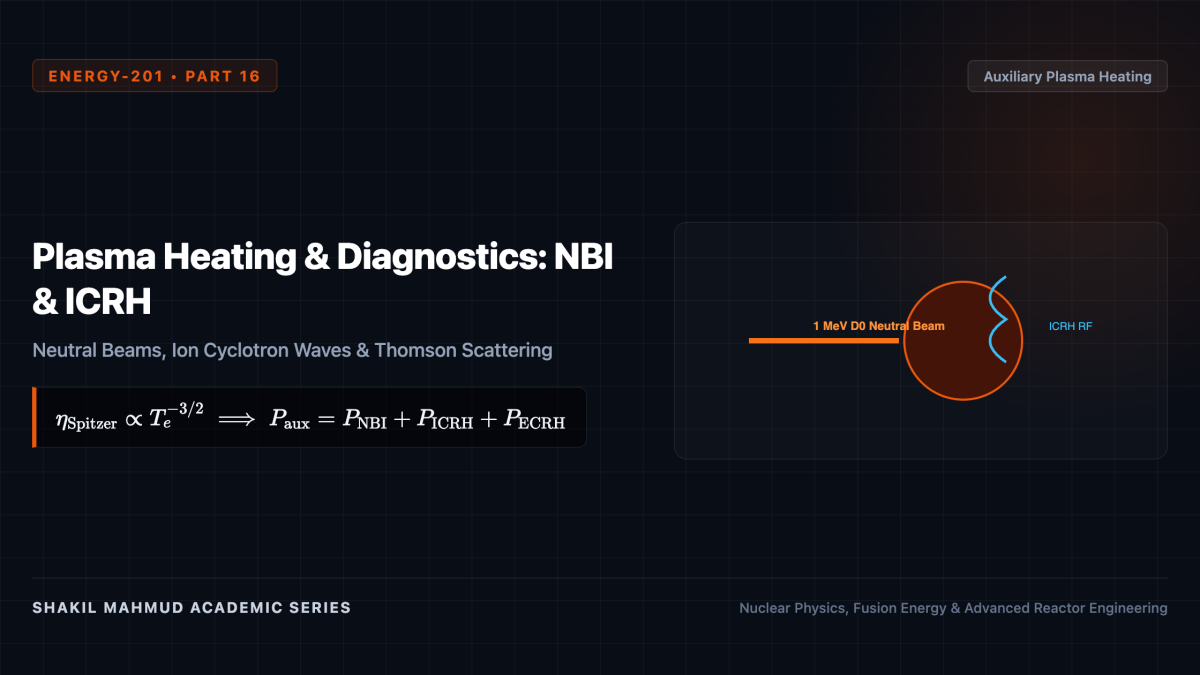
To ignite thermonuclear fusion, a magnetically confined plasma must be heated to temperatures above (15 ext{ keV}) ((> 150 ext{ million K}))—ten times hotter than the core of the Sun. While driving toroidal current provides initial resistive heating, the fundamental laws of plasma physics impose an insurmountable ceiling: as plasma heats up, its electrical resistance drops to near zero, extinguishing ohmic heating. Bringing plasma to ignition requires massive auxiliary heating systems—delivering tens of megawatts of high-energy neutral atom beams and radiofrequency electromagnetic waves—probed in real time by laser diagnostics.
1. The Failure of Ohmic Heating (Spitzer Resistivity)
When a tokamak transformer induces a toroidal plasma current density (mathbf{j}), the ohmic heating power density deposited is:
[
P_{ ext{ohmic}} = ta_{ ext{Spitzer}} j^2
]
According to Lyman Spitzer’s formula, the electrical resistivity of a fully ionized plasma is governed by Coulomb collisions between electrons and ions:
[
ta_{ ext{Spitzer}} = rac{pi e^2 m_e^{1/2} Z_{ ext{eff}} ln Lambda}{(4pi psilon_0)^2 (k_B T_e)^{3/2}} propto T_e^{-3/2}
]
Because Coulomb collision cross-sections plunge with kinetic velocity ((sigma_{ ext{Coulomb}} propto 1/v^4)), resistivity scales inversely with the (3/2) power of electron temperature. At (T_e sim 2 ext{–}3 ext{ keV}) ((sim 30 ext{ million K})), the plasma becomes more electrically conductive than solid copper! Ohmic heating power plummets to near zero, leveling off far below the (15 ext{ keV}) thermonuclear ignition threshold. Megawatts of auxiliary external power are mandatory.
2. Neutral Beam Injection (NBI)
Charged ions cannot penetrate the multi-Tesla magnetic cage of a tokamak; they are reflected immediately by the Lorentz force. Neutral Beam Injection (NBI) circumvents this boundary by injecting energetic uncharged neutral atoms:
- Deuterium gas is ionized into positive (( ext{D}^+)) or negative (( ext{D}^-)) ions inside an arc discharge plasma source.
- Electrostatic accelerator grids accelerate the ions to colossal kinetic energies ((100 ext{ keV}) for positive ions, or (1.0 ext{ MeV}) for negative-ion NBI in ITER).
- The high-energy beam passes through a gas or plasma neutralizer cell, converting back into fast neutral atoms via charge-exchange:
[
ext{D}^+_{ ext{fast}} + ext{D}^0_{ ext{gas}} o ext{D}^0_{ ext{fast}} + ext{D}^+_{ ext{slow}}
] - The energetic neutral beam (( ext{D}^0_{ ext{fast}})) shoots unimpeded across the tokamak magnetic field lines straight into the core plasma.
- Inside the dense core, the neutral atoms are ionized by electron impact and charge exchange (( ext{D}^0 + e^- o ext{D}^+ + 2e^-)). Now trapped on magnetic field lines, the fast ions transfer their kinetic energy to thermal electrons and bulk ions through Coulomb collisions, heating the core to ignition.
3. Radiofrequency (RF) Wave Heating
Auxiliary RF systems beam electromagnetic microwave radiation from high-power gyrotrons and klystrons into the plasma, tuned to match the natural gyro-orbital frequencies of charged particles:
- Ion Cyclotron Resonance Heating (ICRH): Megawatt radio waves at frequencies (omega = Omega_{ci} = rac{q_i B}{m_i} approx 40 ext{–}60 ext{ MHz}) resonate with ion cyclotron gyromotion, pumping energy directly into thermal ions.
- Electron Cyclotron Resonance Heating (ECRH): Millimeter waves at (omega = Omega_{ce} = rac{e B}{m_e} approx 100 ext{–}170 ext{ GHz}) resonate with electron gyration. Because millimeter waves can be focused with optical mirrors to sub-centimeter spots, ECRH can target specific magnetic flux surfaces, suppressing neoclassical tearing modes and stabilizing the plasma.
4. Precision Laser Diagnostics: Thomson Scattering
Measuring the internal temperature and density of a 150-million-degree plasma without physical probes relies on Thomson Scattering:
- A high-power pulsed Nd:YAG laser ((lambda_0 = 1064 ext{ nm})) fires through the plasma core.
- The laser electric field accelerates free electrons, which re-radiate scattered photons.
- Because the electrons move at thermal velocities ((v_{ ext{th}} sim 0.1 ext{–}0.2 c)), the scattered light is heavily Doppler-broadened into a broad Gaussian spectral profile:
[
Delta lambda_D = 2 lambda_0 rac{v_{ ext{th}}}{c} sin( heta/2) propto sqrt{T_e}
] - The spectral width of the scattered light yields the local electron temperature (T_e(mathbf{r})), while the total integrated scattered photon intensity yields local electron density (n_e(mathbf{r})) with nanosecond temporal resolution.




