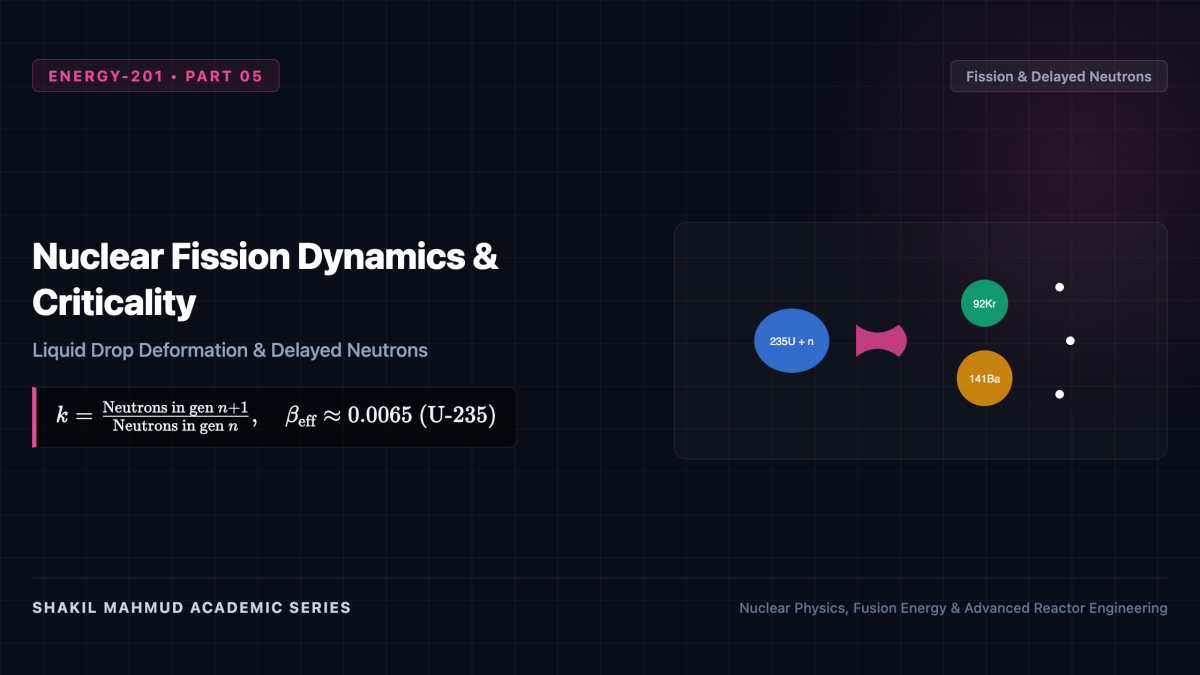
In December 1938, Otto Hahn and Fritz Strassmann irradiated uranium with thermal neutrons and detected the inexplicable chemical presence of barium ((Z=56)). Lise Meitner and Otto Frisch provided the theoretical epiphany: the heavy uranium nucleus had not merely shed nucleons—it had cleaved cleanly in two. Nuclear Fission releases approximately (200 ext{ MeV}) of kinetic and binding energy per split nucleus, transforming mass into energy on a scale millions of times greater than any chemical combustion.
1. The Bohr-Wheeler Mechanism of Nuclear Fission
In 1939, Niels Bohr and John Archibald Wheeler modeled fission by treating the nucleus as an oscillating, charged liquid drop undergoing quadrupole deformation described by Legendre polynomials:
[
R( heta) = R_0 left[ 1 + alpha_2 P_2(cos heta) + dots
ight]
]
Deformation changes both surface energy and Coulomb energy:
[
Delta E_S = +a_S A^{2/3} left( rac{2}{5} alpha_2^2
ight), quad Delta E_C = -a_C rac{Z^2}{A^{1/3}} left( rac{1}{5} alpha_2^2
ight)
]
The net change in deformation energy determines nuclear stability against spontaneous elongation:
[
Delta E_{ ext{def}} = Delta E_S + Delta E_C = rac{1}{5} alpha_2^2 left( 2 a_S A^{2/3} – a_C rac{Z^2}{A^{1/3}}
ight)
]
When the Coulomb repulsion term outweighs surface tension, the nucleus is spontaneously unstable to fission ((Delta E_{ ext{def}} < 0)). This defines the Bohr-Wheeler Fissility Parameter (x):
[
x = rac{E_C^{(0)}}{2 E_S^{(0)}} = rac{a_C Z^2 / A^{1/3}}{2 a_S A^{2/3}} = rac{a_C}{2 a_S} rac{Z^2}{A} approx rac{1}{50} rac{Z^2}{A}
]
When (Z^2/A ge 49 ext{–}50) (the critical limit), the fission barrier vanishes identically; the nucleus undergoes instantaneous spontaneous fission in (10^{-22} ext{ s}). For Uranium-235 ((Z^2/A approx 36)), a finite fission barrier ((E_B approx 5.8 ext{ MeV})) stabilizes the nucleus against immediate decay.
Capturing a zero-energy thermal neutron provides the neutron binding excitation energy (S_n):
- For ({}^{235} ext{U} + n o {}^{236} ext{U}^*): the pairing energy of the even-even compound nucleus yields (S_n = 6.5 ext{ MeV} > E_B). Fission occurs with zero threshold (fissile nuclide).
- For ({}^{238} ext{U} + n o {}^{239} ext{U}^*): forming an even-odd nucleus yields only (S_n = 4.8 ext{ MeV} 1.0 ext{ MeV}) (fertile nuclide).
2. Energetics and Prompt vs. Delayed Neutrons
Each fission event of ({}^{235} ext{U}) releases an average of (Q approx 200 ext{ MeV}), distributed kinematically:
- Kinetic energy of fission fragments: (approx 168 ext{ MeV}) ((84%), deposited as thermal heat within (10 mu ext{m})).
- Prompt fission neutrons ((bar{
u} approx 2.43)): (approx 5 ext{ MeV}) (average birth energy (E approx 2 ext{ MeV})). - Prompt gamma rays: (approx 7 ext{ MeV}).
- Beta decay electrons and antineutrinos from fission fragments: (approx 8 ext{ MeV} + 12 ext{ MeV}).
Crucially, while (99.35%) of neutrons are emitted promptly (( au_{ ext{prompt}} sim 10^{-14} ext{ s})), a vital fraction ((beta approx 0.65%)) are delayed neutrons emitted seconds or minutes later following the beta decay of specific fission precursors (e.g., ({}^{87} ext{Br} xrightarrow{beta^-} {}^{87} ext{Kr}^* xrightarrow{n} {}^{86} ext{Kr}), (t_{1/2} = 55.6 ext{ s})). Without delayed neutrons, mechanical reactor control rods would be hopelessly too slow to prevent runaway prompt-critical excursions.
3. Chain Reactions and Bare Critical Mass
The effective neutron multiplication factor (k) defines the state of a nuclear assembly:
[
k = rac{ ext{Neutron production rate}}{ ext{Neutron absorption rate} + ext{Neutron leakage rate}}
]
Solving the one-group neutron diffusion equation (
abla^2 phi + B_g^2 phi = 0) for an unreflected bare homogeneous sphere of radius (R) yields geometric buckling (B_g^2 = (pi / R)^2). At critical steady state ((k=1)), geometric buckling matches material buckling:
[
B_g^2 = B_m^2 = rac{
u Sigma_f – Sigma_a}{D} implies R_{ ext{crit}} = rac{pi}{sqrt{rac{
u Sigma_f – Sigma_a}{D}}}
]
The bare critical mass (M_{ ext{crit}} = rac{4}{3}pi R_{ ext{crit}}^3
ho) for pure weapon-grade isotopes is (approx 52 ext{ kg}) for highly enriched ({}^{235} ext{U}) ((approx 17 ext{ cm}) diameter sphere) and only (approx 10 ext{ kg}) for ({}^{239} ext{Pu}) ((approx 10 ext{ cm}) sphere), reducible by more than a factor of two using beryllium or natural uranium neutron reflectors.