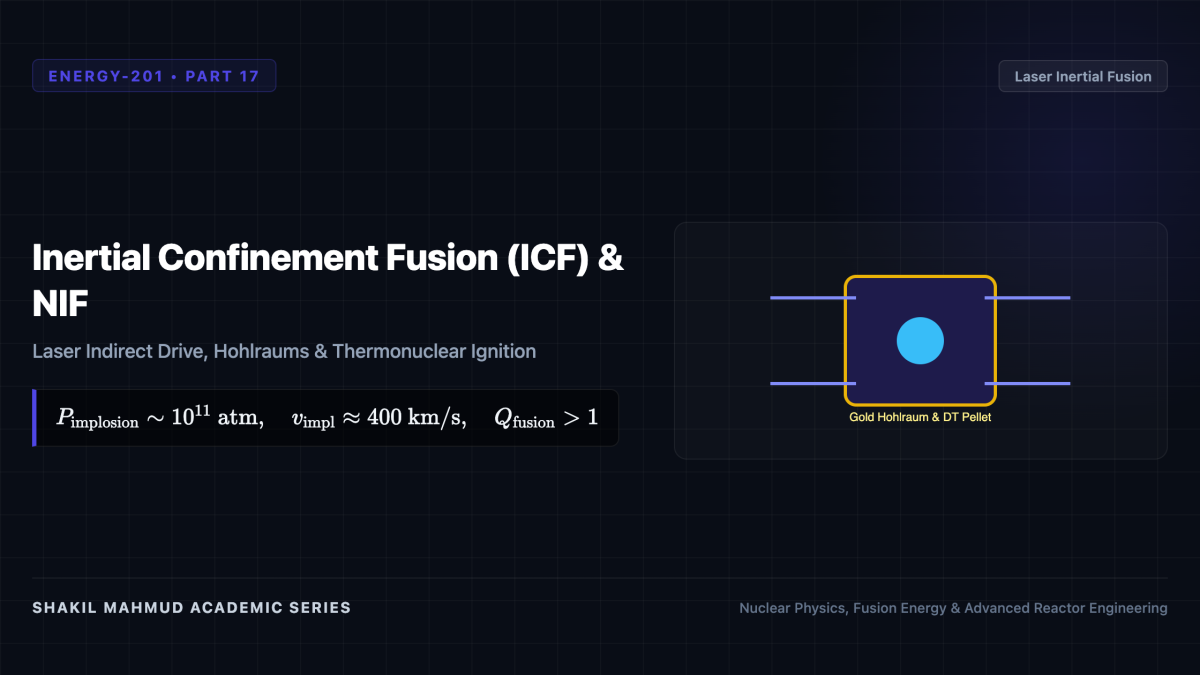
While magnetic confinement fusion isolates low-density plasmas over tens of seconds using massive magnetic cages, Inertial Confinement Fusion (ICF) pursues the opposite extreme of parameter space: compressing a cryogenic deuterium-tritium fuel capsule to densities over (1000 imes) liquid density and pressures exceeding (100 ext{ Gbar}) on a nanosecond timescale. Under these conditions, the inertia of the imploding fuel mass holds the plasma together long enough for self-heating alpha particles to trigger a propagating thermonuclear burn wave.
1. ICF Lawson Criterion and Areal Density
In ICF, the confinement time ( au_c) is determined solely by the hydrodynamic disassembly time of the hot core, governed by the capsule radius (R) and sound speed (c_s = sqrt{gamma k_B T / m_i}):
[
au_c approx rac{R}{4 c_s}
]
The fractional fuel burnup (f_b) depends directly on the product of density (
ho) and radius (R), termed the areal density ((
ho R)):
[
f_b = rac{
ho R}{
ho R + H_B}, quad ext{where } H_B approx rac{8 m_i c_s}{langle sigma v
angle_{DT}} approx 6 ext{–}7 ext{ g/cm}^2
]
To achieve high burnup ((f_b approx 30%)), the compressed fuel must satisfy (
ho R ge 1.0 ext{–}3.0 ext{ g/cm}^2). Because total fuel mass scales as (M propto
ho R^3 = (
ho R)^3 /
ho^2), compressing the fuel to extreme densities ((
ho sim 300 ext{–}1000 ext{ g/cm}^3)) reduces the required laser driver energy from gigajoules down to megajoules.
2. Indirect Drive: Gold Hohlraums and X-Ray Bath
In the indirect drive approach pioneered at Lawrence Livermore National Laboratory’s National Ignition Facility (NIF), 192 ultraviolet laser beams ((lambda = 351 ext{ nm}), delivering (approx 2.05 ext{ MJ})) enter through laser entrance holes into a hollow cylinder of high-Z material (gold or depleted uranium) called a hohlraum.
- Laser photons deposit energy into the inner hohlraum walls, converting laser light into an isotropic thermal soft X-ray radiation bath ((T_{ ext{rad}} approx 300 ext{ eV} approx 3.5 imes 10^6 ext{ K})).
- The X-ray bath uniformly illuminates the outer ablator layer (high-density carbon/diamond) of the spherical fuel capsule.
- Rapid ablation of the outer shell creates an outward rocket-like blow-off, propelling the remaining cryogenic DT shell inward at implosion velocities exceeding (v_{ ext{impl}} approx 380 ext{–}420 ext{ km/s}).
3. Hydrodynamic Instabilities and Shock Timing
Achieving a symmetrical spherical implosion convergence ratio (C_r = R_0 / R_f > 30) is fiercely challenging due to fluid instabilities:
- Rayleigh-Taylor Instability (RTI): Occurs at the ablation front during acceleration (dense shell pushed by low-density ablating plasma) and at the hot-spot boundary during deceleration (low-density hot spot halting dense shell). Perturbations grow as (gamma = sqrt{k a / (1 + k L_n)} – beta k v_{ ext{abl}}).
- Richtmyer-Meshkov Instability (RMI): Triggered when laser shock waves traverse perturbed density interfaces, causing vorticity generation and turbulent mixing.
- Mix Degradation: Ablator material (carbon) mixed into the DT core enhances bremsstrahlung radiation losses ((P_{ ext{brem}} propto Z_{ ext{eff}}^2)), quenching the hotspot if mix exceeds (0.1%).
To minimize entropy generation (keeping the fuel on a low adiabat (alpha = P / P_{ ext{Fermi}} approx 1.5)), the laser pulse is carefully shaped into 3 to 4 distinct shock fronts that coalesce simultaneously inside the central DT gas void, igniting a central hotspot of (sim 5 ext{–}10 ext{ keV}) while leaving the dense surrounding fuel cold and degenerate.
4. The Breakthrough: Thermonuclear Ignition and Energy Gain
On December 5, 2022, and confirmed in subsequent experiments at NIF, humanity achieved scientific fusion ignition. By delivering (2.05 ext{ MJ}) of laser energy to the target, the collapsing capsule generated (3.15 ext{ MJ}) of fusion yield ((Q_{ ext{target}} approx 1.54)), with later shots exceeding (3.88 ext{ MJ}).
The transition from alpha heating to self-propagating burn requires the alpha heating power (P_alpha) to exceed all thermal losses (bremsstrahlung (P_B) and electronic heat conduction (P_e)):
[
rac{d T_0}{dt} = rac{1}{3 n k_B} left( P_alpha – P_{ ext{loss}}
ight) > 0
]
When the areal density of the hot spot (
ho_{ ext{hs}} R_{ ext{hs}} ge 0.3 ext{ g/cm}^2) at (T_0 ge 5 ext{ keV}), (3.5 ext{ MeV}) alpha particles stop entirely within the hot core, triggering runaway bootstrap heating that consumes the outer cryogenic fuel layer in picoseconds.
From Scientific Ignition to Inertial Fusion Energy (IFE)
While NIF proved scientific feasibility, commercial IFE power plants demand: (1) high-repetition rate drivers ((10 ext{ Hz}) vs NIF’s 1 shot per day); (2) high “wall-plug” driver efficiency ((ta_{ ext{driver}} > 10%) using diode-pumped solid-state lasers or heavy-ion beams); and (3) automated, low-cost target fabrication producing millions of precision diamond capsules for pennies apiece.




