At the temperatures required for thermonuclear fusion ((T > 10 ext{–}15 ext{ keV}), exceeding (150 ext{ million K})), matter cannot exist as neutral atoms; it is fully ionized into a turbulent, electrically conducting plasma. No physical container can touch this inferno without vaporizing instantly. The solution pioneered by Soviet physicists Igor Tamm and Andrei Sakharov is the Tokamak (an acronym for toroidal chamber with magnetic coils): an electromagnetic bottle that confines high-temperature plasma within a closed, doughnut-shaped magnetic torus governed by ideal Magnetohydrodynamics (MHD).
1. The Ideal MHD Equilibrium and The Grad-Shafranov Equation
In ideal magnetohydrodynamics, an isotropic conducting plasma in static equilibrium experiences a perfect balance between thermal gas pressure gradients and magnetic Lorentz forces:
[
mathbf{J} imes mathbf{B} =
abla p quad ext{and} quad
abla imes mathbf{B} = mu_0 mathbf{J}, quad
abla cdot mathbf{B} = 0
]
Because (mathbf{B} cdot
abla p = 0) and (mathbf{J} cdot
abla p = 0), magnetic field lines and current paths lie entirely on nested two-dimensional toroidal isobaric surfaces known as magnetic flux surfaces.
In an axisymmetric torus described by cylindrical coordinates ((R, phi, Z)), the magnetic field is decomposed into poloidal ((mathbf{B}_p)) and toroidal ((B_phi)) components via the poloidal magnetic flux function (psi(R, Z)):
[
mathbf{B} = rac{1}{R}
abla psi imes mathbf{hat{phi}} + rac{I(psi)}{R} mathbf{hat{phi}}
]
Substituting this representation into the MHD force balance yields the two-dimensional non-linear elliptic partial differential equation of tokamak equilibrium: the Grad-Shafranov Equation:
[
Delta^* psi = R rac{partial}{partial R}left( rac{1}{R} rac{partial psi}{partial R}
ight) + rac{partial^2 psi}{partial Z^2} = -mu_0 R^2 rac{dp(psi)}{dpsi} – I(psi) rac{dI(psi)}{dpsi}
]
The solution dictates the shape of the nested magnetic flux contours, balancing internal hoop stress and the tire-tube outward expansion force (the Shafranov shift) through external vertical magnetic field coils.
2. Helical Field Lines and The Safety Factor (q)
A purely toroidal magnetic field ((B_phi)) cannot confine a plasma: the (1/R) field gradient and field line curvature cause magnetic gradient and curvature drifts:
[
mathbf{v}_{
abla B + kappa} = rac{m v_parallel^2 + rac{1}{2}m v_perp^2}{q B^3} (mathbf{B} imes
abla B)
]
Because ions drift upward and electrons drift downward, vertical charge separation generates a massive vertical electric field (mathbf{E}). The resulting outward (mathbf{E} imes mathbf{B}) drift ejects the entire plasma into the outer chamber wall in microseconds.
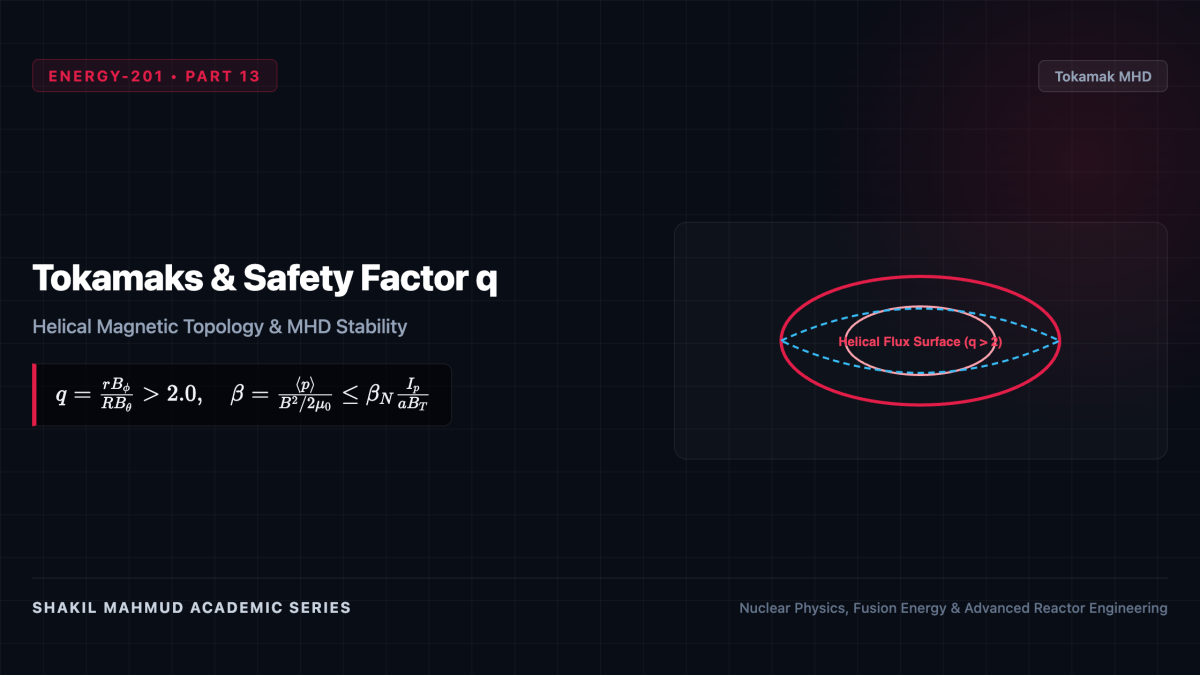
To eliminate charge separation, a tokamak drives an intense toroidal plasma current ((I_p sim ext{several Mega-Amperes})) via transformer action. The current creates a poloidal magnetic field ((B_ heta)). The vector sum of (B_phi) and (B_ heta) produces helical magnetic field lines that wind around the torus, connecting top and bottom regions to short-circuit the charge buildup.
The pitch of this helical winding is parameterized by the dimensionless Safety Factor (q):
[
q(r) = rac{1}{2pi} oint rac{B_phi}{R B_ heta} , ds approx rac{r B_phi}{R_0 B_ heta}
]
The safety factor represents the number of toroidal turns a field line executes before completing a single poloidal turn. To suppress catastrophic external kink magnetohydrodynamic instabilities, the edge safety factor must strictly satisfy the Kruskal-Shafranov Limit:
[
q(a) > 2.0 quad ( ext{typically maintained at } q_{95} ge 3.0 ext{ in commercial designs})
]
3. Empirical Tokamak Operating Boundaries
A commercial tokamak operates inside a narrow stability corridor bounded by three physical limits:
- Troyon Beta Limit ((beta_N)): Plasma beta is the ratio of thermal plasma pressure to magnetic field pressure:
[
beta = rac{langle p
angle}{B^2 / 2mu_0} le beta_N rac{I_p ( ext{MA})}{a ( ext{m}) B_T ( ext{T})}
]
When (beta) exceeds the normalized Troyon limit ((beta_N approx 2.8 ext{–}3.5)), pressure-driven ballooning and neoclassical tearing modes (NTMs) rupture magnetic confinement. - Greenwald Density Limit ((n_G)): The maximum line-averaged electron density achievable before cold radiative collapse triggers a major disruption is strictly proportional to plasma current density:
[
n_e le n_G = rac{I_p}{pi a^2} imes 10^{20} ext{ m}^{-3}
] - Kruskal-Shafranov Current Limit: Attempting to drive too much plasma current drives (q(a) < 2), triggering catastrophic global kink disruptions that release gigajoules of thermal and magnetic energy onto vessel walls in milliseconds.