One of the most consequential socio-technical challenges of the nuclear era is the back-end of the nuclear fuel cycle. Discharged spent nuclear fuel contains over (95%) unused uranium and plutonium, alongside highly radioactive fission products and long-lived minor actinides (americium, curium, neptunium). Managing this radiotoxic legacy requires an integrated triad: chemical reprocessing (PUREX) to recycle unburned fissile isotopes, nuclear transmutation to incinerate long-lived transuranics into short-lived isotopes, and deep geological repositories providing permanent passive isolation.
1. Spent Fuel Composition and Radiotoxicity
Upon discharge from a standard light-water reactor after (approx 45 ext{–}50 ext{ GWd/tHM}) burnup, a metric ton of spent nuclear fuel consists of:
- Unburned Uranium ((approx 93.5%)): Enriched to (approx 0.8 ext{–}1.0% {}^{235} ext{U}) (higher than natural uranium).
- Fissile & Fertile Plutonium ((approx 1.2%)): ({}^{239} ext{Pu}, {}^{240} ext{Pu}, {}^{241} ext{Pu}, {}^{242} ext{Pu}).
- Short-to-Medium Lived Fission Products ((approx 5.0%)): Dominated by ({}^{137} ext{Cs}) ((t_{1/2} = 30.1 ext{ yr})) and ({}^{90} ext{Sr}) ((t_{1/2} = 28.8 ext{ yr})), dictating heat generation for the first (300 ext{ years}).
- Minor Actinides ((approx 0.15%)): ({}^{237} ext{Np}) ((t_{1/2} = 2.14 imes 10^6 ext{ yr})), ({}^{241} ext{Am}) ((t_{1/2} = 432 ext{ yr})), ({}^{243} ext{Am}) ((t_{1/2} = 7370 ext{ yr})), and ({}^{244} ext{Cm}) ((t_{1/2} = 18.1 ext{ yr})).
Without reprocessing, minor actinides dictate that spent fuel radiotoxicity remains above natural uranium ore levels for over (300,000 ext{ years}). Partitioning and transmuting actinides collapses this isolation window from millennia down to merely (300 ext{ years}).
2. Chemical Reprocessing: The PUREX Process
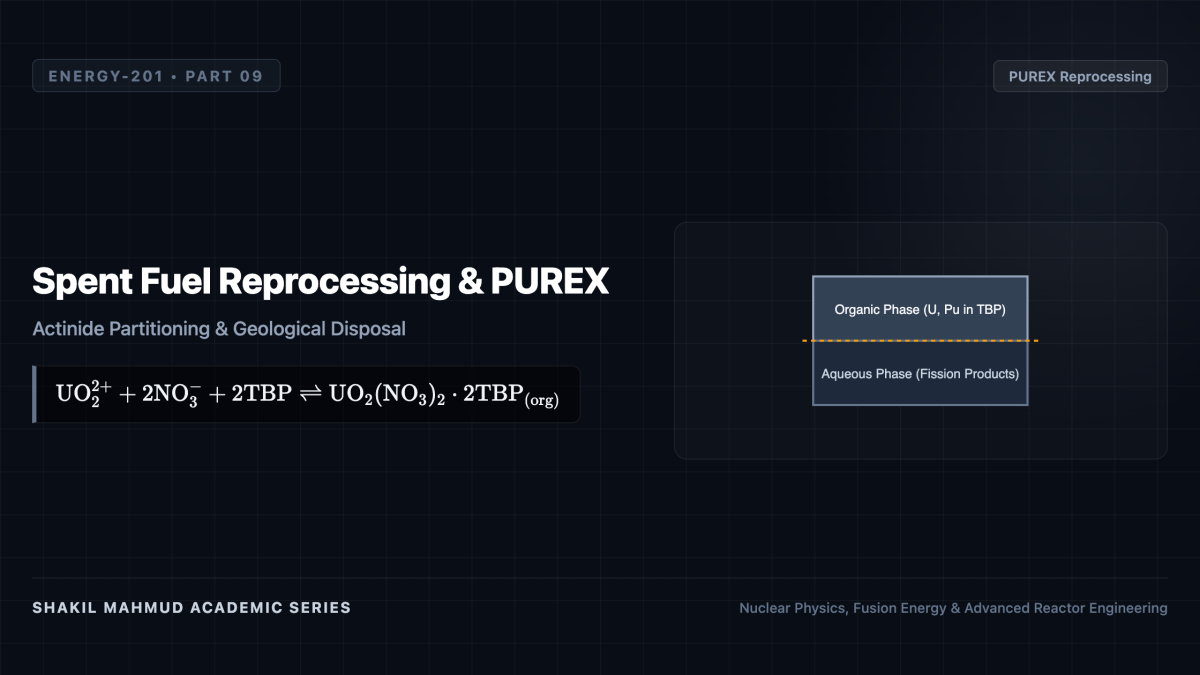
In the industrialized PUREX (Plutonium Uranium Redox Extraction) liquid-liquid extraction process, sheared spent fuel pins are dissolved in boiling nitric acid (( ext{HNO}_3)). The resulting aqueous feed is contacted with an organic solvent composed of (30%) tributyl phosphate (TBP) dissolved in an odorless kerosene diluent (n-dodecane).
Extraction exploits coordination complexation chemistry:
- Hexavalent uranium (( ext{UO}_2^{2+})) and tetravalent plutonium (( ext{Pu}^{4+})) form neutral, lipophilic solvate complexes that selectively extract into the organic phase:
[
ext{UO}_2^{2+}_{( ext{aq})} + 2 ext{NO}_3^- + 2 ext{TBP}_{( ext{org})}
ightleftharpoons ext{UO}_2( ext{NO}_3)_2 cdot 2 ext{TBP}_{( ext{org})}
]
[
ext{Pu}^{4+}_{( ext{aq})} + 4 ext{NO}_3^- + 2 ext{TBP}_{( ext{org})}
ightleftharpoons ext{Pu}( ext{NO}_3)_4 cdot 2 ext{TBP}_{( ext{org})}
] - Trivalent fission products (( ext{Cs}^+, ext{Sr}^{2+}, ext{rare earths})) and minor actinides (( ext{Am}^{3+}, ext{Cm}^{3+})) possess negligible affinity for TBP and remain in the acidic aqueous raffinate.
- To separate plutonium from uranium, a mild reducing agent (e.g., ferrous sulfamate or uranous nitrate ( ext{U}^{4+})) reduces plutonium to the trivalent state (( ext{Pu}^{4+} + e^- o ext{Pu}^{3+})). Because ( ext{Pu}^{3+}) is strictly insoluble in TBP, it strips back cleanly into aqueous solution, leaving pure uranium in the organic phase.
The recovered plutonium and uranium are fabricated into Mixed Oxide (MOX) fuel ((sim 8% ext{PuO}_2 + 92% ext{UO}_2)), closing the fuel cycle and generating (25%) more electricity from the original uranium resource.
3. Nuclear Transmutation in Fast Spectra and ADS
To eliminate long-lived minor actinides, atoms are subjected to high neutron fluxes. In thermal reactors, capture cross-sections exceed fission cross-sections ((sigma_c gg sigma_f)), transmuting minor actinides into even heavier, more radiotoxic isotopes (e.g., ({}^{241} ext{Am} + n o {}^{242m} ext{Am} o {}^{242} ext{Cm})).
In an unmoderated Fast Neutron Spectrum ((E > 100 ext{ keV}))—available in Fast Breeder Reactors (FBR) or subcritical Accelerator-Driven Systems (ADS)—the fission-to-capture ratio (sigma_f / sigma_c) increases by an order of magnitude. Under fast neutron bombardment, transuranics are split cleanly into non-radioactive or short-lived stable isotopes via fast neutron-induced fission, converting high-level waste into clean carbon-free electricity.
4. Multi-Barrier Deep Geological Repositories (DGR)
For residual high-level waste (vitrified into borosilicate glass blocks), the international consensus mandates Deep Geological Disposal ((400 ext{–}1000 ext{ m}) deep in stable crystalline granite, clay, or bedded salt formations, as realized in Finland’s Onkalo repository). The KBS-3 multi-barrier concept employs passive defense-in-depth:
- Insoluble borosilicate glass or sintered ceramic waste matrix.
- Corrosion-resistant copper canisters with nodular cast iron pressure inserts.
- Compacted bentonite clay buffer that swells upon water contact, filtering colloids and sealing fissures.
- Stable host rock under reducing, stagnant hydrogeological conditions, isolating radionuclides for over a million years.