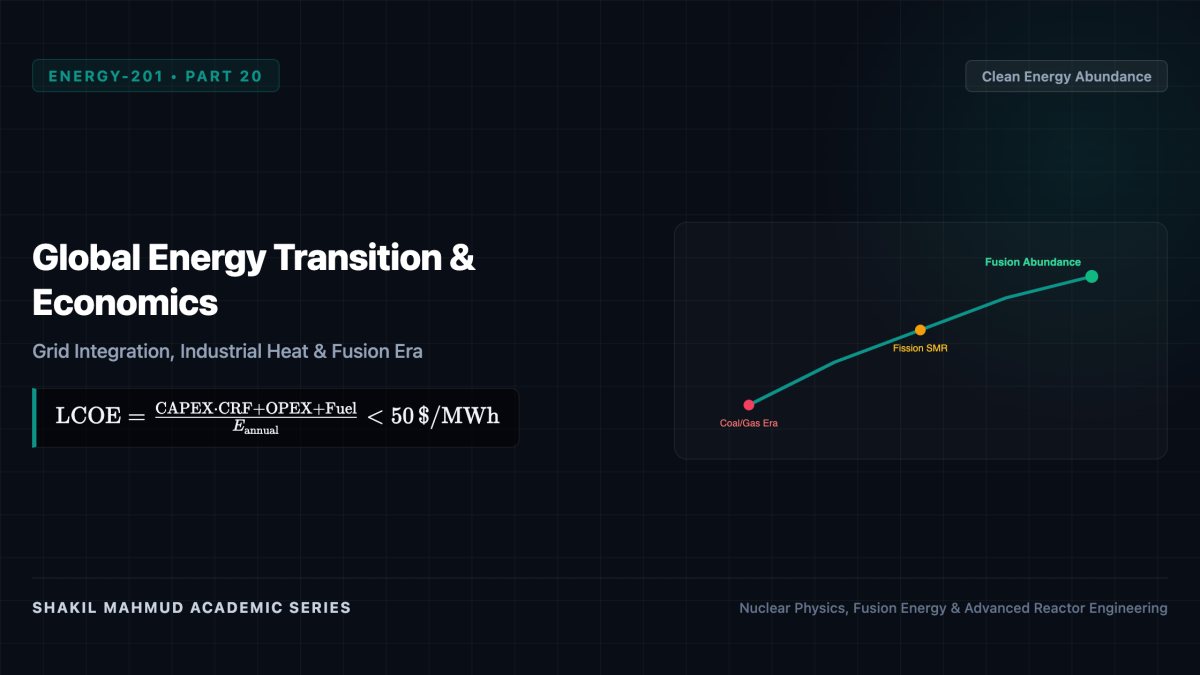
The ultimate metric determining whether advanced nuclear fission and thermonuclear fusion transform the 21st-century energy landscape is not merely scientific feasibility, but techno-economics. Decarbonizing heavy industry, chemical synthesis, desalination, and gigawatt-scale artificial intelligence datacenters demands baseload, dispatchable, zero-carbon energy at a Levelized Cost of Electricity (LCOE) below ($50/ ext{MWh}). As Generation IV Small Modular Reactors (SMRs) enter commercial service and private fusion ventures break records, nuclear physics stands poised to anchor the global clean energy transition.
1. The Levelized Cost of Electricity (LCOE) Equation
The economic competitiveness of advanced nuclear and fusion facilities is modeled through the discounted cash-flow formulation of LCOE:
[
ext{LCOE} = rac{sum_{t=0}^N rac{ ext{CAPEX}_t + ext{OPEX}_t + ext{Fuel}_t + ext{Decom}_t}{(1 + r)^t}}{sum_{t=0}^N rac{E_{ ext{annual}, t}}{(1 + r)^t}}
]
Where:
- CAPEX (Overnight Capital Expenditure): Constitutes (60 ext{–}75%) of total lifetime cost for nuclear assets. Traditional Gen III+ gigawatt plants suffer from exorbitant capital costs (($6,000 ext{–}$10,000/ ext{kWe})). SMRs and compact fusion machines aim for ($2,500 ext{–}$4,000/ ext{kWe}) through factory fabrication and rapid modular assembly.
- Capacity Factor ((CF)): Nuclear fission achieves unmatched reliability with capacity factors exceeding (92%), compared to (25%) for solar PV and (35%) for onshore wind.
- Discount Rate ((r)): High financing costs severely penalize high-CAPEX infrastructure; lowering perceived financial risk via standardized licensing reduces LCOE by over (30%).
2. SMR Modular Economics vs Fusion Power Density
The technological synergy between advanced fission and commercial fusion revolves around power density and modularity:
| Technology | Core Concept | Coolant / Driver | Footprint (( ext{m}^2/ ext{MWe})) | Target LCOE (($/ ext{MWh})) |
|---|---|---|---|---|
| Small Modular Fission (SMR) | Factory-built LWR / HTGR | Water / Helium / Salt | (100 ext{–}200) | ($60 ext{–}$80) |
| Fast Spectrum Breeder | Actinide Incineration | Liquid Sodium / Lead | (150 ext{–}300) | ($70 ext{–}$90) |
| High-Field Tokamak / Stellarator | Compact REBCO Magnets | Helium / Water / Molten Flibe | (200 ext{–}400) | ($40 ext{–}$60) |
| Aneutronic FRC / Laser | Direct Electrostatic Conversion | Charged Particles (No Steam) | (50 ext{–}100) | ($30 ext{–}$45) |
3. High-Temperature Superconductors (REBCO) Revolution
The decisive breakthrough enabling compact, economically viable fusion is Rare-Earth Barium Copper Oxide (REBCO) High-Temperature Superconductors (HTS). Operating at (20 ext{ K}) instead of liquid helium temperatures ((4.2 ext{ K})), REBCO tapes generate on-axis magnetic fields exceeding (B_0 approx 20 ext{ Tesla}).
Because magnetic confinement fusion power density scales as the fourth power of magnetic field:
[
P_{ ext{fusion}} propto beta^2 B^4 V
]
Doubling the magnetic field from (5 ext{ T}) to (10 ext{ T}) yields a (16 imes) increase in fusion power density. This scaling allows reactors to shrink by a factor of 40 in volume compared to ITER, slashing capital expenditure and construction timelines from decades to years.
4. Beyond the Grid: Hydrogen, Synthetic Fuels & Desalination
Future nuclear energy systems will operate as multi-output industrial hubs rather than purely electrical generators:
- High-Temperature Steam Electrolysis (HTSE): High-temperature reactors (VHTR) supplying heat at (800 ext{–}900^circ ext{C}) achieve over (50%) electrical-to-hydrogen efficiency, producing clean green hydrogen for (approx $1.50/ ext{kg}).
- Direct Air Capture and Synthetic Hydrocarbons: Pairing high-temperature heat with captured atmospheric ( ext{CO}_2) produces carbon-neutral aviation fuels and commodity chemicals.
- Grid Peaking and Heat Storage: Molten salt energy storage buffers reactor output, enabling nuclear plants to flexibly ramp up electrical generation during renewable intermittency dips.
5. Conclusion: The Century of Fusion and Nuclear Abundance
From Rutherford’s discovery of the atomic nucleus and Fermi’s Chicago Pile-1 to the ignition of thermonuclear burn at NIF and magnetic confinement in HTS tokamaks, humanity has mastered the fundamental forces binding matter together. Advanced nuclear energy offers the only scalable, high-density, carbon-free foundation capable of lifting billions out of energy poverty while preserving the planetary biosphere.




