While contemporary Gen-III+ light water reactors offer exceptional operational safety, they utilize less than (1%) of the potential energy stored in natural uranium mined from the Earth. The Generation-IV International Forum (GIF) defined six revolutionary nuclear reactor concepts designed to operate at ultra-high temperatures ((550 ext{–}1000 ^circ ext{C})), deliver thermal efficiencies exceeding (45 ext{–}50%), breed their own fuel from fertile isotopes, and achieve walk-away passive safety. Foremost among these are Sodium-Cooled Fast Reactors (SFR) and Molten Salt Reactors (MSR).
1. Sodium-Cooled Fast Reactors (SFR) and Nuclear Breeding
Standard light water reactors require a moderator because thermal neutrons maximize the fission cross-section of ({}^{235} ext{U}). However, in an unmoderated fast neutron spectrum ((E > 100 ext{ keV})), the parameter (ta) (neutrons produced per neutron absorbed in fissile fuel) surges above (2.3) for Plutonium-239 (({}^{239} ext{Pu})):
[
ta =
u rac{sigma_f}{sigma_a} approx 2.5 ext{–}2.9 quad ( ext{at } E sim 1 ext{ MeV})
]
Because (ta > 2.0), one neutron sustains the fission chain reaction, a second neutron is captured by fertile ({}^{238} ext{U}) to breed a new fissile atom of ({}^{239} ext{Pu}) via double beta decay:
[
{}^{238} ext{U} + n o {}^{239} ext{U} xrightarrow[beta^-]{23.5 ext{ min}} {}^{239} ext{Np} xrightarrow[beta^-]{2.36 ext{ d}} {}^{239} ext{Pu}
]
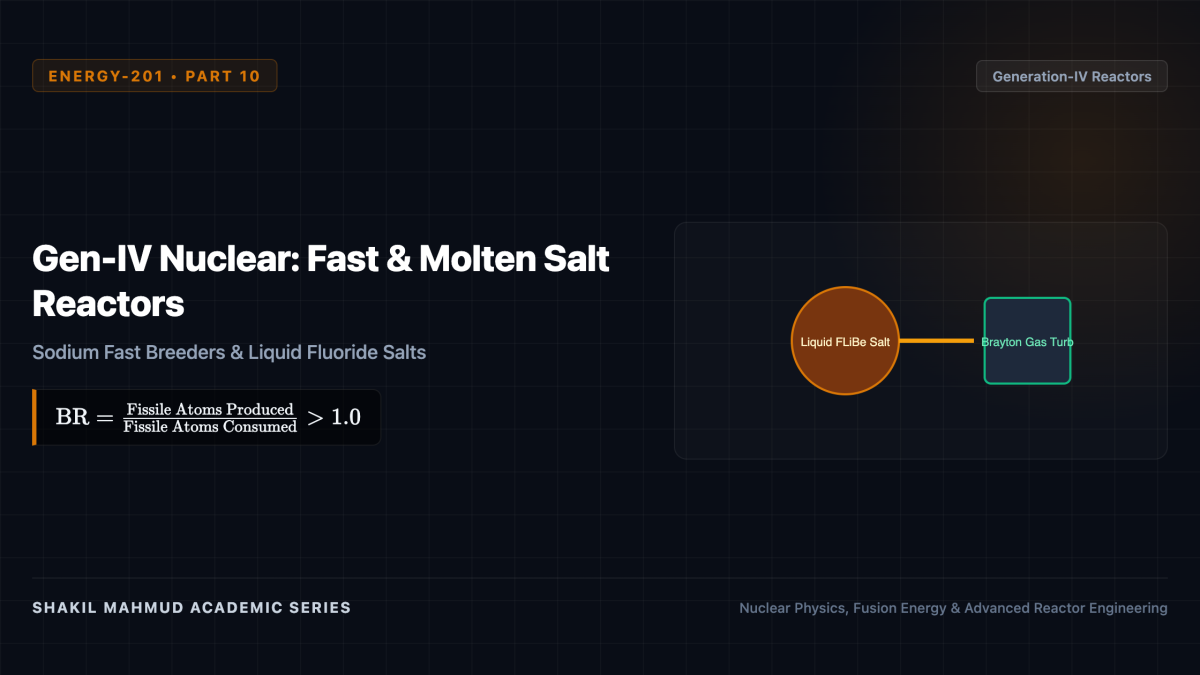
The remaining surplus neutrons ((approx 0.3 ext{–}0.7)) overcome parasitic capture and leakage. This achieves a Breeding Ratio (( ext{BR} = ext{fissile produced} / ext{fissile burned}) > 1.0), multiplying the usable energy yield of mined uranium by a factor of (60 ext{–}100 imes) and allowing current stockpiles of depleted uranium tails to power industrial civilization for millennia.
To eliminate moderation, SFRs use liquid sodium metal (( ext{Na})) as coolant. Sodium possesses outstanding thermal-hydraulic credentials:
- High boiling point ((883 ^circ ext{C})), allowing near-atmospheric core operating pressure ((approx 0.1 ext{–}0.3 ext{ MPa})), completely eliminating catastrophic high-pressure LOCA explosions.
- Colossal thermal conductivity ((k approx 70 ext{ W}/( ext{m} cdot ext{K})), over (100 imes) higher than water), driving powerful natural buoyancy circulation that removes decay heat indefinitely without electric pumps.
- Challenge: Sodium reacts vigorously with water and burns in air, mandating intermediate secondary sodium loops and inert argon gas blanketing.
2. Molten Salt Reactors (MSR) and The Thorium Fuel Cycle
Pioneered by Alvin Weinberg at Oak Ridge National Laboratory in the 1960s (Molten-Salt Reactor Experiment, MSRE), the Molten Salt Reactor dissolves fuel directly into a liquid fluoride or chloride salt matrix (e.g., ( ext{LiF-BeF}_2), known as FLiBe):
- Liquid Fuel Paradigm: The fuel is the coolant. There is no solid fuel pellet, no cladding, and zero risk of core structural meltdown.
- Low Pressure and High Temperature: FLiBe boils at (1430 ^circ ext{C}) while operating at (650 ext{–}750 ^circ ext{C}) at atmospheric pressure, driving closed-loop supercritical ( ext{CO}_2) Brayton turbines with thermodynamic cycle efficiency (> 45%).
- Freeze Plug Safety Mechanism: Underneath the reactor vessel sits an actively chilled solid salt plug. If a total station blackout occurs and electrical power is lost, the freeze plug melts passively; gravity immediately drains the entire molten core into subcritical subterranean dump tanks where decay heat dissipates safely.
MSRs excel as thermal breeders using the Thorium-232 Fuel Cycle:
[
{}^{232} ext{Th} + n o {}^{233} ext{Th} xrightarrow[beta^-]{22.3 ext{ min}} {}^{233} ext{Pa} xrightarrow[beta^-]{27.0 ext{ d}} {}^{233} ext{U}
]
Because ({}^{233} ext{U}) maintains (ta > 2.2) even in thermal neutron spectra, the thorium MSR breeds fissile fuel in a thermal graphite-moderated core, generating virtually zero transuranic waste (plutonium, americium) and exploiting the Earth’s abundant thorium reserves.