At the fundamental center of every atom lies the atomic nucleus: an ultra-dense femtometer-scale quantum droplet containing more than (99.95%) of the atom’s total mass packed into a volume (10^{15}) times smaller than the electron cloud. The total mass of any bound nucleus is strictly less than the sum of its individual constituent free protons and neutrons. This missing mass—the nuclear mass defect ((Delta m))—is transmuted by Einstein’s mass-energy equivalence into nuclear binding energy ((B)), governing both stellar nucleosynthesis and the release of terrestrial nuclear energy.
1. Mass Defect and Nuclear Binding Energy
For a nuclide composed of (Z) protons and (N = A – Z) neutrons, the total bound nuclear mass (M(A, Z)) satisfies:
[
Delta m = left[ Z m_p + (A – Z) m_n
ight] – M(A, Z)
]
The total nuclear binding energy represents the mechanical work required to disassemble the bound nucleus into isolated, non-interacting nucleons at infinite separation:
[
B(A, Z) = Delta m cdot c^2 = left[ Z m_p + (A – Z) m_n – M(A, Z)
ight] c^2
]
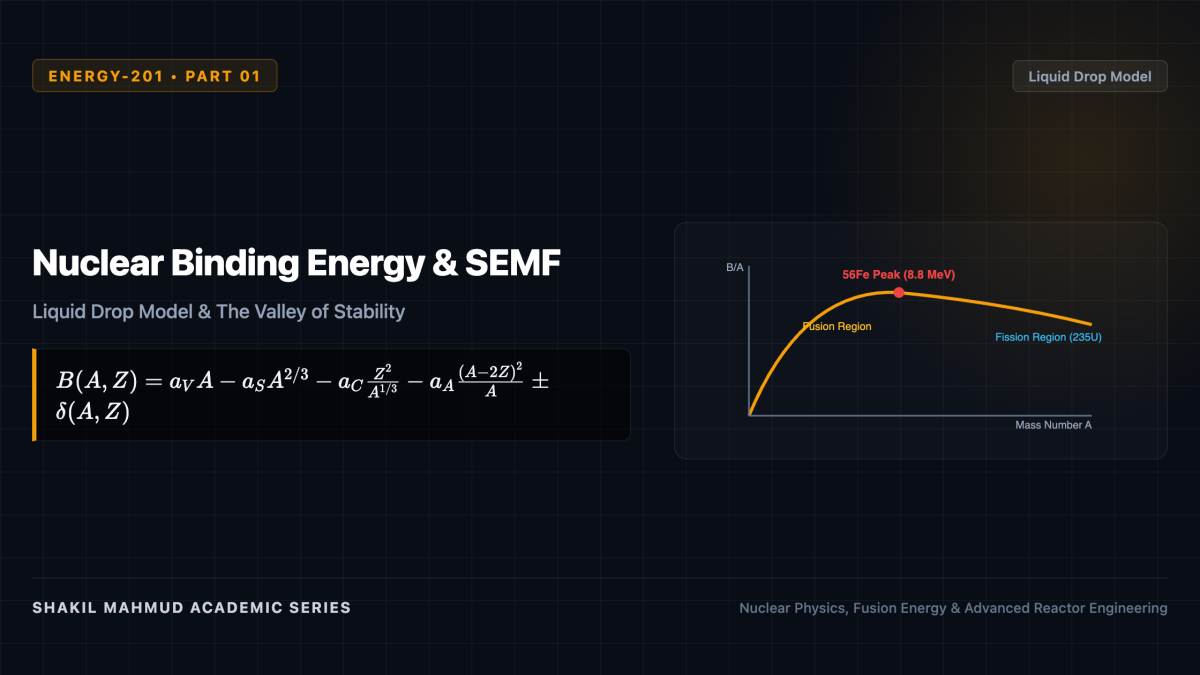
Dividing total binding energy by the mass number (A) yields the binding energy per nucleon ((B/A)). Across the table of nuclides, (B/A) begins at (1.11 ext{ MeV}) for Deuterium (({}^2 ext{H})), climbs steeply through light alpha-conjugate nuclei (({}^4 ext{He}), ({}^{12} ext{C}), ({}^{16} ext{O})), peaks at Iron-56 (({}^{56} ext{Fe}), (8.79 ext{ MeV/nucleon})) and Nickel-62 (({}^{62} ext{Ni}), (8.795 ext{ MeV/nucleon})), and gently declines to (7.57 ext{ MeV/nucleon}) for Uranium-238 (({}^{238} ext{U})).
This curve dictates the global thermodynamics of nuclear reactions:
- Nuclear Fusion: Combining light nuclei ((A < 60)) moves up the steep binding energy curve, releasing colossal kinetic energy.
- Nuclear Fission: Splitting heavy actinide nuclei ((A > 230)) into intermediate fragments moves up the curve toward the iron peak, releasing (sim 200 ext{ MeV}) per fission event.
2. The Bethe-Weizsäcker Semi-Empirical Mass Formula (SEMF)
Formulated in 1935 by Carl Friedrich von Weizsäcker and refined by Hans Bethe, the Liquid Drop Model treats the nucleus as an incompressible, charged macroscopic fluid droplet of uniform density (
ho_0 approx 0.17 ext{ nucleons/fm}^3) with nuclear radius (R = R_0 A^{1/3}) ((R_0 approx 1.2 ext{ fm})).
The total binding energy is parameterized by five distinct physical terms:
[
B(A, Z) = a_V A – a_S A^{2/3} – a_C rac{Z(Z-1)}{A^{1/3}} – a_A rac{(A – 2Z)^2}{A} + delta(A, Z)
]
- Volume Energy ((a_V A), (a_V approx 15.8 ext{ MeV})): Originates from the short-range saturation of the strong nuclear force. Each nucleon interacts only with its immediate nearest neighbors, contributing a constant binding energy proportional to nuclear volume ((propto R^3 propto A)).
- Surface Energy ((-a_S A^{2/3}), (a_S approx 18.3 ext{ MeV})): Nucleons at the nuclear surface boundary have fewer nearest neighbors than core nucleons, reducing binding energy in direct proportion to nuclear surface area ((propto R^2 propto A^{2/3})), acting as a macroscopic surface tension.
- Coulomb Repulsion ((-a_C rac{Z(Z-1)}{A^{1/3}}), (a_C approx 0.71 ext{ MeV})): Represents the electrostatic potential energy of (Z) uniformly distributed protons repelling one another across the nuclear volume:
[
E_C = rac{3}{5} rac{Z(Z-1) e^2}{4pi psilon_0 R} propto rac{Z^2}{A^{1/3}}
] - Asymmetry Energy ((-a_A rac{(A-2Z)^2}{A}), (a_A approx 23.2 ext{ MeV})): Arises from the quantum-mechanical Pauli exclusion principle in a Fermi gas. Protons and neutrons occupy independent sets of discrete energy levels. For fixed (A), displacing nucleons from (N=Z) forces excess neutrons into successively higher momentum states, penalizing asymmetric nuclei with an energy cost scaling quadratically with ((N – Z)^2 / A = (A – 2Z)^2 / A).
- Pairing Term ((delta(A, Z))): Nucleons exhibit short-range spin-pairing attraction, forming spin-singlet ((J=0)) Cooper-like pairs:
[
delta(A, Z) = begin{cases} +a_P A^{-1/2} & ext{even } Z ext{, even } N ext{ (most stable)} 0 & ext{odd } A ext{ (even-odd or odd-even)} -a_P A^{-1/2} & ext{odd } Z ext{, odd } N ext{ (least stable)} nd{cases}
]
where (a_P approx 11.2 ext{–}12.0 ext{ MeV}).
3. The Nuclear Valley of Stability
Differentiating the binding energy with respect to (Z) at fixed mass number (A) reveals the proton number (Z_{ ext{stable}}) that minimizes atomic mass:
[
left( rac{partial B}{partial Z}
ight)_A = 0 implies Z_{ ext{stable}} = rac{A}{2 + rac{a_C}{2 a_A} A^{2/3}} approx rac{A}{2 + 0.015 A^{2/3}}
]
For light nuclei ((A < 40)), the Coulomb correction is negligible, yielding (Z approx A/2) ((N/Z approx 1)). However, as (A) grows, the long-range Coulomb repulsion ((propto Z^2)) scales faster than the short-range nuclear attraction ((propto A)). To maintain structural stability against electrostatic disruption, heavy nuclei require an increasing excess of non-repelling neutrons, shifting the ratio to (N/Z approx 1.54) for Lead-208 (({}^{208} ext{Pb}), (Z=82, N=126)).
Nuclides deviating from this Valley of Stability undergo radioactive decay: neutron-rich isotopes emit negative beta particles ((beta^-)) to convert neutrons to protons, while proton-rich isotopes undergo positron emission ((beta^+)) or electron capture (EC) to descend toward the valley floor.