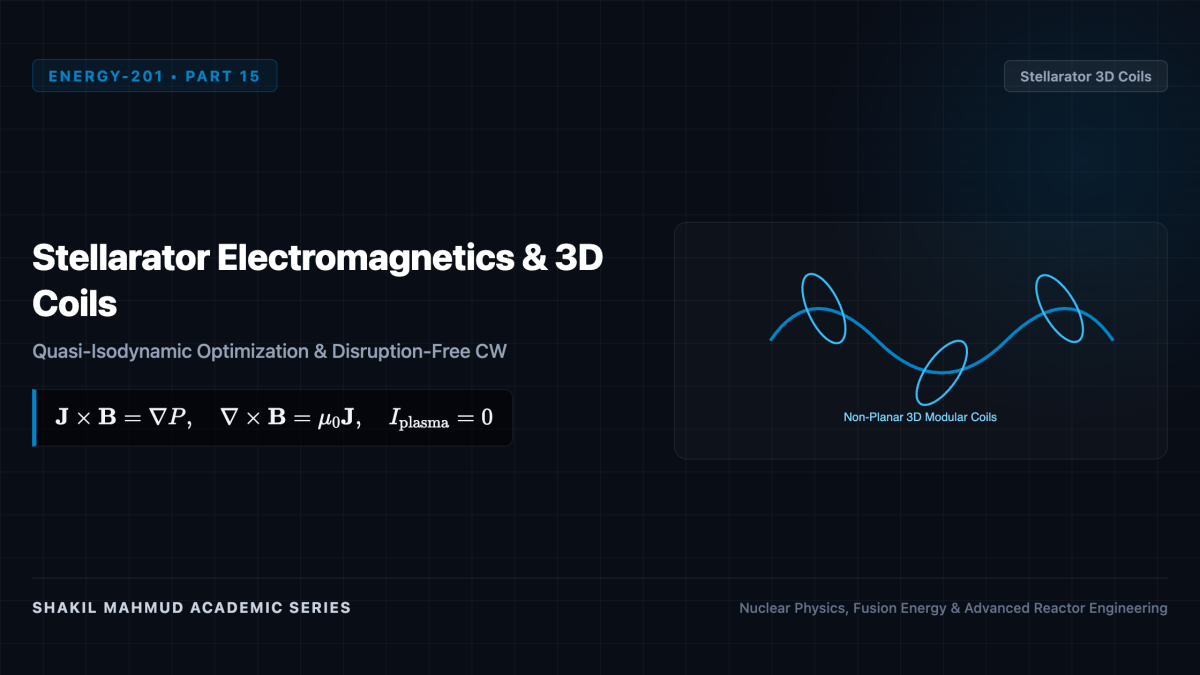
In 1951, Princeton astrophysicist Lyman Spitzer was riding a ski chairlift in Aspen when inspiration struck: instead of relying on an internal plasma current like a tokamak—which introduces violent magnetohydrodynamic disruptions and mandates pulsed operation—one could twist the magnetic field lines entirely from the outside using complex three-dimensional geometric coils. This is the Stellarator (named after the stars): an inherently continuous, disruption-free magnetic fusion architecture realizing true steady-state fusion.
1. The Stellarator Principle: External Rotational Transform
In a tokamak, the helical pitch of magnetic field lines is created by combining an external toroidal field (B_phi) with a poloidal field (B_ heta) generated by driving an internal electric current (I_p) through the plasma. This current is the tokamak’s fatal Achilles’ heel: it acts as a reservoir of free energy driving current-driven kink disruptions, tearing modes, and resistive wall instabilities.
In a stellarator, the plasma current is zero ((I_{ ext{plasma}} = 0)). The rotational transform (iota = 1/q)—the poloidal angle advance per toroidal transit—is generated entirely by shaping the external magnetic field coils into intricate three-dimensional, non-axisymmetric configurations:
[
iota = lim_{N o infty} rac{1}{2pi N} sum_{k=1}^N Delta heta_k
]
Because there is no net toroidal current, a stellarator has no free magnetic energy to feed disruptions; it operates in inherently stable, steady-state continuous wave (CW) equilibrium without pulsed inductive transformers or complex current-drive systems.
2. The Neoclassical Transport Curse of Early Stellarators
For decades, tokamaks outpaced stellarators because classic axisymmetric tokamaks possess toroidal symmetry: by Noether’s theorem, toroidal symmetry ensures conservation of canonical toroidal angular momentum (p_phi = m v_phi + q A_phi). This strictly confines particle guiding centers within drift orbits close to magnetic flux surfaces.
In classical non-axisymmetric stellarators, breaking toroidal symmetry destroys (p_phi) conservation. In regions of local magnetic field minima, particles become trapped in local magnetic ripples. Unlike tokamak banana orbits that precess around the torus, stellarator trapped particles experience uncompensated vertical (
abla B) drifts, drifting completely out of the machine. At high temperatures, this neoclassical ripple transport scales disastrously as (chi propto 1 / (
u B^2) propto T^{7/2}), causing core heat to hemorrhage uncontrollably.
3. Supercomputing Optimization: Quasi-Symmetry and Quasi-Isodynamicity
In the 1980s, Jürgen Nührenberg and Allen Boozer unlocked the mathematical solution using supercomputer optimization: physical axisymmetry is unnecessary; what matters is symmetry in the magnetic field magnitude (B = |mathbf{B}|) in Boozer magnetic coordinates ((psi, heta, zeta)).
Two primary optimized stellarator architectures emerged:
- Quasi-Axisymmetric (QA) Stellarators: The field magnitude (B(psi, heta)) depends only on poloidal angle ( heta), mimicking a tokamak without toroidal current.
- Quasi-Isodynamic (QI) Stellarators (Wendelstein 7-X): Field lines are closed in magnetic strength along helical ridges. The second adiabatic invariant (J_parallel = oint v_parallel , dl) satisfies (partial J_parallel / partial heta = 0) on flux surfaces. All trapped particles precess poloidally rather than drifting radially, eliminating ripple transport and simultaneously suppressing the neoclassical bootstrap current to near-zero.
4. The Wendelstein 7-X (W7-X) Engineering Triumph
Realizing a quasi-isodynamic field requires winding coils that conform to mathematically optimized non-Euclidean surfaces. Germany’s Wendelstein 7-X (W7-X) in Greifswald represents the apex of this technology:
- A 5-fold periodic pentagonal stellarator utilizing **50 non-planar superconducting coils** shaped like twisted metal ribbons, plus 20 planar auxiliary coils.
- Each 6-ton niobium-titanium (( ext{NbTi})) superconducting coil was machined with millimeter precision to sustain colossal magnetic forces at (4 ext{ Kelvin}).
- W7-X demonstrated major milestones: achieving steady-state (30 ext{-minute}) high-performance plasma discharges, verifying neoclassical transport suppression, and validating island divertor heat exhaust without disruptions.




