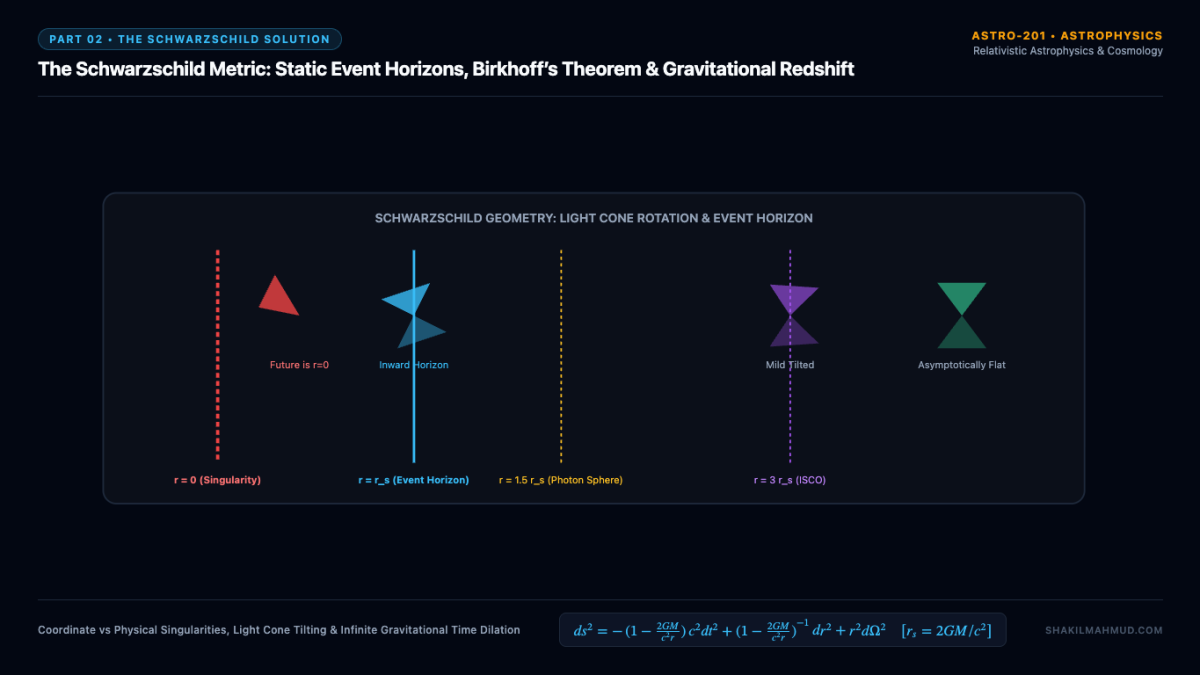
Within months of Einstein publishing the field equations, Karl Schwarzschild derived the first exact non-trivial solution to general relativity while stationed on the Russian front in 1916. The Schwarzschild Metric describes the static, spherically symmetric vacuum spacetime surrounding an uncharged, non-rotating mass $M$—revealing the mathematical reality of an Event Horizon, the ultimate boundary of causal disconnect.
1. The Schwarzschild Line Element
In standard spherical polar coordinates $(t, r, theta, phi)$, the vacuum Einstein equations $R_{munu} = 0$ yield the unique line element:
ds^2 = -left(1 – frac{2GM}{c^2 r}right) c^2 dt^2 + left(1 – frac{2GM}{c^2 r}right)^{-1} dr^2 + r^2 (dtheta^2 + sin^2theta dphi^2)
The characteristic geometric scale is the Schwarzschild Radius:
r_s = frac{2GM}{c^2}
For Earth, $r_s approx 8.87text{ mm}$; for the Sun, $r_s approx 2.95text{ km}$. If a mass is compressed within its Schwarzschild radius, gravity overcomes all known physical forces, producing a black hole.
2. Birkhoff’s Theorem & Spherical Vacuum Rigidity
A profound consequence of spherical symmetry is Birkhoff’s Theorem: any spherically symmetric vacuum solution of the Einstein equations is necessarily static and asymptotically flat, uniquely described by the Schwarzschild metric. This implies:
- A radially pulsating spherical star emits zero gravitational waves.
- The gravitational field outside any spherically symmetric body depends strictly on its total mass $M$, completely independent of its internal radius or radial pulsations.
3. Gravitational Time Dilation & Infinite Redshift
Consider a static observer located at radius $r$ emitting a photon of proper frequency $nu_0$. A distant observer at spatial infinity ($r to infty$) measures redshifted frequency $nu_infty$:
nu_infty = nu_0 sqrt{1 – frac{2GM}{c^2 r}} = nu_0 sqrt{1 – frac{r_s}{r}}
As the emission radius approaches the event horizon ($r to r_s$), the measured frequency drops to zero: $nu_infty to 0$. Time for the infalling source appears frozen to distant observers, an effect known as Infinite Gravitational Redshift.
4. Coordinate vs Physical Singularities
Inspection of the metric reveals two apparent divergences: at $r = r_s$ where $g_{rr} to infty$, and at $r = 0$ where $g_{00} to -infty$. To determine whether these are physical singularities or coordinate artifacts, we evaluate coordinate-independent curvature scalars:
K = R^{alphabetagammadelta} R_{alphabetagammadelta} = frac{48 G^2 M^2}{c^4 r^6}
At $r = r_s$, the Kretschmann scalar remains perfectly smooth and finite ($K = frac{48}{r_s^4}$). The horizon is a pure Coordinate Singularity; an infalling observer crosses $r = r_s$ in finite proper time $tau$ without encountering infinite tidal forces. Conversely, at $r = 0$, $K to infty$: this is an un-removable physical Curvature Singularity where spacetime itself tears asunder.