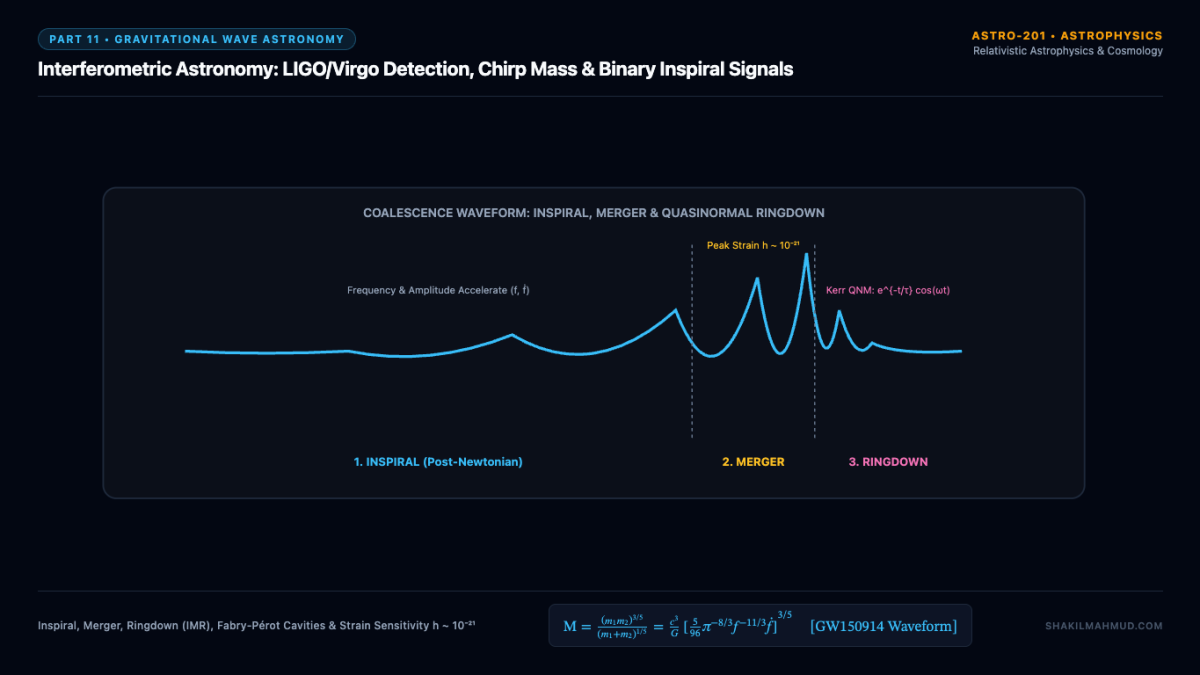
On September 14, 2015, a century after Albert Einstein predicted their existence, humanity made the first direct observation of gravitational waves: event GW150914. Two stellar-mass black holes ($36 M_odot$ and $29 M_odot$) collided 1.3 billion light-years away, converting 3 solar masses of pure spacetime into gravitational radiation within 200 milliseconds. The detection by the LIGO/Virgo Collaboration inaugurated a revolutionary new sensory window onto the cosmos: Gravitational-Wave Astronomy.
1. The Geometry of Laser Interferometric Detection
Gravitational-wave strain is defined as the fractional change in distance between two freely falling test masses:
h = frac{2 Delta L}{L}
For an astrophysical signal arriving on Earth, the strain amplitude is incomprehensibly faint: $h sim 10^{-21}$. Across a $4text{ km}$ interferometer arm, the physical displacement to be measured is:
Delta L = frac{1}{2} h L approx frac{1}{2} left(10^{-21}right) left(4 times 10^3text{ m}right) approx 2 times 10^{-18}text{ m}
This is less than one-thousandth the diameter of a single proton ($r_{text{proton}} approx 10^{-15}text{ m}$). To achieve this precision, Advanced LIGO utilizes dual-orthogonal 4-kilometer arms with Fabry-Pérot resonant optical cavities that bounce $1064text{ nm}$ laser light 300 times (effective path length $1,200text{ km}$), fused-silica quadruple pendulum suspensions, and active seismic isolation systems.
2. Post-Newtonian Binary Inspiral & Chirp Mass Derivation
As two compact objects of masses $m_1$ and $m_2$ orbit each other, the loss of orbital energy accelerates their orbital frequency. At leading post-Newtonian order, the gravitational-wave frequency $f = 2 f_{text{orb}}$ and its first time derivative $dot{f}$ are related by:
dot{f} = frac{96}{5} pi^{8/3} left( frac{G mathcal{M}}{c^3} right)^{5/3} f^{11/3}
Where $mathcal{M}$ is the single combined parameter governing frequency evolution: the Chirp Mass:
mathcal{M} = frac{(m_1 m_2)^{3/5}}{(m_1 + m_2)^{1/5}} = frac{c^3}{G} left[ frac{5}{96} pi^{-8/3} f^{-11/3} dot{f} right]^{3/5}
Remarkably, because both $f$ and $dot{f}$ are directly observable from the instantaneous spectrogram (the “chirp” sound of rising pitch and volume), the chirp mass is measured directly with extreme precision, independent of the distance to the source.
3. The Coalescence Trilogy: Inspiral, Merger, Ringdown
The gravitational waveform of a compact binary merger partitions cleanly into three distinct physical regimes:
- Inspiral (Post-Newtonian Analytic Theory): Separation is large ($r gg r_s$). The binary is modeled as point particles with post-Newtonian expansions ($v/c ll 1$), producing an oscillatory wave whose frequency and amplitude sweep upward in time.
- Merger (Numerical Relativity Supercomputing): The event horizons touch and merge. Spacetime curvature becomes violently non-linear, requiring 3D supercomputer solutions of the full 10 non-linear Einstein field equations using the BSSN or generalized harmonic formulation. The peak gravitational power momentarily reaches $P_{text{peak}} sim 10^{56}text{ erg/s}$—outshining the combined luminous power of all stars in the observable universe.
- Ringdown (Black Hole Perturbation Theory): The newly formed, highly distorted single Kerr black hole settles into a stationary Kerr state by shedding its asymmetries through damped Quasinormal Modes (QNMs):
h(t) sim e^{-t / tau} cos(omega_{text{QNM}} t + phi)
Measuring the fundamental frequency $omega_{220}$ and damping time $tau_{220}$ directly tests the No-Hair Theorem: confirming that the final object is defined exclusively by mass $M$ and spin $J$.
4. Multi-Detector Triangulation & The Global Network
A single gravitational-wave detector has an all-sky quadrupolar antenna pattern with virtually no directional pointing resolution. By constructing a worldwide baseline network—LIGO Hanford, LIGO Livingston, Virgo (Italy), and KAGRA (Japan)—astronomers localize sources via Triangulation: measuring sub-millisecond arrival time delays $Delta t = mathbf{d} cdot mathbf{n} / c$ across continental baselines to construct precision sky-localization error ellipses.




