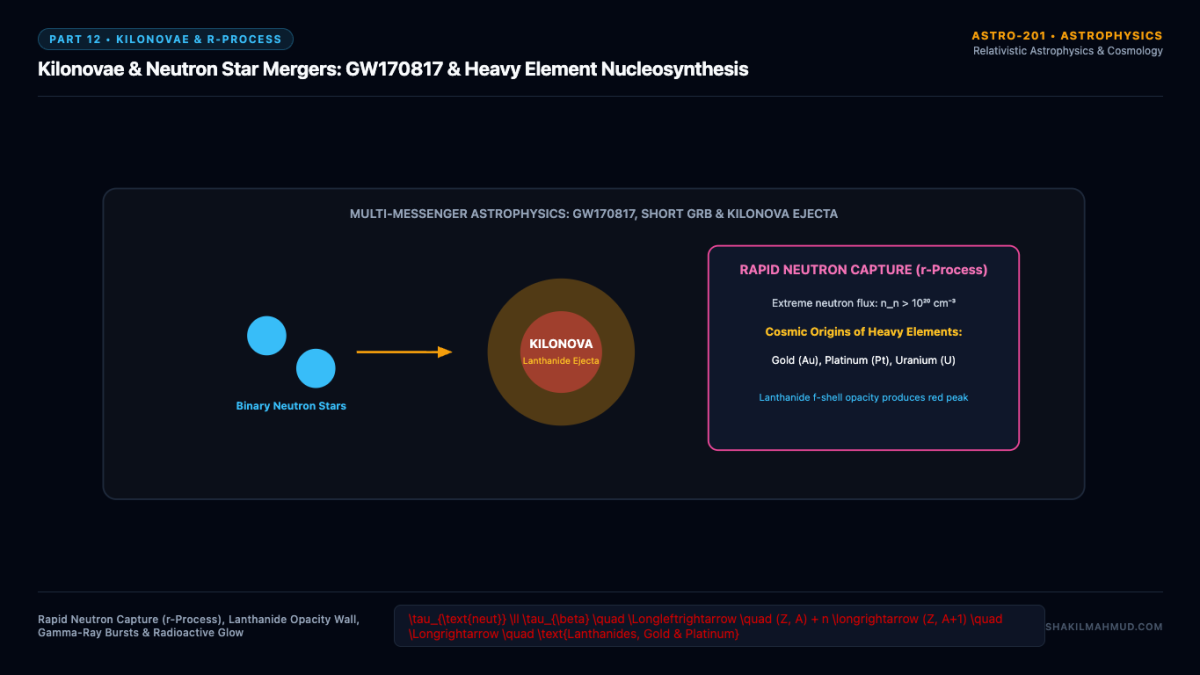
On August 17, 2017, astrophysical science achieved its holy grail: the simultaneous observation of gravitational waves and light from a single cosmic cataclysm. Event GW170817 captured the inspiral of two colliding neutron stars, followed 1.7 seconds later by a short gamma-ray burst (GRB 170817A) and hours later by a glowing radioactive optical transient: AT 2017gfo. This historical Kilonova confirmed that the heaviest elements in the universe—including gold, platinum, and uranium—are forged through the rapid neutron capture (r-process) in the decompressed nuclear wreckage of neutron star mergers.
1. The Multi-Messenger Landmark: GW170817
Unlike binary black holes, which merge in darkness, binary neutron star (BNS) mergers involve ultradense baryonic matter. GW170817 yielded monumental discoveries across fundamental physics:
- The Speed of Gravitational Waves: The arrival time delay of only $Delta t = 1.74 pm 0.05text{ s}$ between the gravitational waves and the gamma-ray burst across a distance of 130 million light-years ($40text{ Mpc}$) constrained the difference between the speed of gravity and the speed of light to an unprecedented precision:
-3 times 10^{-15} le frac{c_{text{GW}} – c}{c} le +7 times 10^{-16}
Instantly eliminating broad classes of modified gravity theories that predicted anomalous propagation speeds.
- Direct Hubble Constant Measurement: By combining the gravitational-wave standard siren distance ($d_L approx 40text{ Mpc}$) with the optical redshift of the host galaxy NGC 4993, astronomers achieved an independent geometric measurement of $H_0 approx 70text{ km/s/Mpc}$.
2. Decompressed Nuclear Matter & The r-Process
Stellar fusion in ordinary stars halts at iron ($^{56}text{Fe}$) because iron has the highest binding energy per nucleon; creating heavier nuclei requires neutron capture. When two neutron stars collide, $sim 0.01 – 0.05 M_odot$ of neutron-degenerate matter is dynamically ejected at $0.1 – 0.3 c$. As this matter decompresses, the neutron density remains astronomical ($n_n > 10^{20}text{ cm}^{-3}$):
tau_{text{neutron capture}} ll tau_{betatext{-decay}}
Seed nuclei absorb neutrons far faster than they can undergo beta decay, climbing all the way to the neutron drip line. When the neutron flux finally subsides, the unstable, neutron-super-saturated nuclei undergo cascades of beta-minus decays ($n to p + e^- + bar{nu}_e$), synthesizing the third r-process peak: the heavy Lanthanides and Actinides (such as Gold $^{197}text{Au}$, Platinum $^{195}text{Pt}$, and Uranium $^{238}text{U}$).
3. The Physics of the Kilonova Thermal Transient
A kilonova is powered by the radioactive decay heat of thousands of newly synthesized exotic isotopes. The radioactive energy injection rate follows a power law:
dot{epsilon}_{text{radioactive}}(t) propto t^{-1.3}
The observational signature of a kilonova is governed by the Lanthanide Opacity Wall:
- Blue Kilonova (Lanthanide-Poor): Polar ejecta irradiated by neutrino winds undergoes proton conversion ($Y_e > 0.25$), preventing lanthanide production. With low iron-like opacity ($kappa sim 0.5text{ cm}^2/text{g}$), radiation diffuses out rapidly, peaking in the ultraviolet and blue optical spectrum within $sim 1text{ day}$.
- Red Kilonova (Lanthanide-Rich): Equatorial dynamical ejecta remains extremely neutron-rich ($Y_e < 0.2$). The complex atomic structure of lanthanide f-shell electrons creates millions of absorption lines, driving opacity up to $kappa sim 10 – 30text{ cm}^2/text{g}$. Radiation is trapped longer and emerges as an infrared glow lasting several weeks.
4. Cosmic Chemical Abundance Resolution
Before GW170817, the primary astrophysical site of the r-process was debated between core-collapse supernovae and neutron star mergers. Spectroscopy of AT 2017gfo detected the direct absorption signature of strontium ($^{88}text{Sr}$), and the estimated heavy-element yield ($sim 100text{ Earth masses}$ of pure gold and platinum) proved that binary neutron star mergers are indeed the dominant cosmic foundry of the universe’s precious metals.