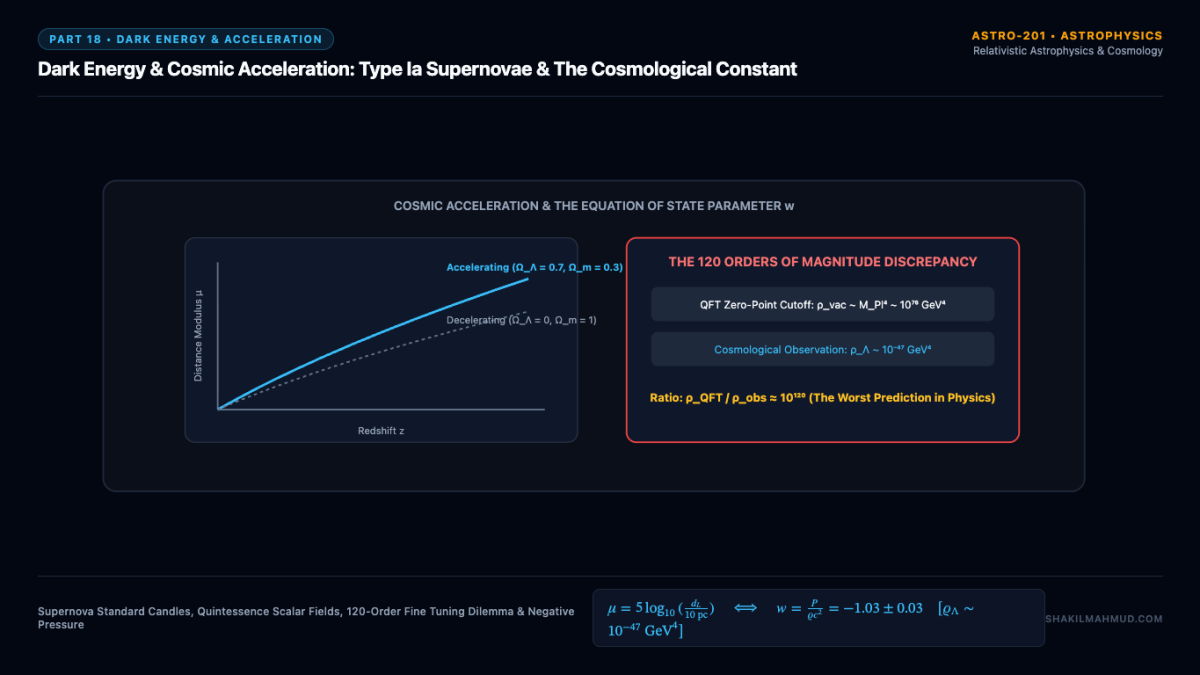
In 1998, two independent international teams—the High-Z Supernova Search Team and the Supernova Cosmology Project—stunned the scientific world with an unexpected discovery: the expansion of the universe is not slowing down under the attractive pull of gravity; it is accelerating. Constituting roughly $68%$ of the total cosmic energy budget, the enigmatic agent driving this runaway expansion is known as Dark Energy. Interpreted by general relativity as Einstein’s Cosmological Constant ($Lambda$), it represents the most profound mystery in modern theoretical physics.
1. Type Ia Supernovae as Standard Candles
Because white dwarfs detonate when accreted mass approaches the universal Chandrasekhar limit ($1.44 M_odot$), thermonuclear Type Ia Supernovae (SNe Ia) possess a remarkably uniform peak absolute luminosity ($M_B approx -19.3$). Mark Phillips established the empirical Phillips Relation, standardizing luminosity by measuring the post-peak light curve decline rate over 15 days ($Delta m_{15}$):
d_L(z) = left( frac{L}{4pi F} right)^{1/2} = c(1+z) int_0^z frac{dz’}{H(z’)}
The distance modulus $mu(z) = m – M = 5 log_{10}(d_L / 10text{ pc})$ measured for high-redshift supernovae ($z sim 0.5 – 1.0$) was consistently fainter (further away) than predicted by any decelerating matter-dominated universe. The universe transitioned from cosmic deceleration to cosmic acceleration at redshift $z approx 0.6$ (approximately 6 billion years ago).
2. Negative Pressure & Acceleration Mechanics
In general relativity, acceleration is governed by the second Friedmann equation:
frac{ddot{a}}{a} = -frac{4pi G}{3} left( rho + frac{3P}{c^2} right)
For $ddot{a} > 0$, the effective active gravitational mass density must be negative: $rho + 3P/c^2 < 0$. Dark energy possesses an equation of state $w equiv P / (rho c^2)$ satisfying:
w < -frac{1}{3}
For Einstein’s classical cosmological constant $Lambda$, energy density is invariant with expansion ($rho_Lambda = frac{Lambda c^2}{8pi G} = text{const}$), which by fluid continuity ($dot{rho} + 3H(rho + P) = 0$) demands an exact negative pressure:
P_Lambda = -rho_Lambda c^2 quad Longleftrightarrow quad w = -1
Combined cosmological measurements from Planck CMB, Baryon Acoustic Oscillations (BAO), and SNe Ia yield $w = -1.03 pm 0.03$, entirely consistent with a pure cosmological constant.
3. The Cosmological Constant Problem: The Worst Prediction in Physics
In Quantum Field Theory (QFT), the quantum vacuum is not empty; it is populated by zero-point quantum harmonic oscillator ground-state energies ($E_0 = frac{1}{2}hbaromega$):
rho_{text{vac}}^{text{QFT}} = int_0^{k_{text{max}}} frac{4pi k^2 dk}{(2pi)^3} frac{1}{2} hbar sqrt{k^2 c^2 + m^2 c^4} sim frac{hbar k_{text{max}}^4}{16pi^2 c}
If the ultraviolet cutoff $k_{text{max}}$ is set to the Planck energy scale ($M_{text{Pl}} approx 1.22 times 10^{19}text{ GeV}$), quantum field theory predicts:
rho_{text{vac}}^{text{QFT}} sim 10^{76}text{ GeV}^4 sim 10^{114}text{ J/m}^3
However, the observationally measured dark energy density is:
rho_{text{obs}} = Omega_Lambda rho_{text{crit}} approx 10^{-47}text{ GeV}^4 sim 10^{-9}text{ J/m}^3
The theoretical expectation exceeds the cosmological observation by a staggering 120 orders of magnitude ($sim 10^{120}$). Resolving this monumental discrepancy is widely considered the central open challenge of quantum gravity.
4. Dynamic Dark Energy: Quintessence & Modified Gravity
To avoid severe fine-tuning, theorists have proposed dynamic dark energy models where $w(z)$ evolves over cosmic time:
- Quintessence: A rolling scalar field $phi$ with potential $V(phi)$ where $w_phi = frac{frac{1}{2}dot{phi}^2 – V(phi)}{frac{1}{2}dot{phi}^2 + V(phi)}$ varies between $-1$ and $+1$.
- Phantom Energy ($w < -1$): Super-negative dark energy where energy density increases with expansion, leading inevitably to a catastrophic Big Rip.
- $f(R)$ Modified Gravity: General relativity itself is modified at cosmological scales by replacing the Einstein-Hilbert Ricci scalar $R$ with an arbitrary non-linear function $f(R)$.




