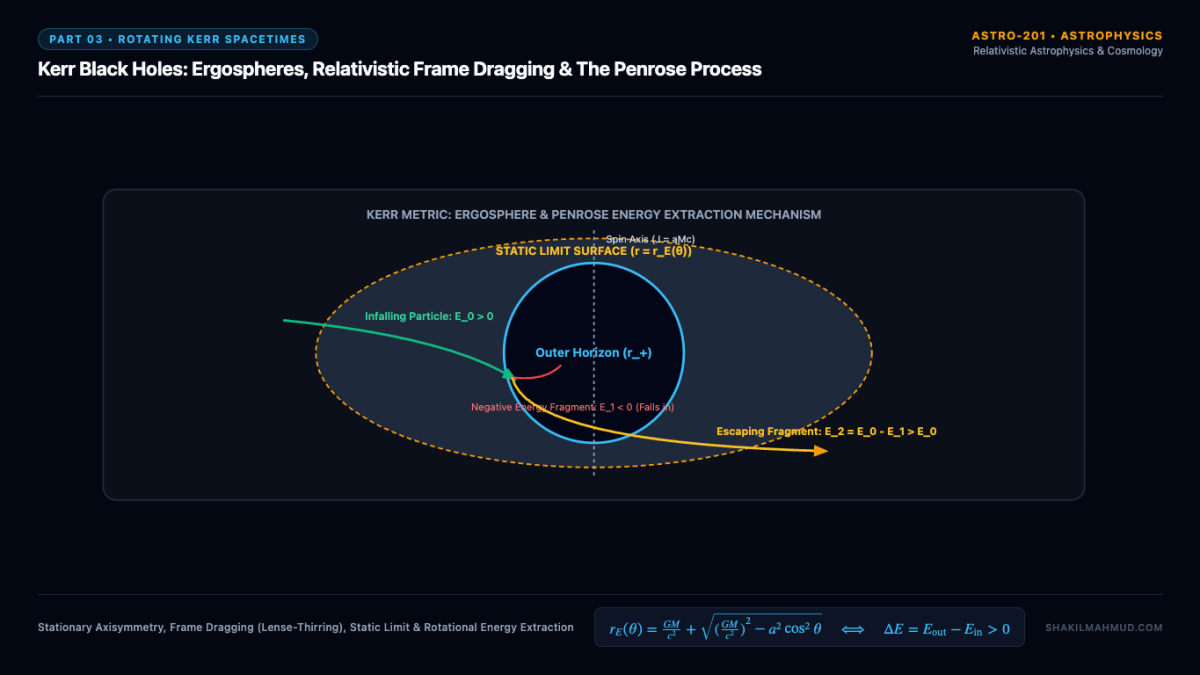
Real astrophysical bodies rotate. When a massive spinning star undergoes gravitational collapse, conservation of angular momentum accelerates its spin toward extreme relativistic velocities. In 1963, Roy Kerr derived the exact vacuum solution for a stationary, axisymmetric, rotating mass $M$ with angular momentum $J$. The resulting Kerr Metric introduces phenomena completely absent in Newtonian gravity: the compulsory dragging of inertial frames and the existence of the Ergosphere.
1. The Kerr Metric in Boyer-Lindquist Coordinates
With spin parameter $a = J / (Mc)$, the spacetime line element is expressed as:
ds^2 = -left(1 – frac{2GMr}{rho^2 c^2}right) c^2 dt^2 – frac{4GMarsin^2theta}{rho^2 c} dt dphi + frac{rho^2}{Delta} dr^2 + rho^2 dtheta^2 + left(r^2 + a^2 + frac{2GMa^2 r sin^2theta}{rho^2 c^2}right) sin^2theta dphi^2
Where the geometric metric auxiliary functions are:
Delta(r) = r^2 – frac{2GM}{c^2} r + a^2, quad rho^2(r, theta) = r^2 + a^2 cos^2theta
The coordinate horizons occur where $Delta(r) = 0$, giving outer ($r_+$) and inner ($r_-$) horizons:
r_pm = frac{GM}{c^2} pm sqrt{left(frac{GM}{c^2}right)^2 – a^2}
A black hole is extremal when $a = GM/c^2$; beyond this threshold ($a > GM/c^2$), horizons vanish, exposing a naked ring singularity.
2. Frame Dragging & The Ergosphere
The off-diagonal term $g_{tphi} propto -a sin^2theta$ forces spacetime itself to swirl around the rotating black hole—the Lense-Thirring Effect. The angular velocity of zero-angular-momentum observers (ZAMO) is:
omega(r, theta) = -frac{g_{tphi}}{g_{phiphi}} = frac{2GMar}{rho^2 (r^2 + a^2) + 2GMa^2 r sin^2theta}
The Static Limit Surface occurs where $g_{tt} = 0$:
r_E(theta) = frac{GM}{c^2} + sqrt{left(frac{GM}{c^2}right)^2 – a^2 cos^2theta}
Because $r_E(theta) ge r_+$, there exists a region outside the event horizon known as the Ergosphere. Inside the ergosphere, the timelike Killing vector $partial_t$ becomes spacelike: no physical particle can remain stationary relative to distant stars ($dphi/dt > 0$ is strictly compulsory).
3. The Penrose Mechanism: Tapping Black Hole Energy
Because time-translation symmetry is spacelike within the ergosphere, a particle can possess negative conserved energy $E = -p_mu xi^mu < 0$ relative to infinity. In 1969, Roger Penrose demonstrated that rotational energy can be extracted:
- A particle with positive energy $E_0 > 0$ enters the ergosphere.
- It splits into two fragments: fragment 1 with negative energy $E_1 0$.
- Fragment 1 falls across the event horizon $r_+$, reducing the mass and angular momentum of the black hole.
- Fragment 2 escapes to infinity with net energy $E_2 = E_0 – E_1 > E_0$.
Up to $29%$ of the total rest mass energy ($M c^2$) of an extremal Kerr black hole can be extracted through this process, providing the physical engine powering relativistic quasar jets.




