For the first 380,000 years of cosmic history, the universe was an opaque, roaring plasma of tightly coupled photons, protons, and electrons. At redshift $z approx 1100$, ambient temperatures cooled below $sim 3000text{ K}$, allowing electrons to bind into neutral hydrogen atoms: Recombination. Photons decoupled from matter and streamed freely across transparent spacetime, cooling over 13.8 billion years of cosmic expansion into the Cosmic Microwave Background (CMB): a near-perfect $2.7255text{ K}$ blackbody fossil carrying the acoustic fingerprint of cosmic genesis.
1. Recombination Dynamics & The Saha Equation
The ionization fraction $X_e = n_e / n_b$ of hydrogen is governed by the thermodynamic equilibrium of the reaction $p + e^- leftrightarrow H + gamma$. Applying the Saha Ionization Equation:
frac{X_e^2}{1 – X_e} = frac{1}{n_b} left( frac{m_e k_B T}{2pi hbar^2} right)^{3/2} e^{-E_I / (k_B T)}
Where $E_I = 13.6text{ eV}$ is the ground-state hydrogen binding energy. Although $E_I$ corresponds to $T sim 158,000text{ K}$, recombination is delayed until $T_{text{rec}} approx 3000text{ K}$ ($k_B T approx 0.3text{ eV}$) because the colossal photon-to-baryon ratio ($eta^{-1} sim 10^9$) ensures that the high-energy Wien tail of the blackbody spectrum keeps hydrogen ionized. When $X_e$ drops below $10^{-3}$, Thomson scattering optical depth drops below unity, defining the Last Scattering Surface.
2. Acoustic Plasma Oscillations & Peak Physics
Prior to decoupling, the photon-baryon fluid acted as a tightly coupled oscillator. Gravity pulled the fluid into dark matter gravitational potential wells, while photon radiation pressure resisted compression and drove expansion. This competitive push-and-pull established acoustic sound waves propagating at relativistic sound speed:
c_s = frac{c}{sqrt{3 left( 1 + frac{3rho_b}{4rho_gamma} right)}} approx frac{c}{sqrt{3}} approx 0.577 c
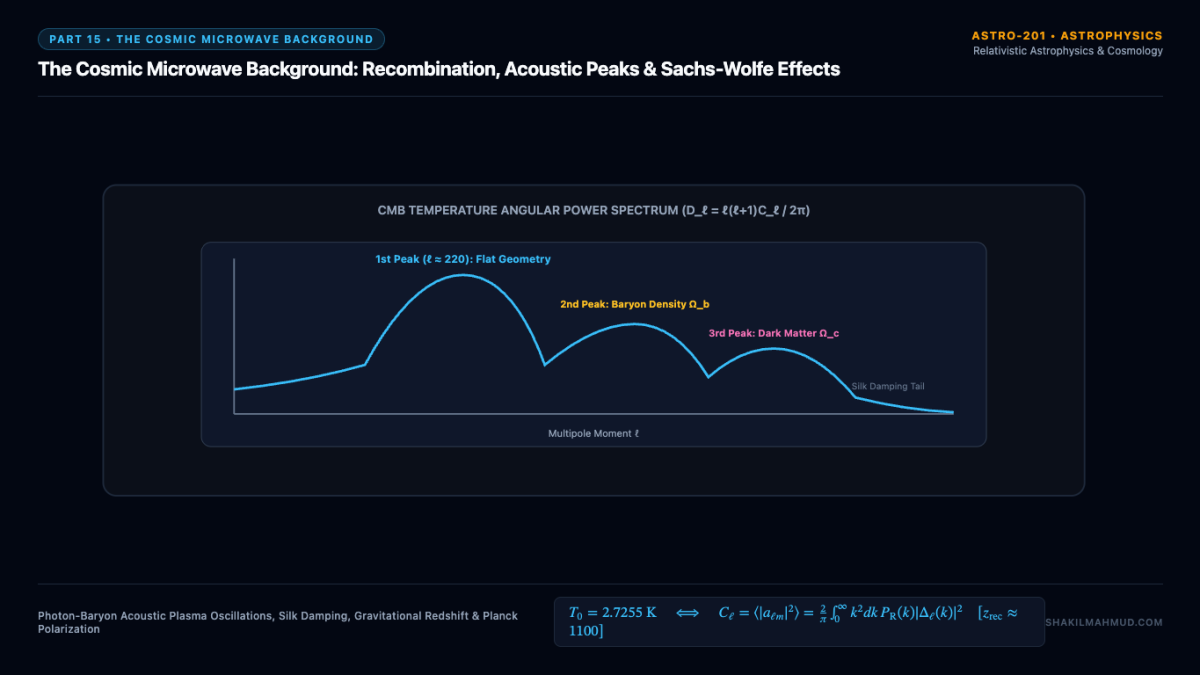
When recombination occurred, the oscillation phases were instantaneously frozen in time across the sky. Expanding the temperature fluctuations $Delta T(hat{n}) / T$ in spherical harmonics $a_{ell m} = int frac{Delta T}{T} Y_{ell m}^* dOmega$, the angular power spectrum $C_ell = langle |a_{ell m}|^2 rangle$ reveals characteristic acoustic peaks:
- First Peak ($ell approx 220$): Represents the fundamental acoustic mode that completed exactly one half-cycle (maximum compression into potential wells). Its angular location measures the sound horizon distance, confirming that our universe is spatially flat ($k = 0$).
- Second Peak ($ell approx 540$): Represents the mode caught at maximum rarefaction (compression followed by bounce). The ratio of the 1st to 2nd peak measures the total baryon density $Omega_b$: adding baryons increases inertia, deepening potential wells and suppressing the rarefaction peak.
- Third Peak ($ell approx 800$): Represents the second compression mode, whose amplitude directly measures the cold dark matter density $Omega_c$.
3. Secondary Anisotropies: Sachs-Wolfe & Sunyaev-Zel’dovich
As CMB photons traverse the evolving universe over 13.8 billion years, secondary anisotropies alter their frequencies:
- Integrated Sachs-Wolfe (ISW) Effect: When photons cross evolving gravitational potential wells in an accelerating dark-energy dominated universe, the potential decays while the photon traverses it, imparting a net blueshift to large-scale modes ($ell < 20$).
- Sunyaev-Zel’dovich (SZ) Effect: Inverse Compton scattering of CMB photons off hot electrons ($T_e sim 10^7 – 10^8text{ K}$) in massive galaxy clusters shifts microwave photons to higher frequencies, providing an optical-depth-independent census of massive clusters across cosmic time.
4. CMB Polarization: E-Modes & Primordial B-Modes
Thomson scattering of radiation with a local quadrupole anisotropy produces linear polarization on the last scattering surface, decomposed into parity-even E-Modes (gradient-like) and parity-odd B-Modes (curl-like):
- Scalar density perturbations generate pure E-mode polarization and zero B-modes at linear order.
- Tensor metric perturbations—primordial Gravitational Waves generated during cosmic inflation—uniquely imprint both E-modes and curl-like B-modes on angular scales $ell sim 80$. Detecting this primordial B-mode signal represents the definitive smoking gun for the energy scale of cosmic inflation ($V^{1/4} sim 10^{16}text{ GeV}$).




