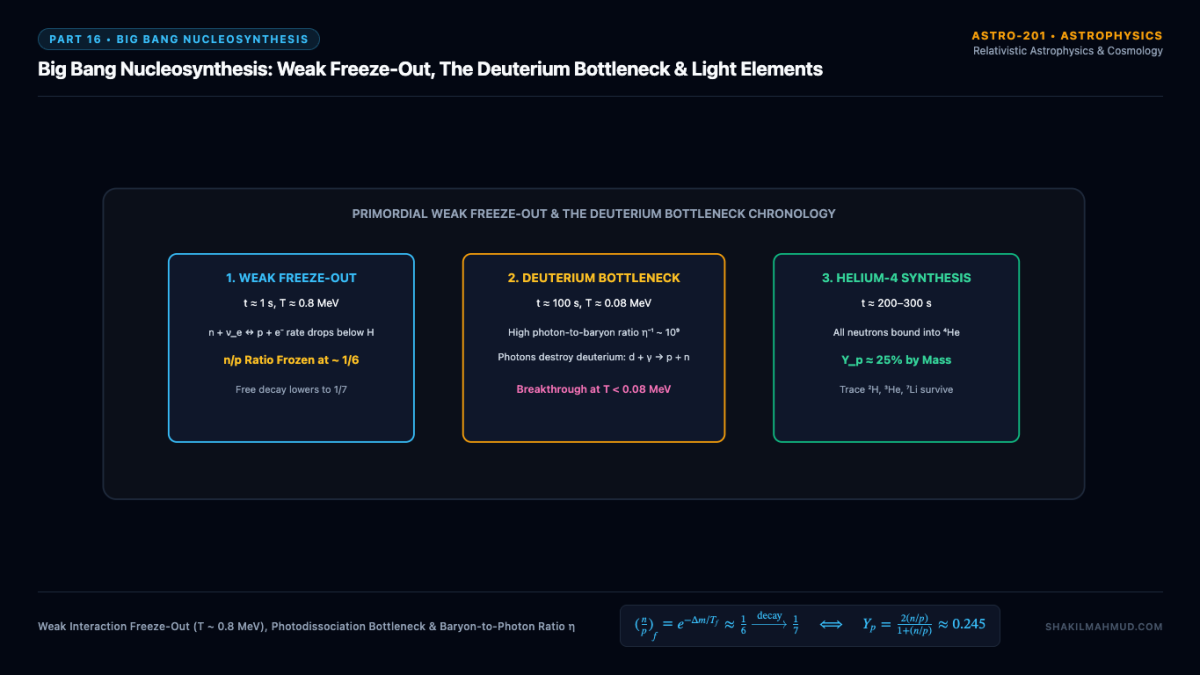
During the first twenty minutes following the Big Bang, the universe was an expansive, furiously cooling thermonuclear reactor. In this primordial furnace, the light atomic nuclei—Deuterium ($^2text{H}$), Helium-3 ($^3text{He}$), Helium-4 ($^4text{He}$), and Lithium-7 ($^7text{Li}$)—were forged directly from fundamental protons and neutrons. Known as Big Bang Nucleosynthesis (BBN), this era provides the earliest observational pillar of modern cosmology, grounding our understanding of physical conditions merely one second after the cosmic genesis.
1. Weak Interaction Freeze-Out ($T sim 0.8text{ MeV}$)
At temperatures exceeding $T sim 10^{10}text{ K}$ ($k_B T sim 1text{ MeV}$, $t < 1text{ s}$), neutrons and protons were maintained in dynamic thermal equilibrium through weak interaction reactions mediated by electron neutrinos and positrons:
n + nu_e longleftrightarrow p + e^-, quad n + e^+ longleftrightarrow p + bar{nu}_e, quad n longleftrightarrow p + e^- + bar{nu}_e
The neutron-to-proton ratio was governed by the Maxwell-Boltzmann factor:
left(frac{n}{p}right) = left( frac{m_n}{m_p} right)^{3/2} e^{-Delta m c^2 / (k_B T)} approx e^{-Delta m / T}
Where $Delta m = m_n – m_p = 1.293text{ MeV}$. As the universe expanded, the weak interaction rate $Gamma_{text{weak}} approx G_F^2 T^5$ dropped precipitously. When $Gamma_{text{weak}}$ fell below the cosmological Hubble expansion rate $H(T) approx sqrt{8pi G rho_r / 3} propto T^2$ at $T_f approx 0.8text{ MeV}$ ($t approx 1text{ s}$), weak reactions froze out, locking the primordial neutron-to-proton ratio at:
left(frac{n}{p}right)_f = e^{-1.293 / 0.8} approx frac{1}{6}
2. Free Neutron Decay & The Deuterium Bottleneck
Following freeze-out, neutrons were no longer replenished by inverse reactions. While drifting freely, they decayed via beta minus decay ($n to p + e^- + bar{nu}_e$) with a mean lifetime of $tau_n approx 879.4text{ s}$:
left(frac{n}{p}right)(t) approx frac{e^{-t/tau_n}}{6 + (1 – e^{-t/tau_n})}
Why did nuclear fusion not initiate immediately at $T sim 0.8text{ MeV}$? The nuclear reaction chain must begin with the fusion of a proton and neutron into deuterium ($p + n to {}^2text{H} + gamma$). However, the binding energy of deuterium is exceptionally fragile: $B_D = 2.22text{ MeV}$. Because the baryon-to-photon ratio is minuscule ($eta equiv n_b / n_gamma approx 6 times 10^{-10}$), there were roughly two billion high-energy gamma-ray photons for every baryon.
Any newly formed deuterium nucleus was instantly shattered by photodissociation. This impasse—the Deuterium Bottleneck—delayed all nucleosynthesis until the universe cooled to $T_{text{BBN}} approx 0.08text{ MeV}$ ($t sim 200 – 300text{ s}$). During this delay, free decay reduced the neutron fraction to $n/p approx 1/7$.
3. Rapid Synthesis of Helium-4 & Primordial Abundance
Once the temperature fell below $0.08text{ MeV}$, the deuterium bottleneck broke, triggering a rapid cascade of two-body nuclear reactions:
{}^2text{H} + {}^2text{H} longrightarrow {}^3text{H} + p, quad {}^2text{H} + {}^2text{H} longrightarrow {}^3text{He} + n, quad {}^3text{H} + {}^2text{H} longrightarrow {}^4text{He} + n, quad {}^3text{He} + {}^2text{H} longrightarrow {}^4text{He} + p
Because Helium-4 ($^4text{He}$) possesses an exceptionally high binding energy ($B_alpha approx 28.3text{ MeV}$, or $7.07text{ MeV}$ per nucleon), nearly every surviving neutron was rapidly locked into $^4text{He}$. The resulting primordial helium mass fraction $Y_p$ is derived analytically:
Y_p equiv frac{M_{text{He}}}{M_{text{total}}} = frac{4 n_{text{He}}}{n_n + n_p} = frac{4 (n_n / 2)}{n_n + n_p} = frac{2 (n/p)}{1 + (n/p)} approx frac{2(1/7)}{1 + 1/7} = frac{2}{8} = 25%
Detailed numerical network calculations yield $Y_p = 0.245 pm 0.003$, matching primordial spectroscopic observations in metal-poor HII regions with stunning precision.
4. The Mass-5 and Mass-8 Stability Gaps
Why did BBN halt at Helium? In nature, there are no stable atomic nuclei of mass $A = 5$ or $A = 8$. Any collision between $^4text{He}$ and a proton or neutron creates unstable $^5text{He}$ or $^5text{Li}$, which instantly decays. Collisions between two $^4text{He}$ nuclei produce $^8text{Be}$, which decays back into two alpha particles within $10^{-16}text{ seconds}$.
In stellar cores, this gap is bridged by the Hoyle triple-alpha resonance ($3,{}^4text{He} to {}^{12}text{C}$), but this requires densities far exceeding those of the expanding BBN universe. Thus, primordial nucleosynthesis terminated after producing $75%$ Hydrogen, $25%$ Helium-4, trace Deuterium ($sim 10^{-5}$), Helium-3 ($sim 10^{-5}$), and Lithium-7 ($sim 10^{-10}$)—leaving all heavier carbon, oxygen, and iron to be forged billions of years later inside the cores of stars.




