At the center of almost every massive galaxy in the cosmos resides a Supermassive Black Hole (SMBH) containing between $10^6$ and $10^{10}$ solar masses. When these gravitational behemoths actively accrete surrounding gas, they ignite as Active Galactic Nuclei (AGN)—radiating up to $10^{47}text{ erg/s}$ and outshining the combined starlight of their entire host galaxy by hundreds of times. Far from being passive cosmic drains, SMBHs actively govern the cosmological growth, star formation, and structural morphology of galaxies.
1. The Eddington Luminosity Limit
The maximum sustainable steady-state luminosity for a spherical body of mass $M$ accreting ionized hydrogen is dictated by the balance between inward gravitational attraction and outward radiation pressure mediated by Thomson scattering on free electrons:
F_{text{grav}} = frac{G M m_p}{r^2} = F_{text{rad}} = frac{L sigma_T}{4pi r^2 c}
Solving for luminosity yields the fundamental Eddington Limit:
L_{text{Edd}} = frac{4pi G M m_p c}{sigma_T} approx 1.26 times 10^{38} left( frac{M}{M_odot} right) text{ erg/s}
Where $sigma_T approx 6.65 times 10^{-25}text{ cm}^2$ is the Thomson cross-section. The corresponding mass accretion rate (assuming radiative efficiency $eta sim 0.1$) defines the Salpeter e-folding growth timescale:
t_{text{Salpeter}} = frac{eta sigma_T c}{4pi G m_p (1-eta)} approx 4.5 times 10^7 text{ years}
2. Unified Model of Active Galactic Nuclei
The bewildering variety of AGN—Seyfert galaxies, Quasars (QSOs), Blazars, and Radio Galaxies—is unified by a single axisymmetric architecture viewed at different inclination angles $theta$:
- Central Engine: A spinning SMBH surrounded by an optically thick accretion disc emitting ultraviolet and soft X-rays.
- Broad-Line Region (BLR): Dense, high-velocity gas clouds ($v sim 10^3 – 10^4text{ km/s}$) orbiting close to the disc within $sim 0.1text{ pc}$.
- Obscuring Molecular Torus: A dusty donut-shaped ring situated at $1 – 10text{ pc}$ that blocks optical and UV line emission along edge-on lines of sight (producing Type 2 AGN).
- Narrow-Line Region (NLR): Low-density, lower-velocity gas ($v sim 500text{ km/s}$) extending to kiloparsec scales along the polar axis.
- Relativistic Jets: Radio-emitting synchrotron plasma columns launched along the rotational axis. When viewed directly down the jet barrel ($theta approx 0^circ$), relativistic Doppler beaming amplifies the apparent flux by factors of $10^3$, classified as a Blazar.
3. The $M_bullet – sigma$ Coevolution Relation
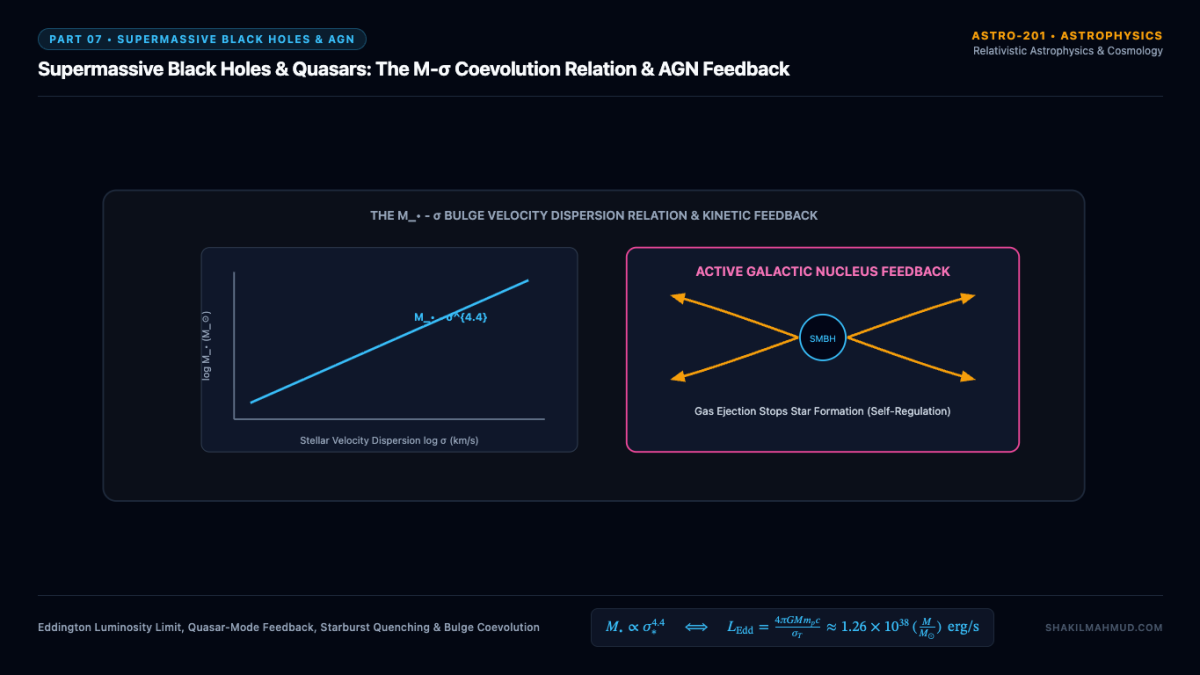
Despite the black hole occupying only $sim 10^{-6}$ of the host galaxy’s total volume, observations reveal an extraordinarily tight empirical correlation between the black hole mass $M_bullet$ and the stellar velocity dispersion $sigma$ of the host galaxy bulge:
M_bullet propto sigma_*^beta, quad text{where } beta approx 4.0 – 4.5
This power law demonstrates that black holes and their host galaxies do not grow independently; they undergo coupled co-evolution across cosmic time.
4. AGN Feedback: Quenching Cosmic Star Formation
The energy liberated by an actively accreting black hole ($E_{text{BH}} = eta M_bullet c^2$) exceeds the gravitational binding energy of the host galaxy gas by a factor of 10 to 100. AGN regulate their environment through two primary feedback regimes:
- Quasar Mode (Radiative / Wind): Near the Eddington limit, high radiation pressure and ultrafast accretion disc winds ($v sim 0.1c$) blast through the galaxy, sweeping cold molecular gas out of the potential well and terminating (“quenching”) star formation.
- Radio Mode (Kinetic / Maintenance): At low accretion rates, relativistic radio jets inflate massive bubbles in the surrounding intergalactic cluster gas, injecting heat and preventing cooling flows from collapsing into new stars.