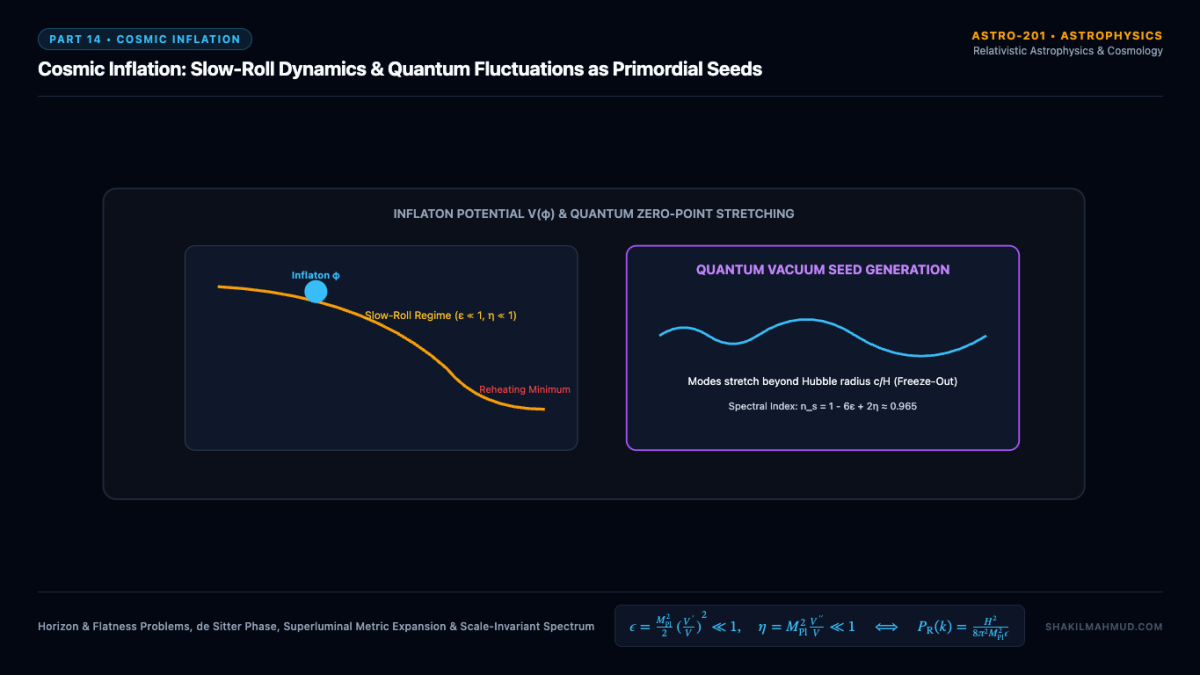
Despite the triumphs of the standard Big Bang model, classical FLRW cosmology suffered from deep fine-tuning pathologies: why is the universe so exquisitely spatially flat, and how could regions separated by billions of light-years possess the exact same temperature without ever having been in causal contact? In 1980, Alan Guth, Andrei Linde, and Alexei Starobinsky proposed the revolutionary paradigm of Cosmic Inflation: an exponential, superluminal expansion of space driven by a scalar field within the first $10^{-36}text{ seconds}$ of cosmic genesis.
1. The Pathologies of Classical Big Bang Cosmology
Classical cosmology was plagued by three catastrophic fine-tuning dilemmas:
- The Horizon Problem: The Cosmic Microwave Background (CMB) is isotropic to within one part in $10^5$ across the entire sky. Yet at recombination ($z approx 1100$), the observable sky contained roughly $40,000$ causally disconnected regions. How could they establish thermal equilibrium without exchanging information?
- The Flatness Problem: Spatial curvature evolves as $|Omega(t) – 1| propto a^2 H^{-2} propto t$ during radiation domination. For the universe to remain flat today ($|Omega_0 – 1| sim 10^{-3}$), the curvature at the Planck time had to be fine-tuned to zero to an absurd precision of one part in $10^{60}$.
- The Relic Monopole Problem: Grand Unified Theories (GUTs) predict that spontaneous symmetry breaking in the early universe should have produced an unobserved catastrophic abundance of heavy magnetic monopoles.
2. Inflaton Scalar Field & Slow-Roll Dynamics
Inflation resolves all three problems by postulating that the early universe was dominated by the potential energy density $V(phi)$ of a fundamental scalar field: the Inflaton $phi$. The action of the scalar field minimally coupled to gravity is:
S = int d^4x sqrt{-g} left[ frac{M_{text{Pl}}^2}{2} R – frac{1}{2} g^{munu} partial_mu phi partial_nu phi – V(phi) right]
The homogeneous scalar field obeys the Klein-Gordon equation in expanding FLRW spacetime:
ddot{phi} + 3Hdot{phi} + V'(phi) = 0, quad H^2 = frac{1}{3 M_{text{Pl}}^2} left[ frac{1}{2}dot{phi}^2 + V(phi) right]
Under the Slow-Roll Approximation, the kinetic energy is negligible compared to the potential energy ($dot{phi}^2 ll V(phi)$) and friction dominates acceleration ($|ddot{phi}| ll |3Hdot{phi}|$):
H^2 approx frac{V(phi)}{3 M_{text{Pl}}^2} approx text{const} quad Longrightarrow quad a(t) propto e^{Ht}
The duration of inflation is measured in $e$-folds $N = int H dt ge 60$. Space expanded by at least $e^{60} sim 10^{26}$, stretching a microscopic, causally connected patch into our entire observable universe, diluting monopoles to zero, and flattening spatial curvature like an inflating balloon.
3. Slow-Roll Parameters
The consistency and longevity of slow-roll inflation require the potential to be extraordinarily flat, parameterized by two dimensionless Slow-Roll Parameters:
epsilon equiv frac{M_{text{Pl}}^2}{2} left( frac{V’}{V} right)^2 ll 1, quad eta equiv M_{text{Pl}}^2 frac{V”}{V} ll 1
Inflation terminates when $epsilon(phi_{text{end}}) = 1$, where the field accelerates down the potential into rapid oscillations around the minimum, converting its potential energy into hot Standard Model particles through Reheating.
4. Quantum Fluctuations as the Seeds of Cosmic Structure
The most profound triumph of inflationary cosmology is that it explains where galaxies came from. During inflation, microscopic quantum vacuum zero-point fluctuations of the scalar field $deltaphi(t, mathbf{x})$ are stretched exponentially by metric expansion. When a physical wavelength crosses the Hubble radius ($lambda > c/H$), it freezes out as a classical primordial curvature perturbation $mathcal{R}_k$ with a nearly scale-invariant power spectrum:
P_mathcal{R}(k) = frac{H^2}{8pi^2 M_{text{Pl}}^2 epsilon} left( frac{k}{k_*} right)^{n_s – 1}
Where the scalar spectral tilt is $n_s – 1 = -6epsilon + 2eta approx -0.035$, predicting $n_s approx 0.965$. This precise quantum prediction matches Planck CMB observations to within four decimal places—confirming that the vast cosmic web of galaxies began as subatomic quantum uncertainty stretched across the sky.




