Approximately $84%$ of all matter in the universe emits, absorbs, and reflects zero electromagnetic radiation: it is Cold Dark Matter (CDM). First inferred by Fritz Zwicky in 1933 from the Coma cluster and firmly established by Vera Rubin’s observations of spiral galaxies in the 1970s, dark matter acts as the indispensable gravitational scaffolding of the cosmos. Without dark matter, the feeble baryonic density perturbations in the early universe could never have collapsed to form galaxies within the age of the cosmos.
1. Flat Galactic Rotation Curves
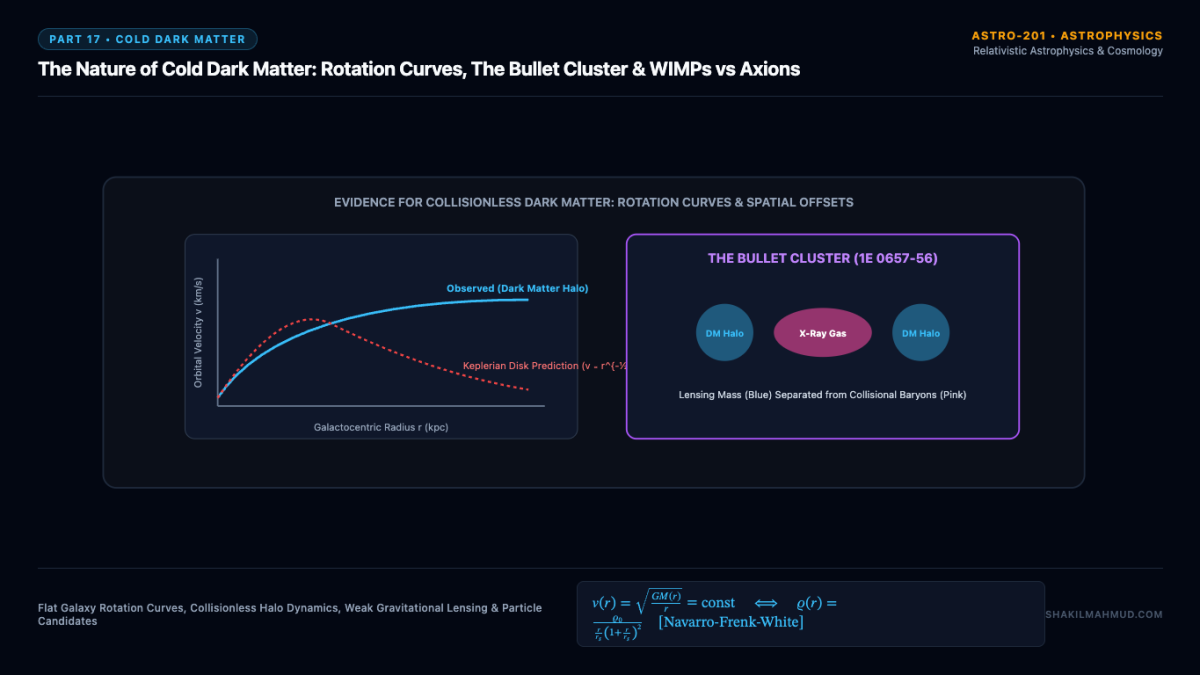
In Newtonian mechanics, the circular orbital velocity $v(r)$ of stars and neutral gas clouds orbiting at galactocentric radius $r$ outside the visible stellar disk is predicted by Kepler’s third law:
v(r) = sqrt{frac{G M(r)}{r}} propto r^{-1/2} quad text{for } r > R_{text{disk}}
Vera Rubin and Kent Ford measured the $21text{ cm}$ neutral hydrogen line and optical H$alpha$ emission out to several optical radii, discovering that rotation curves remain stubbornly flat: $v(r) approx text{const}$. This requires the enclosed mass to grow linearly with radius:
M(r) propto r quad Longrightarrow quad rho_{text{DM}}(r) = frac{v_0^2}{4pi G r^2} propto r^{-2}
Cosmological $N$-body simulations reveal that collisionless dark matter settles into the universal Navarro-Frenk-White (NFW) Profile:
rho(r) = frac{rho_0}{left(frac{r}{r_s}right) left(1 + frac{r}{r_s}right)^2}
Scaling as $r^{-1}$ in the central cusp and transitioning to $r^{-3}$ in the outer virialized halo.
2. Gravitational Lensing & The Bullet Cluster Proof
Alternative theories, such as Modified Newtonian Dynamics (MOND), attempted to explain flat rotation curves by modifying gravity at low accelerations ($a < a_0 approx 1.2 times 10^{-10}text{ m/s}^2$) without invoking invisible matter. The definitive empirical disproof of pure modified gravity came from the Bullet Cluster (1E 0657-56), a high-velocity collision of two galaxy clusters:
- Baryonic Gas (Chandra X-Ray): Intergalactic plasma constitutes $sim 90%$ of ordinary baryonic matter. During the collision, the gas clouds collided hydrodynamically, experiencing ram-pressure drag that slowed them down and concentrated them in the collision center.
- Stars / Galaxies (Optical): The individual stars within galaxies are separated by immense interstellar voids, so galaxies passed right through each other without collision.
- Gravitational Potential (Weak Lensing): Weak gravitational lensing maps of background galaxies revealed that the dominant gravitational mass peaks coincide with the collisionless galaxies, spatially offset from the hot X-ray gas by over $8sigma$ statistical significance.
Because gravity follows the non-collisional mass rather than the baryonic plasma, the Bullet Cluster proves that dark matter is a physical, collisionless substance rather than an artifact of modified gravitational laws.
3. Particle Candidates: WIMPs, Axions & Sterile Neutrinos
Because Big Bang Nucleosynthesis strictly constrains the baryon density to $Omega_b h^2 approx 0.022$, dark matter must be fundamentally non-baryonic:
- WIMPs (Weakly Interacting Massive Particles): Hypothesized stable particles ($m sim 10 – 1000text{ GeV}$) interacting via weak nuclear force and gravity. In thermal freeze-out, a weak-scale cross-section ($langle sigma v rangle approx 3 times 10^{-26}text{ cm}^3/text{s}$) naturally yields the observed relic density $Omega_{text{DM}} approx 0.26$—the famous “WIMP Miracle”.
- QCD Axions: Ultralight pseudo-Nambu-Goldstone bosons ($m_a sim 10^{-6} – 10^{-3}text{ eV}$) predicted by the Peccei-Quinn mechanism to resolve the Strong CP Problem. Despite their tiny mass, axions are produced non-thermally via vacuum misalignment, behaving as cold, pressureless dark matter.
- Sterile Neutrinos: Right-handed, gauge-singlet fermions with masses $m_s sim text{keV}$ that could explain both neutrino oscillation masses via the seesaw mechanism and serve as Warm Dark Matter.