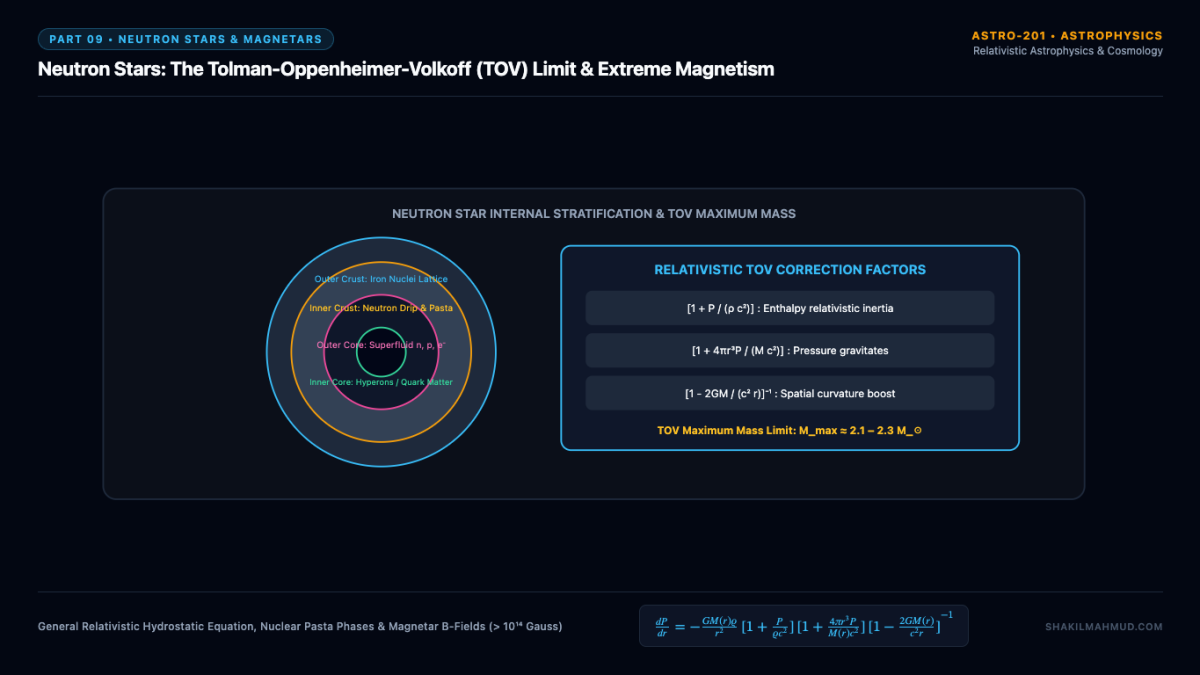
When a core-collapse supernova occurs in a progenitor star with $M approx 8 – 25 M_odot$, crushing gravitational pressure forces electrons and protons to undergo inverse beta decay ($p + e^- to n + nu_e$). The result is a Neutron Star: an atomic nucleus scaled to city dimensions, packing $sim 1.4 – 2.1 M_odot$ into a sphere of radius $R approx 11 – 13text{ km}$ at central densities exceeding $rho_c sim 10^{15}text{ g/cm}^3$. In this regime, general relativity fundamentally modifies hydrostatic equilibrium via the Tolman-Oppenheimer-Volkoff (TOV) Equation.
1. The Tolman-Oppenheimer-Volkoff (TOV) Equation
In Newtonian mechanics, stellar balance is described by $dP/dr = -G M rho / r^2$. In general relativity, three distinct relativistic effects amplify gravity, as derived by Richard Tolman, J. Robert Oppenheimer, and George Volkoff in 1939:
frac{dP}{dr} = -frac{G M(r) rho}{r^2} left[ 1 + frac{P}{rho c^2} right] left[ 1 + frac{4pi r^3 P}{M(r) c^2} right] left[ 1 – frac{2GM(r)}{c^2 r} right]^{-1}
Each bracketed term represents a purely relativistic correction:
- $left[ 1 + frac{P}{rho c^2} right]$ accounts for the relativistic inertia of pressure (enthalpy).
- $left[ 1 + frac{4pi r^3 P}{M(r) c^2} right]$ reflects the fact that in general relativity, pressure itself is an active source of spacetime curvature ($T_{munu}$).
- $left[ 1 – frac{2GM(r)}{c^2 r} right]^{-1}$ accounts for the spatial metric stretching ($g_{rr}$) around dense masses.
Because pressure actively increases gravitational attraction, higher central pressure eventually accelerates collapse rather than preventing it. This establishes the TOV Maximum Mass Limit ($M_{text{TOV}} approx 2.1 – 2.3 M_odot$). Any stellar core exceeding this limit collapses into a black hole.
2. Internal Stratification & Nuclear Pasta
The internal morphology of a neutron star exhibits dramatic phase transitions across its depth:
- Outer Crust ($0.3text{ km}$, $rho sim 10^6 – 4times 10^{11}text{ g/cm}^3$): A solid Coulomb lattice of neutron-rich nuclei ($^{56}text{Fe}$, $^{62}text{Ni}$, $^{118}text{Kr}$) embedded in a relativistic degenerate electron gas.
- Inner Crust ($0.6text{ km}$, $rho sim 4times 10^{11} – 2times 10^{14}text{ g/cm}^3$): Beyond the neutron drip density ($4.3 times 10^{11}text{ g/cm}^3$), neutrons spill out of nuclei, forming a superfluid neutron sea alongside the nuclear lattice.
- Nuclear Pasta ($10^{14}text{ g/cm}^3$): At the core-crust interface, the competition between nuclear surface tension and Coulomb repulsion deforms spherical nuclei into exotic topological geometries: “gnocchi” (rods), “spaghetti” (cylinders), “lasagna” (sheets), and “Swiss cheese” (void tubes). This constitutes the mechanically strongest material known in the universe ($10^{10}$ times stronger than steel).
- Core ($10text{ km}$, $rho > 2times 10^{14}text{ g/cm}^3$): Uniform Fermi liquid of superfluid neutrons, superconducting protons, and relativistic electrons/muons, potentially transitioning into hyperons or deconfined quark-gluon matter at the center.
3. Pulsars & Magnetars: The Ultimate Magnetic Dynamos
During core collapse, conservation of magnetic flux ($Phi = B R^2 = text{const}$) compresses a progenitor star’s magnetic field by a factor of $(R_{text{star}} / R_{text{NS}})^2 sim (10^6 / 10)^2 = 10^{10}$, producing standard radio pulsars with surface fields of $B sim 10^{12}text{ Gauss}$.
In roughly $10%$ of collapses, rapid rotation ($sim 1text{ ms}$) drives a helical convective $alpha$-$Omega$ dynamo, generating fields of $B sim 10^{14} – 10^{15}text{ Gauss}$—creating a Magnetar. At these field strengths, the magnetic energy density exceeds the quantum electrodynamic (QED) critical field ($B_{text{QED}} = frac{m_e^2 c^3}{ehbar} approx 4.414 times 10^{13}text{ Gauss}$): the vacuum itself becomes birefringent, photons split spontaneously ($gamma to gamma + gamma$), and magnetic crustquakes trigger catastrophic giant gamma-ray flares releasing $10^{46}text{ erg}$ in fractions of a second.




