In 1916, Albert Einstein deduced that accelerating mass distributions must perturb the geometry of spacetime, generating ripples in the metric that propagate across the cosmos at the speed of light: Gravitational Waves. Unlike electromagnetic waves, which represent vibrations of a vector field propagating through spacetime, gravitational waves represent ripples of spacetime itself—stretching and compressing spatial dimensions perpendicular to their direction of propagation.
1. Linearized Gravity in the Weak-Field Limit
Far from strong gravitational sources, the metric tensor can be decomposed as flat Minkowski spacetime $eta_{munu} = text{diag}(-1, 1, 1, 1)$ perturbed by an infinitesimal perturbation $h_{munu}$ ($|h_{munu}| ll 1$):
g_{munu} = eta_{munu} + h_{munu}
Defining the trace-reversed perturbation $bar{h}_{munu} = h_{munu} – frac{1}{2} eta_{munu} h$ and adopting the Lorenz gauge condition $partial^mu bar{h}_{munu} = 0$, the non-linear Einstein field equations simplify to an exact, linear wave equation:
Box bar{h}_{munu} = left( -frac{1}{c^2} frac{partial^2}{partial t^2} + nabla^2 right) bar{h}_{munu} = -frac{16pi G}{c^4} T_{munu}
In vacuum ($T_{munu} = 0$), the equation becomes $Box bar{h}_{munu} = 0$, proving that spacetime metric disturbances propagate at precisely the speed of light ($v = c$).
2. The Transverse-Traceless (TT) Gauge
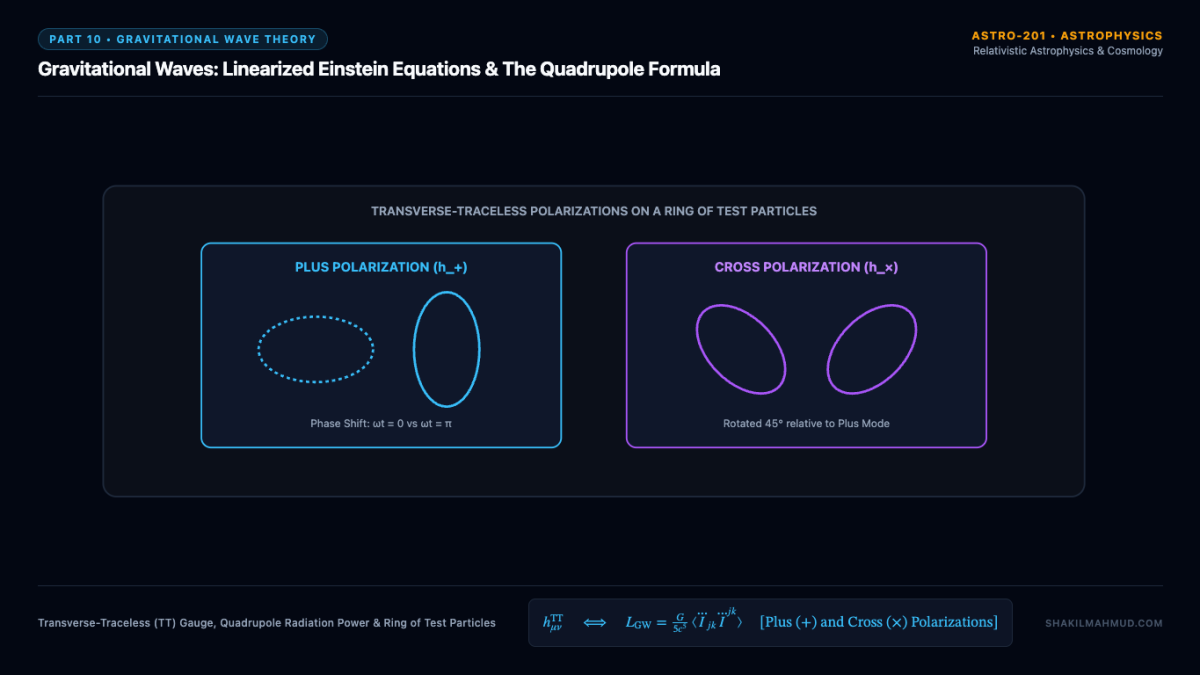
Using the residual coordinate gauge freedoms of general relativity, the physical radiation field outside the source can be cast into the Transverse-Traceless (TT) Gauge ($h_{0mu} = 0$, $h^i_{;i} = 0$, and $partial^j h_{ij} = 0$). For a wave traveling along the $z$-axis ($k^mu = (omega/c, 0, 0, omega/c)$), the metric perturbation tensor possesses only two independent physical polarization states:
h_{ij}^{text{TT}}(t, z) = begin{pmatrix} h_+ & h_times & 0 \ h_times & -h_+ & 0 \ 0 & 0 & 0 end{pmatrix} e^{i(omega t – kz)}
Where $h_+$ represents the “plus” polarization and $h_times$ represents the “cross” polarization (rotated by $45^circ$). A circular ring of freely falling test particles in the $x-y$ plane deformed by an incoming $h_+$ wave stretches along the $x$-axis while compressing along the $y$-axis during the first half-cycle, reversing the distortion during the second half-cycle.
3. The Quadrupole Radiation Formula
Why are gravitational monopoles and dipoles forbidden? Conservation of total mass ($dot{M} = 0$) eliminates monopole radiation. Conservation of total linear momentum ($dot{mathbf{P}} = ddot{mathbf{d}} = 0$) eliminates mass-dipole radiation. Therefore, gravitational radiation begins at the Mass Quadrupole Moment order:
I_{ij} = int rho(t, mathbf{x}) left( x_i x_j – frac{1}{3} r^2 delta_{ij} right) d^3x
In 1918, Einstein derived the total gravitational radiation luminosity emitted by an arbitrary non-relativistic source:
L_{text{GW}} = frac{G}{5 c^5} leftlangle dddot{I}_{jk} dddot{I}^{jk} rightrangle
The coupling constant $G/c^5 approx 2.74 times 10^{-60}text{ s/erg}$ is astonishingly small, explaining why gravitational waves are imperceptible for laboratory masses and require cosmic compact binaries to be detected.
4. Binary Orbital Decay: The Hulse-Taylor Pulsar
For a circular binary system of masses $m_1$ and $m_2$ separated by orbital distance $r$ with angular velocity $Omega$, the emitted gravitational power is:
L_{text{GW}} = frac{32}{5} frac{G^4}{c^5} frac{m_1^2 m_2^2 (m_1 + m_2)}{r^5}
This steady radiation of energy drains orbital angular momentum, causing the orbital period $P_b$ to decrease over time:
dot{P}_b = -frac{192pi}{5 c^5} left( frac{2pi G}{P_b} right)^{5/3} frac{m_1 m_2}{(m_1 + m_2)^{1/3}} left( 1 + frac{73}{24} e^2 + frac{37}{96} e^4 right) (1-e^2)^{-7/2}
Russell Hulse and Joseph Taylor monitored the binary pulsar PSR B1913+16 for three decades, measuring an orbital period decay matching general relativity’s prediction to within $0.2%$, providing the first definitive indirect proof of gravitational waves (Nobel Prize 1993).