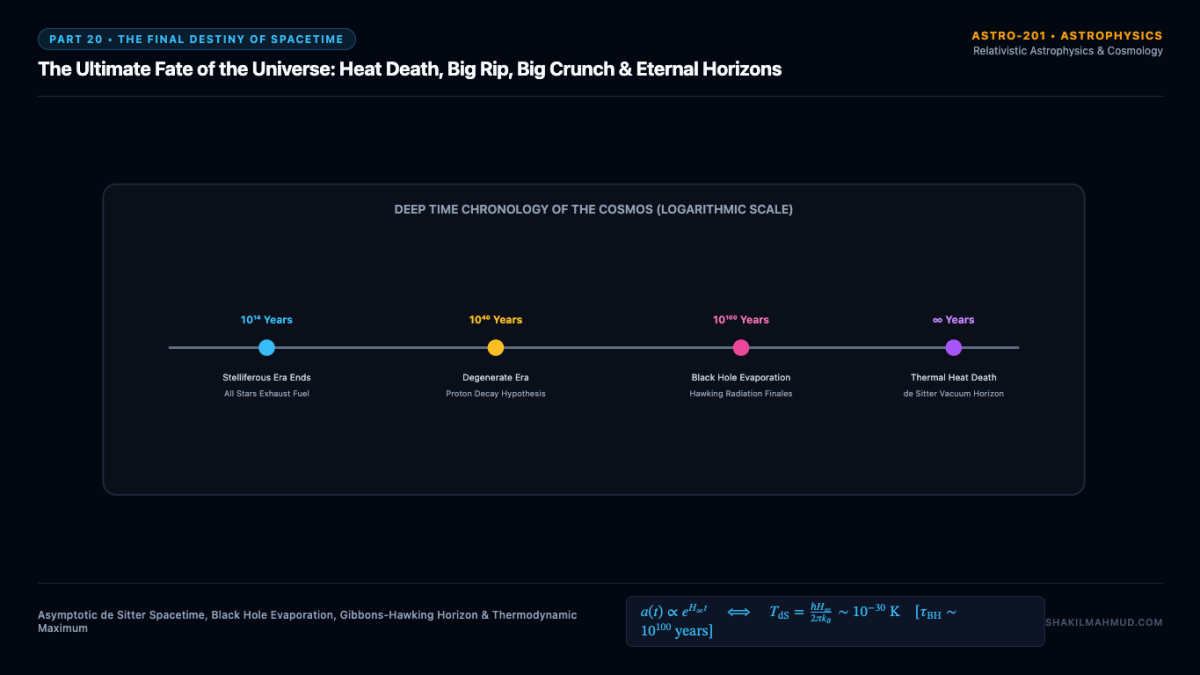
All physical structures across the universe—from subatomic nucleons and planets to burning stars and colossal galaxies—are temporary thermodynamic fluctuations against the relentless arrow of entropy. Dictated by the equation of state of dark energy, general relativity allows us to peer across trillions of years into the unimaginable deep-time future of reality. In a flat $Lambdatext{CDM}$ universe, spacetime asymptotes toward an eternal, dark, causally disconnected vacuum: The Thermodynamic Heat Death.
1. The Five Cosmological Eras of Deep Time
Astrophysicists Fred Adams and Gregory Laughlin categorized the future history of the cosmos across five distinct logarithmic epochs:
- The Primordial Era ($t < 10^5text{ yr}$): From the Big Bang, inflation, and nucleosynthesis to recombination and structure formation.
- The Stelliferous Era ($10^6 – 10^{14}text{ yr}$): The current vibrant era in which matter is organized into stars, galaxies, and planetary systems. In $sim 10^{11}text{ yr}$, interstellar gas reservoirs will be exhausted. The longest-lived red dwarf stars ($M sim 0.08 M_odot$) will burn their fuel over $10^{13}text{ yr}$, finally fading into cold white embers. By $t sim 10^{14}text{ yr}$, all stellar fusion across the universe terminates.
- The Degenerate Era ($10^{14} – 10^{40}text{ yr}$): The universe is populated exclusively by cold stellar corpses: white dwarfs, neutron stars, brown dwarfs, and black holes. Galaxies dissolve through dynamical relaxation, ejecting $99%$ of stars into intergalactic space while the remaining $1%$ fall into central supermassive black holes. If Grand Unified Theories are correct, baryons are unstable to proton decay ($p to e^+ + pi^0$) with a half-life of $tau_p sim 10^{34} – 10^{37}text{ yr}$, causing all solid degenerate matter to dissolve into positrons and photons by $10^{40}text{ yr}$.
- The Black Hole Era ($10^{40} – 10^{100}text{ yr}$): Black holes are the sole remaining gravitational macro-structures in the cosmos. Even these ultimate abysses are not permanent: via quantum Hawking radiation, stellar black holes evaporate in $sim 10^{67}text{ yr}$, and gargantuan supermassive black holes ($10^{10} M_odot$) evaporate in $sim 10^{100}text{ yr}$, culminating in blinding, sub-microsecond energetic explosions.
- The Dark Era ($t > 10^{100}text{ yr}$): The universe contains only an extraordinarily diffuse bath of ultra-low-energy photons, neutrinos, electrons, and positrons, separated by horizons exceeding the size of the current observable cosmos. No work can ever be extracted; the thermodynamic entropy of the universe reaches its global maximum.
2. The Asymptotic de Sitter Spacetime & Event Horizon
Because dark energy remains constant ($w = -1$), the cosmic scale factor expands exponentially without bound: $a(t) propto e^{H_infty t}$, where $H_infty = csqrt{Lambda / 3} approx 56text{ km/s/Mpc}$. This imposes a permanent physical Cosmological Event Horizon at comoving radius:
r_{text{horizon}} = c int_t^infty frac{dt’}{a(t’)} = frac{c}{H_infty} approx 16text{ billion light-years}
Every galaxy beyond our gravitationally bound Local Supercluster (Milky Way-Andromeda merger) will cross this horizon, redshifting into absolute invisibility within $sim 100text{ billion years}$. Future astronomers will observe a lonely island galaxy surrounded by completely pitch-black, empty space, with all traces of the Big Bang and the CMB erased forever.
3. Alternative Cosmological Fates
The ultimate destiny of spacetime depends strictly on the microphysics of dark energy:
- The Big Rip (Phantom Energy, $w < -1$): If dark energy density increases with expansion, cosmic acceleration diverges in finite time ($t_{text{rip}} sim 20 – 50text{ Gyr}$). Metric expansion tears apart galaxy clusters, stars, planets, and finally atoms and quarks as the fabric of spacetime rips into infinite singularity.
- The Big Crunch (Decaying $Lambda < 0$): If the cosmological constant decays to negative values (as in Anti-de Sitter vacua), cosmic expansion halts and reverses, crushing the entire universe into a fiery microscopic singularity.
- Conformal Cyclic Cosmology (CCC): Proposed by Roger Penrose: in the far Dark Era when all rest mass has decayed into massless conformally invariant radiation ($m to 0$), spacetime loses all physical clocks and rulers. A conformal rescaling maps the infinite future boundary smoothly into the low-entropy Big Bang singularity of a new cosmic “aeon”.
4. The Thermodynamic Horizon
The empty de Sitter vacuum itself possesses an irreducible quantum Gibbons-Hawking temperature:
T_{text{dS}} = frac{hbar H_infty}{2pi k_B} approx 2.4 times 10^{-30}text{ K}
At this temperature, random thermal and quantum fluctuations can spontaneously fluctuate microstates over Poincaré recurrence times ($t_{text{recurrence}} sim 10^{10^{120}}text{ yr}$), reminding us that in the infinite expanse of mathematical physics, spacetime itself remains an eternal playground of quantum geometry.




