Throughout the early decades of general relativity, physicists believed that the singularities in the Schwarzschild and Friedmann solutions were merely mathematical artifacts of idealized spherical symmetry. In 1965, Roger Penrose revolutionized mathematical physics by proving the first Singularity Theorem using modern differential topology, establishing that once gravitational collapse progresses past a critical point, a physical singularity is the geometrically inevitable consequence of classical spacetime.
1. The Raychaudhuri Equation: Universal Gravitational Focusing
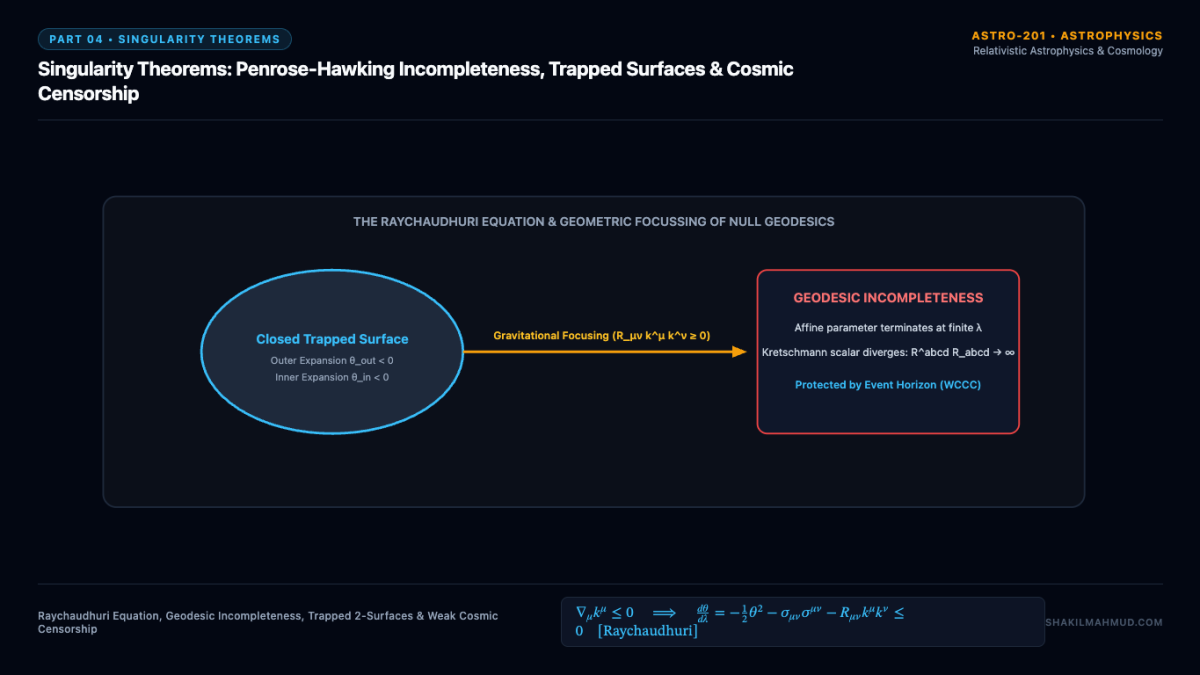
At the mathematical core of the singularity theorems lies the Raychaudhuri Equation (derived by Amal Kumar Raychaudhuri in 1955). For a bundle of null geodesics with affine parameter $lambda$, tangent vector $k^mu$, expansion scalar $theta = nabla_mu k^mu$, shear tensor $sigma_{munu}$, and vorticity tensor $omega_{munu}$:
frac{dtheta}{dlambda} = -frac{1}{2} theta^2 – sigma_{munu} sigma^{munu} + omega_{munu} omega^{munu} – R_{munu} k^mu k^nu
For hypersurface-orthogonal null congruences ($omega_{munu} = 0$), and assuming matter obeys the Null Energy Condition (NEC) ($T_{munu} k^mu k^nu ge 0$, which via the Einstein equations implies $R_{munu} k^mu k^nu ge 0$):
frac{dtheta}{dlambda} le -frac{1}{2} theta^2
Integrating this differential inequality demonstrates that if a bundle is converging ($theta_0 < 0$), $theta to -infty$ within a finite affine parameter $lambda le 2 / |theta_0|$. Gravity acts universally as an attractive focusing lens.
2. Closed Trapped Surfaces
Penrose introduced the topological concept of a Closed Trapped Surface: a compact spacelike 2-surface $mathcal{T}$ where both the outgoing ($theta_{text{out}}$) and ingoing ($theta_{text{in}}$) families of orthogonal null geodesics are converging:
theta_{text{out}} < 0 quad text{and} quad theta_{text{in}} < 0
In flat Minkowski space, the area of an outgoing spherical wavefront of light expands ($theta_{text{out}} > 0$). Inside a trapped surface, even light rays directed radially outward are forced inward by intense spacetime curvature.
3. Penrose’s Singularity Theorem (1965)
Penrose’s theorem states that a spacetime $(mathcal{M}, g)$ cannot be null geodesically complete if:
- The Null Energy Condition holds: $R_{munu} k^mu k^nu ge 0$ for all null vectors $k^mu$.
- $mathcal{M}$ possesses a non-compact Cauchy surface $Sigma$ (global hyperbolicity).
- $mathcal{M}$ contains a closed trapped surface $mathcal{T}$.
Under these minimal, generic conditions, there exists at least one null geodesic that terminates at a finite affine parameter—proving that physical singularities are not accidents of spherical symmetry, but an inescapable structural feature of general relativity.
4. Cosmic Censorship Hypotheses
Because physical singularities represent boundaries where predictable laws of physics collapse, Penrose formulated the Weak Cosmic Censorship Hypothesis (WCCH): all singularities formed via realistic gravitational collapse are hidden from distant observers behind an event horizon. The naked singularity remains strictly censored from the causal universe.