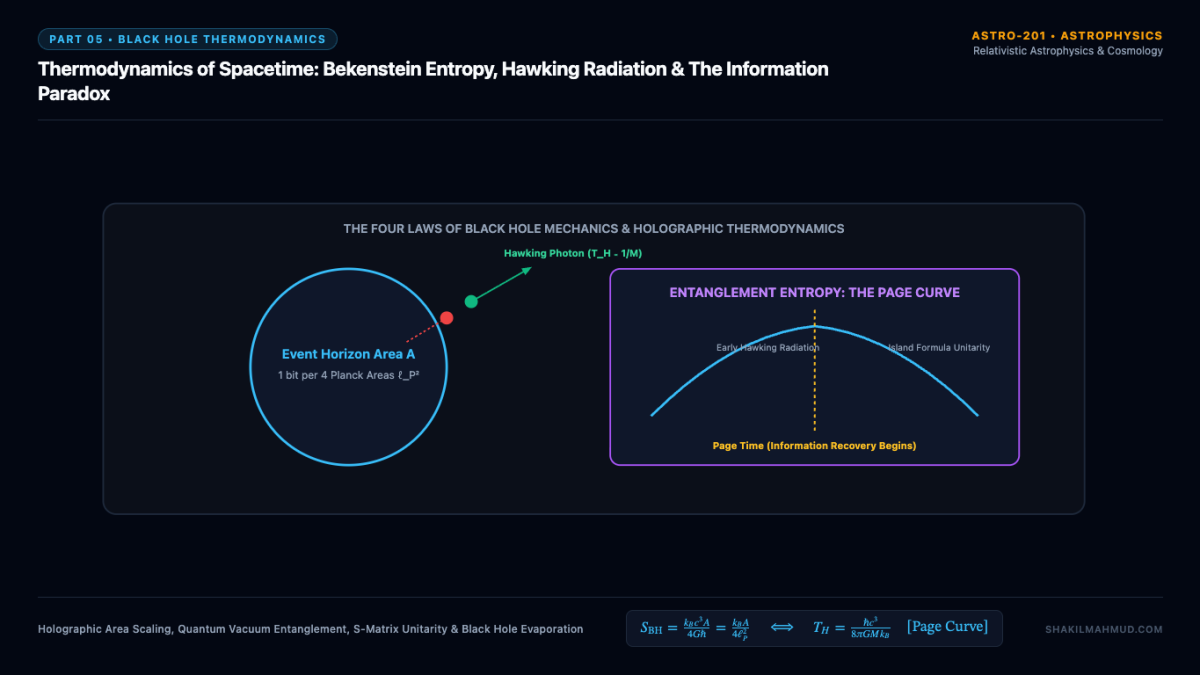
In classical general relativity, black holes are pure vacuum spacetime sinks from which nothing—not even light—can ever escape. However, when quantum field theory is formulated on curved spacetime backgrounds, black holes are revealed to be fully thermodynamic objects possessing a non-zero temperature, emitting thermal radiation, and carrying an astronomical microscopic entropy proportional to their event horizon area. This synthesis, pioneered by Jacob Bekenstein and Stephen Hawking, bridges gravitation, quantum mechanics, and statistical thermodynamics.
1. The Four Laws of Black Hole Mechanics
In 1973, Bardeen, Carter, and Hawking formulated the geometric laws of black hole mechanics, drawing an exact mathematical isomorphism to classical thermodynamics:
| Law | Thermodynamics | Black Hole Mechanics |
|---|---|---|
| Zeroth | Temperature $T$ is uniform at thermal equilibrium | Surface gravity $kappa$ is constant over the event horizon of a stationary black hole |
| First | $dE = T dS + dW$ | $dM = frac{kappa}{8pi} dA + Omega_H dJ + Phi_H dQ$ |
| Second | $Delta S ge 0$ (Entropy never decreases) | $Delta A ge 0$ (Hawking Area Theorem: total horizon area never decreases in classical mergers) |
| Third | $T = 0$ cannot be reached in finite operations | $kappa = 0$ (Extremal state) cannot be reached in a finite sequence of physical steps |
2. Bekenstein Entropy & The Holographic Bound
Jacob Bekenstein realized that if black holes lacked entropy, dropping an entropy-rich object into a black hole would violate the Second Law of Thermodynamics. He conjectured that the horizon area $A$ is physical entropy. In 1974, Stephen Hawking computed the exact normalization coefficient via quantum field theory on curved spacetime:
S_{text{BH}} = frac{k_B c^3 A}{4 G hbar} = frac{k_B A}{4 ell_P^2}
Where $ell_P = sqrt{frac{Ghbar}{c^3}} approx 1.616 times 10^{-35}text{ m}$ is the Planck length. Unlike ordinary thermodynamic systems where entropy scales extensively with spatial volume ($S propto V$), black hole entropy scales strictly with the two-dimensional enclosing boundary surface ($S propto A$). This remarkable relationship laid the foundation for Gerard ‘t Hooft and Leonard Susskind’s Holographic Principle.
3. Hawking Radiation & Black Hole Evaporation
Hawking demonstrated that quantum vacuum fluctuations near the event horizon undergo tidal particle-antiparticle separation. Modes with negative energy relative to infinity tunnel across the horizon, while positive-energy modes escape to infinity. A stationary black hole radiates as a perfect blackbody at the Hawking Temperature:
T_H = frac{hbar c^3}{8pi G M k_B} approx 6.17 times 10^{-8} left(frac{M_odot}{M}right) text{ K}
Because temperature is inversely proportional to mass, black holes possess Negative Specific Heat: radiating energy makes them hotter, accelerating evaporation until final quantum dissolution over a timescale scaling as:
tau_{text{evap}} = frac{5120 pi G^2 M^3}{hbar c^4} propto M^3
For a solar-mass black hole, $tau_{text{evap}} approx 2.1 times 10^{67}text{ years}$.
4. The Black Hole Information Paradox & The Page Curve
If a pure quantum state $rho_{text{in}} = |psiranglelanglepsi|$ collapses into a black hole that subsequently evaporates entirely into mixed thermal Hawking radiation, quantum mechanical unitarity ($text{Tr}(rho^2) = 1$) is violated: information is destroyed. Don Page resolved this paradox by showing that if quantum evaporation is unitary, the entanglement entropy of the emitted radiation must follow the Page Curve: initially rising, peaking at the Page Time ($sim tau_{text{evap}} / 2$) when the black hole has shed half its Bekenstein-Hawking entropy, and thereafter declining back to zero as late radiation purifies early radiation via quantum entanglement.




