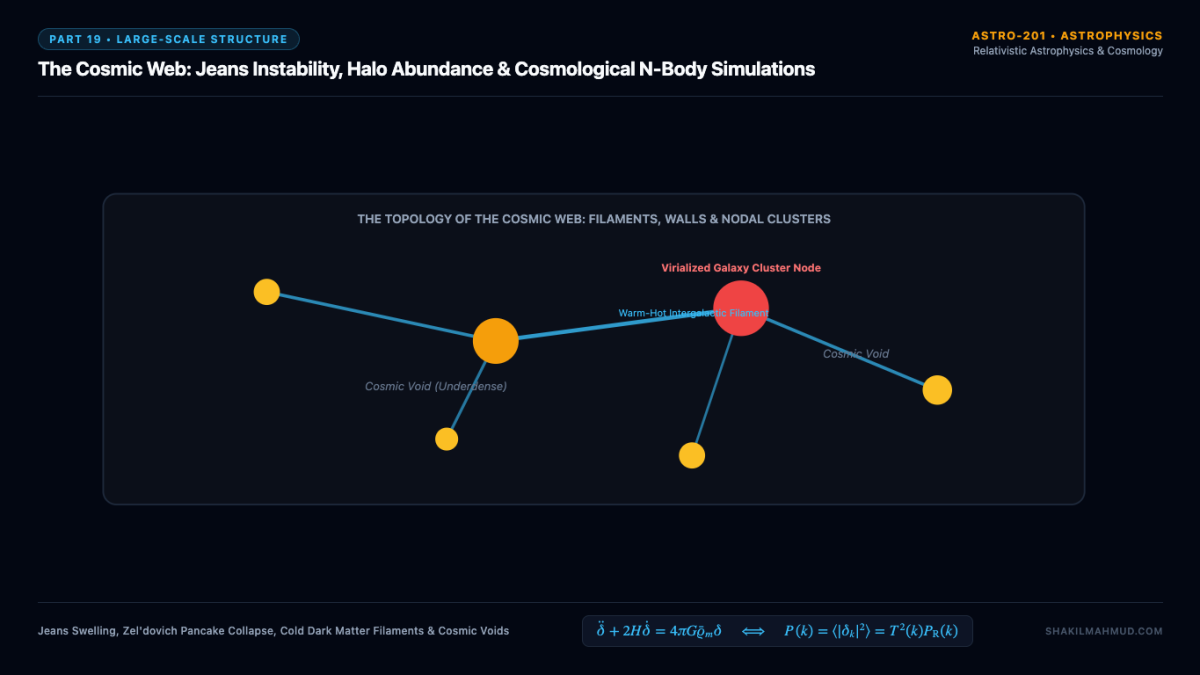
On the largest observable cosmological scales, the universe is not a uniform soup of stars, nor is it a random scattering of points. It is an intricate, gossamer tapestry known as the Cosmic Web: interconnected filamentary bridges of dark matter and hot intergalactic gas spanning hundreds of millions of light-years, intersecting at dense gravitational nodes harboring giant galaxy clusters, and surrounding gargantuan, desolate Cosmic Voids. This macroscopic architecture grew from subatomic quantum seeds via Relativistic Gravitational Instability.
1. Jeans Instability in an Expanding Spacetime
In a static medium (Sir James Jeans, 1902), gravitational collapse occurs exponentially: $delta rho / rho propto e^{t/tau_J}$. In an expanding FLRW universe, however, Hubble expansion opposes gravitational collapse, transforming exponential runaway into a gentle power-law growth. Perturbing the continuity, Euler, and Poisson equations in an expanding frame yields the fundamental perturbation equation for density contrast $delta(t, mathbf{x}) equiv frac{rho(t, mathbf{x}) – bar{rho}}{bar{rho}}$:
ddot{delta}_k + 2Hdot{delta}_k + left( frac{c_s^2 k^2}{a^2} – 4pi G bar{rho}_m right) delta_k = 0
Where $k$ is the comoving wavenumber. The balance between sound pressure and self-gravity defines the Jeans Wavenumber $k_J$ and Jeans length $lambda_J$:
lambda_J = c_s sqrt{frac{pi}{G bar{rho}_m}}
- For perturbations on scales smaller than the Jeans length ($lambda < lambda_J$), pressure dominates: perturbations oscillate as acoustic sound waves.
- For scales larger than the Jeans length ($lambda > lambda_J$), gravity dominates: perturbations grow monotonically. During the matter-dominated era ($H = frac{2}{3t}$ and $bar{rho}_m = frac{1}{6pi G t^2}$), the growing mode scales as:
delta(a) propto a(t) propto t^{2/3}
Remarkably, density perturbations grow purely linearly with the cosmic scale factor $a$.
2. Dark Matter Scaffolding & The Meszaros Effect
Prior to recombination ($z > 1100$), baryonic matter was tightly coupled to radiation, with sound speed $c_s approx c/sqrt{3}$ producing an enormous Jeans mass ($M_J sim 10^{16} M_odot$). Baryons were physically forbidden from collapsing. Cold dark matter, being uncoupled to photons, had zero pressure ($c_s approx 0$): dark matter perturbations began collapsing into gravitational potential wells deep inside the radiation-dominated era (subject to the logarithmic Meszaros slowdown $delta propto ln a$).
When baryons decoupled at $z approx 1100$, their Jeans mass plummeted precipitously to $M_J sim 10^5 M_odot$ (the scale of globular clusters). Baryonic gas fell rapidly into the pre-existing dark matter gravitational wells, allowing galaxies to form within merely hundreds of millions of years.
3. The Zel’dovich Approximation & Anisotropic Pancake Collapse
In 1970, Soviet physicist Yakov Zel’dovich formulated an elegant kinematic approximation describing the non-linear transition of cosmic structure. The Eulerian comoving position $mathbf{x}$ of a fluid element is mapped from its initial Lagrangian coordinate $mathbf{q}$ via:
mathbf{x}(mathbf{q}, t) = mathbf{q} – D(t) nabla Phi_0(mathbf{q})
Where $D(t)$ is the linear growth factor and $Phi_0$ is the primordial gravitational potential. The Jacobian tensor governing local deformation has three eigenvalues: $alpha ge beta ge gamma$. Because the eigenvalues are generically unequal, gravitational collapse occurs anisotropically across three successive stages:
- 1D Compression (Sheets / Pancakes): Collapse occurs along the axis of the largest eigenvalue $alpha$, flattening spherical matter into giant, two-dimensional planar walls (Zel’dovich pancakes).
- 2D Compression (Filaments): Secondary collapse occurs along the intermediate eigenvalue $beta$, channeling matter from sheets into one-dimensional cosmic filaments.
- 3D Virialization (Cluster Nodes): Final collapse along the third axis $gamma$ draws matter along filaments into dense, zero-dimensional virialized nodes containing rich galaxy clusters.
4. Cosmological N-Body Simulations: The Millenium & Illustris Proofs
Modern supercomputing projects—such as the Millennium, IllustrisTNG, and Euclid Flagship simulations—trace the gravitational interaction of hundreds of billions of dark matter particles across trillions of cubic light-years. Starting from Planck CMB initial quantum fluctuations at $z = 1000$, these simulations reproduce the observed galaxy survey maps (SDSS, 2dFGRS, DESI) with breathtaking fidelity—confirming that the Cosmic Web is the natural macroscopic crystallization of inflationary quantum seeds.




