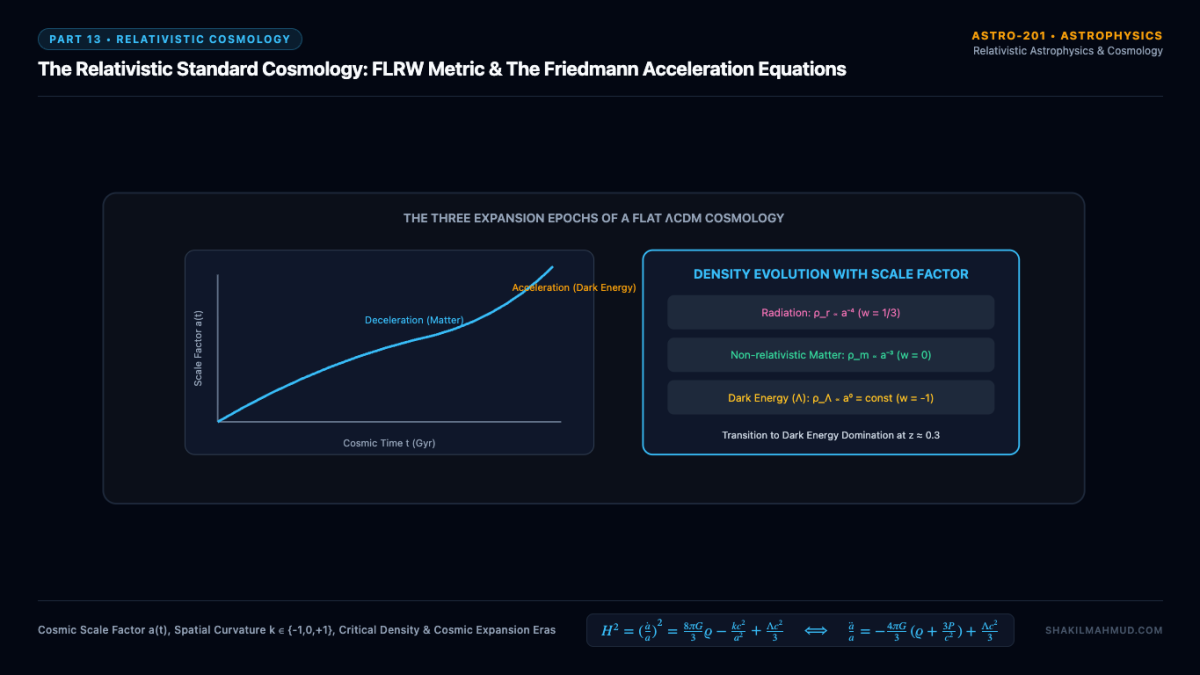
Physical cosmology is the scientific study of the universe as a unified dynamical system. Applying general relativity to the cosmos as a whole rests upon the Cosmological Principle: on spatial scales exceeding $sim 100text{ Mpc}$, the universe is both spatially homogeneous (identical at every point) and isotropic (identical in every direction). Under these fundamental symmetries, spacetime geometry reduces to the Friedmann-Lemaître-Robertson-Walker (FLRW) Metric, and Einstein’s ten coupled non-linear equations collapse into the elegant Friedmann Equations.
1. The FLRW Line Element & Cosmic Scale Factor
The unique spacetime metric satisfying spatial homogeneity and isotropy is the FLRW metric, written in comoving spatial coordinates $(r, theta, phi)$ and cosmic time $t$:
ds^2 = -c^2 dt^2 + a^2(t) left[ frac{dr^2}{1 – k r^2} + r^2 (dtheta^2 + sin^2theta dphi^2) right]
Where $a(t)$ is the dimensionless Cosmic Scale Factor (normalized to $a(t_0) = 1$ today) parameterizing the physical expansion of space, and $k in {-1, 0, +1}$ is the discrete spatial curvature parameter:
- $k = +1$: Closed 3-sphere geometry with positive spatial curvature and finite volume.
- $k = 0$: Spatially flat Euclidean geometry with infinite volume.
- $k = -1$: Open hyperbolic geometry with negative spatial curvature and infinite volume.
2. The First & Second Friedmann Equations
Modeling cosmic matter-energy as a perfect fluid with energy-momentum tensor $T^mu_{;nu} = text{diag}(-rho c^2, P, P, P)$, the $00$-component and spatial components of the Einstein field equations yield the two fundamental Friedmann equations:
First Friedmann Equation (Energy Conservation):
H^2 equiv left( frac{dot{a}}{a} right)^2 = frac{8pi G}{3}rho – frac{k c^2}{a^2} + frac{Lambda c^2}{3}
Second Friedmann Equation (Acceleration Equation):
frac{ddot{a}}{a} = -frac{4pi G}{3} left( rho + frac{3P}{c^2} right) + frac{Lambda c^2}{3}
Where $H(t) equiv dot{a}/a$ is the Hubble parameter. A profound revelation of the acceleration equation is that ordinary pressure decelerates the universe ($ddot{a} < 0$) because pressure actively gravitates in general relativity. Only a substance with negative pressure satisfying $P 0$).
3. Density Parameters & Critical Density
The First Friedmann equation can be recast in terms of dimensionless density parameters $Omega_i equiv rho_i / rho_{text{crit}}$, where the Critical Density is the exact density required for spatial flatness ($k = 0$):
rho_{text{crit}}(t) = frac{3 H^2(t)}{8pi G} quad left[ rho_{text{crit}, 0} approx 8.5 times 10^{-30}text{ g/cm}^3 approx 5text{ protons/m}^3 right]
Dividing the Friedmann equation by $H^2$ yields the cosmic sum rule:
Omega_m(t) + Omega_r(t) + Omega_Lambda(t) – 1 = frac{k c^2}{a^2 H^2} equiv Omega_k(t)
Modern CMB observations (Planck 2018) establish that $|Omega_k| < 0.001$: our observable universe is spatially flat to extraordinary precision.
4. The Cosmological Continuity Equation & Expansion Eras
From local energy-momentum conservation $nabla_mu T^mu_{;nu} = 0$, we obtain the fluid continuity equation:
dot{rho} + 3frac{dot{a}}{a}left( rho + frac{P}{c^2} right) = 0
For a barotropic fluid with linear equation of state $P = w rho c^2$, the density scales as $rho(a) propto a^{-3(1+w)}$, defining three distinct expansion eras:
- Radiation Domination ($w = 1/3$): $rho_r propto a^{-4}$, $a(t) propto t^{1/2}$.
- Matter Domination ($w = 0$): $rho_m propto a^{-3}$, $a(t) propto t^{2/3}$.
- Dark Energy Domination ($w = -1$): $rho_Lambda = text{const}$, $a(t) propto e^{H t}$ (de Sitter exponential expansion).




