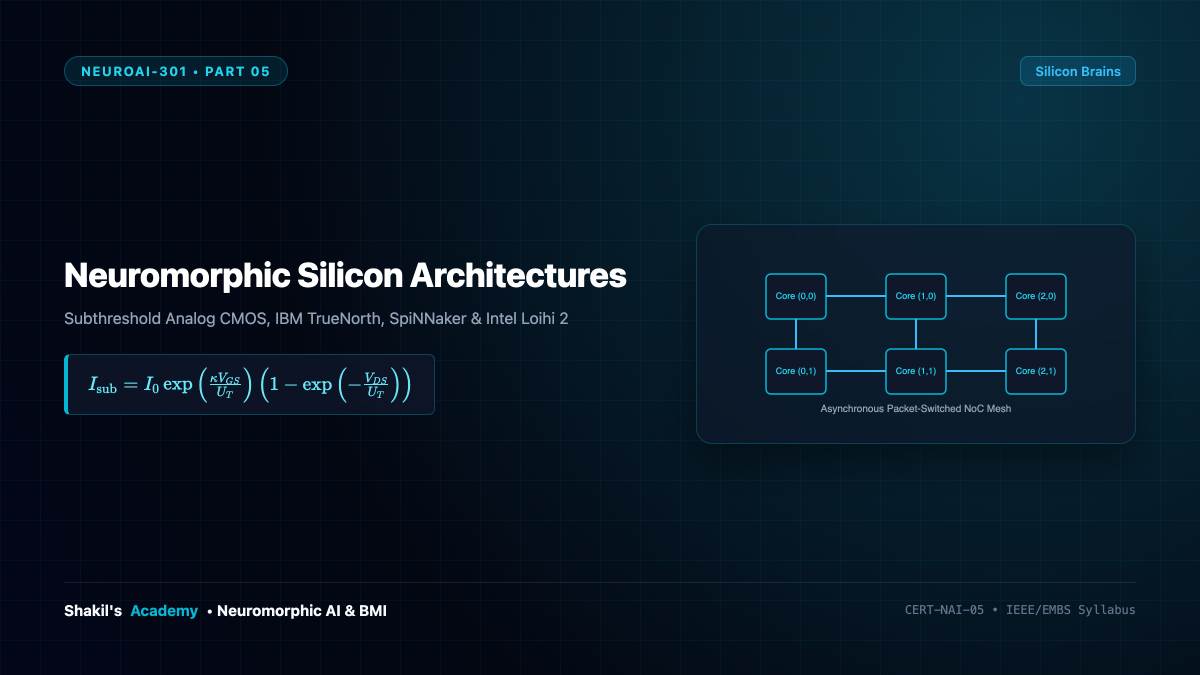
In the late 1980s, Caltech pioneer Carver Mead realized a profound physical truth: the exponential current-voltage physics of a MOSFET operating in its subthreshold (weak inversion) regime is mathematically identical to the Boltzmann statistics governing ion transport through biological cell membranes. This insight gave birth to Neuromorphic Silicon Engineering. Over the past decade, neuromorphic design has bifurcated into subthreshold analog bio-emulation and asynchronous digital massively-parallel spiking chips—culminating in industrial-scale platforms like IBM TrueNorth, SpiNNaker, and Intel Loihi 2.
1. Carver Mead’s Subthreshold Analog CMOS Physics
When a MOSFET’s gate-to-source voltage is biased below its threshold voltage ((V_{GS} < V_{th})), drift current drops to zero. However, thermal energy allows a minority carrier diffusion current to cross the channel barrier, known as the Subthreshold Current:
[
I_{ ext{sub}} = I_0 xpleft( rac{kappa V_{GS}}{U_T}
ight) left( 1 – xpleft(-rac{V_{DS}}{U_T}
ight)
ight)
]
where (kappa = C_{ ext{ox}} / (C_{ ext{ox}} + C_{ ext{dep}})) is the subthreshold gate coupling coefficient ((approx 0.7)), and (U_T = rac{k_B T}{q} approx 25.8 ext{ mV}) is the thermal voltage at room temperature. For (V_{DS} > 4 U_T approx 100 ext{ mV}), the current saturates:
[
I_{ ext{sub}} approx I_0 xpleft( rac{kappa V_{GS}}{U_T}
ight)
]
This exponential relationship mirrors the Nernst-Planck ionic flux equations of biological cell membranes. By operating in weak inversion, analog neuromorphic circuits simulate continuous differential membrane dynamics using mere picoamps of current per neuron.
2. Asynchronous Digital Neuromorphic Cores: TrueNorth and SpiNNaker
While analog circuits achieve supreme energy efficiency, they suffer from transistor mismatch, thermal drift, and signal degradation across long distances. Modern large-scale systems therefore adopt digital event-driven architectures:
- IBM TrueNorth (2014): Fabricated on Samsung 28nm, TrueNorth integrates 4,096 neurosynaptic cores on a single die, totaling 1 million LIF neurons and 256 million programmable synapses. It uses a clock-free asynchronous communication fabric operating at a 1 ms tick, dissipating only (70 ext{ mW}) (approx (20 ext{ pJ}) per synaptic event).
- SpiNNaker (University of Manchester): Steve Furber designed SpiNNaker as a massively parallel digital multiprocessing engine. Composed of 1,036,800 ARM968 processor cores interconnected via a custom toroidal packet-switched Network-on-Chip (NoC), SpiNNaker simulates biological brain networks in real time using software-defined differential equation solvers.
3. Intel Loihi 2: The Frontier of Programmable Neuromorphic Computing
Unveiled by Intel Labs in 2021 and manufactured on the Intel 4 process (EUV lithography), Loihi 2 represents the state-of-the-art in digital neuromorphic engineering:
| Feature | Intel Loihi 1 (2018) | Intel Loihi 2 (2021) |
|---|---|---|
| Process Node | 14nm FinFET | Intel 4 (EUV, ~7nm class) |
| Die Area | (60 ext{ mm}^2) | (31 ext{ mm}^2) |
| Neurons per Chip | 131,072 (128 cores) | Up to 1,000,000 (128 cores) |
| Synapses per Chip | 130 million | Up to 120 million |
| Neuron Model Support | Fixed-function CUBA LIF | Fully Programmable Microcode Engines |
| Spike Payload | Binary 1-bit pulses | Graded Integer Payloads (0 to 32 bits) |
| Synaptic Operations / sec | (sim 3 imes 10^{10} ext{ Ops/s}) | (> 10^{12} ext{ Ops/s}) ((10 imes) faster) |
Loihi 2 replaces hardwired LIF circuits with custom programmable SIMD pipeline microcode, enabling researchers to execute arbitrary non-linear differential equations (such as resonant spiking, adaptive thresholds, and fractional derivatives) directly in hardware.
4. Asynchronous Network-on-Chip (NoC) and AER Protocols
In all digital neuromorphic chips, inter-neuron communication bypasses shared memory busses by utilizing Address-Event Representation (AER). When a neuron fires on core (A), its unique integer address is encoded into a discrete packet and routed across a 2D mesh Network-on-Chip to destination core (B):
[
ext{Packet} = { ext{Timestamp } t_k, ext{ Core ID } (x, y), ext{ Axon ID } a_i, ext{ Payload } p }
]
Asynchronous handshaking (using 4-phase dual-rail protocols) ensures that routers consume zero static switching power when no packets are traveling, delivering true zero-idle-power computation.